


SINGAPORE – Critical thinking and the ability to keep learning are among essential skills one should possess to stay relevant in an AI-driven workplace, said UOB deputy chairman and chief executive Wee Ee Cheong.
Critical thinking, sound judgment and a strong sense of responsibility enable individuals to ask the right questions, not simply to generate faster answers, the banking leader told The Straits Times in an interview.
“AI can process information at scale, but for now it cannot fully understand context, values or consequences in the way people can,” he said.
UOB, Singapore’s third-largest bank by assets, rolled out programmes such as Better U Pivot, where employees whose roles are impacted by digitalisation and automation are supported to move into growth areas such as risk, compliance and sales.
People should have a basic understanding of AI as well – not to become technologists, but to work alongside machines thoughtfully and with care, Mr Wee noted.
The ability to keep learning is also critical. “As roles evolve, adaptability and commitment to lifelong learning will sustain long-term relevance,” he said.
A recent survey on economic sentiments conducted by NTUC found that nearly 30 per cent of respondents expressed anxiety that artificial intelligence would replace their job or current role.
Mr Wee also noted that companies and employees have a shared responsibility to stay competitive and sustainable – firms must support their workers through change while workers are expected to continue adapting in an evolving environment.
“At UOB, we approach AI as a tool to support our people, not a substitute for them,” he said, adding that the bank retrains employees, embeds generative AI into daily work and redesigns roles so routine tasks are supported by technology.
When AI removes routine and repetitive work, it should free people to focus on higher-value activities – making better decisions, strengthening customer relationships and improving outcomes through judgment and experience, he said.
“We should aim to harness technology to enable people to do higher-value work, not simply more work.”
He further noted that some roles anchored in human empathy, judgment, trust and accountability will remain fundamentally important in an AI-driven economy.
These include advisory roles that require a deep understanding of customers’ circumstances and relationship building, leadership roles that involve guiding teams through complexity and change and decision‐making roles where ethical judgment and responsibility for outcomes cannot be delegated to systems.
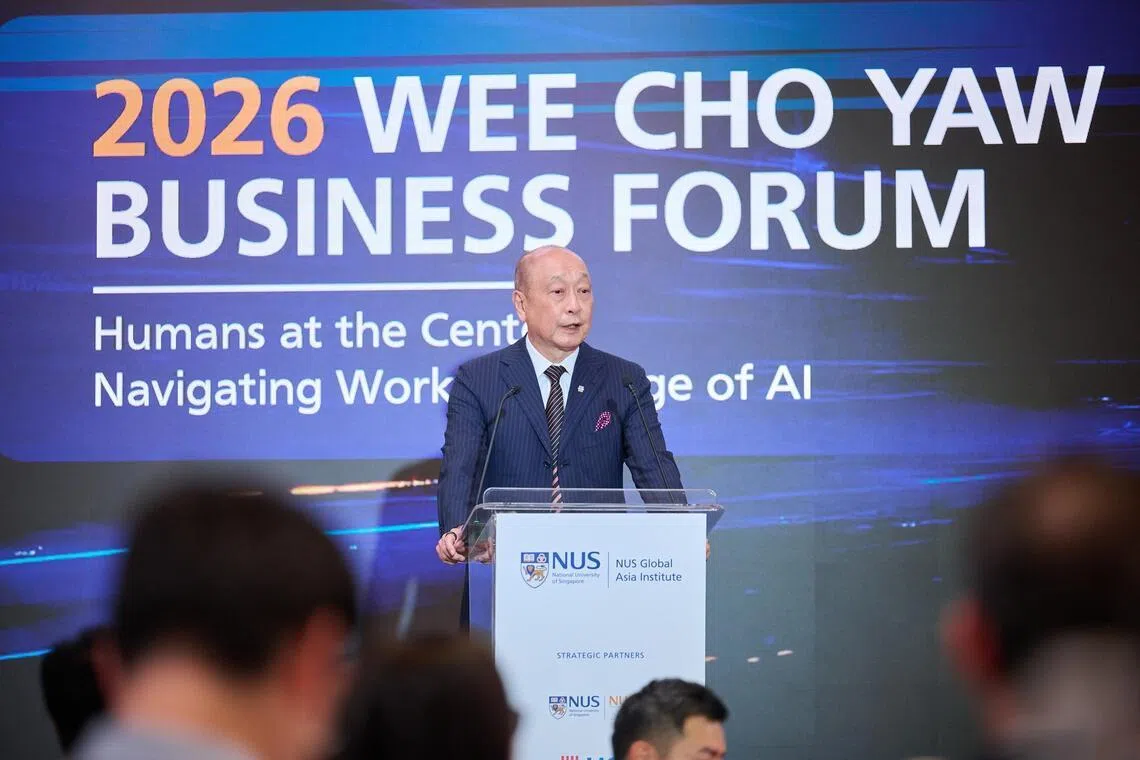
In his opening remarks at the Wee Cho Yaw business forum held at Four Seasons Hotel on April 9, Mr Wee noted that smaller companies are moving slower in AI adoption compared to their larger peers.
“Larger corporates are moving faster while many small and medium-sized enterprises (SMEs) are only starting their journeys. Sixteen per cent of large enterprises are at the advanced stage of AI adoption. But for SMEs, that is only 7 per cent,” he said, citing findings from the UOB business outlook study 2026.
He added that through initiatives like the UOB FinLab AI Ready programme, the bank has supported more than 1,000 SMEs across Asean in the first step towards AI adoption.
Mr Wee previously said AI should help people do more and do it faster, instead of replacing them. AI also cannot replace empathy in advice as well as ethics in decisions, leadership and judgment, he said during a keynote speech at Singapore FinTech Festival 2025.

