


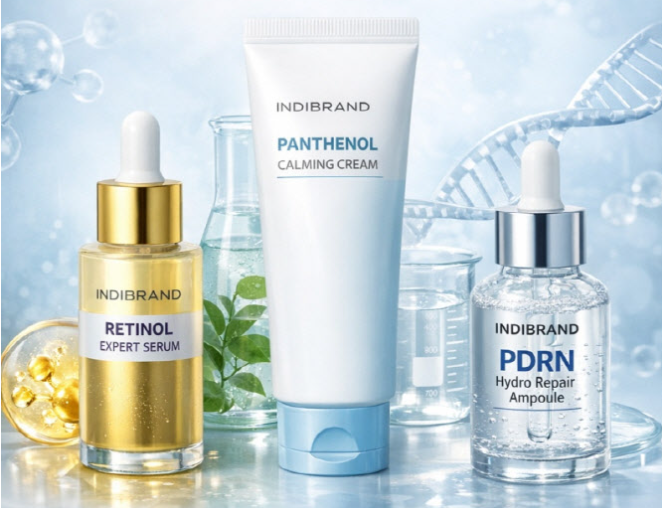
This method encourages consumers to choose based on strategies that reflect specific ingredients and functions in their product names. Boncep, a sub-brand of Tony Moly, has decided to expand its high-functionality product line in earnest this year. Launched in April last year as a Daiso brand, Boncep has built more than 50 product lines, including retinol line and Vita C line.
Boncep emphasizes that it is “high functionality” while selling products worth less than 5,000 won at Daiso. Regarding the recently released “D-Panthenol,” Boncep also mentioned, “It has better skin absorption and efficacy than general panthenol, which was previously used mainly as an auxiliary ingredient.”
The strategy focused on efficacy was also shown in sales performance. Last year, the Boncep Vitac freeze-dried double-shot ampoule kit topped the list of best whitening ampoules at Daiso Mall.
As such, it is analyzed that in the past, brand image or advertising model influenced consumer purchase, but recently, ingredients such as retinol, panthenol, and PDRN are acting as product competitiveness. There is also an increasing number of cases in which ingredients are directly reflected in product names or lineups emphasizing specific effects are expanded. Representatively, APR’s MediCube ‘PDRN Line’ and Anua ‘PDRN Hyaluronic Acid Line’ are included.
This is interpreted as a strategy for indie brands to break the formula of “mid- and low-priced = basic products.” Until now, functional cosmetics have been a marketing point limited to high-priced brands in department stores. This is because years of research and technology must be supported to see how precisely a product can be absorbed or effective. Mid- to low-end brands are lowering unit prices of functional products by removing some ingredients, reducing capacity, or mass-producing them. In particular, the fact that technology barriers were lowered through cosmetics ODM and OEM also affected the decline in unit prices.
From the standpoint of mid- to low-end indie brands, ingredients also complement trust. Unlike large brands, the recognition is low, so it is a strategy to explain product efficacy and secure initial trust by putting proven ingredients at the forefront. In addition, it is penetrating a gap with a ‘functional niche’ strategy. In particular, in the anti-aging market, technology to effectively deliver polymer growth factor components to actual skin is emerging as a key element of skin care competitiveness.
An industry official said, “Now, cosmetics are changing into a market where what ingredients they contain are compared first rather than brands,” adding, “The product name itself is evolving in the form of explaining its efficacy.”
SALLY LEE
US ASIA JOURNAL