


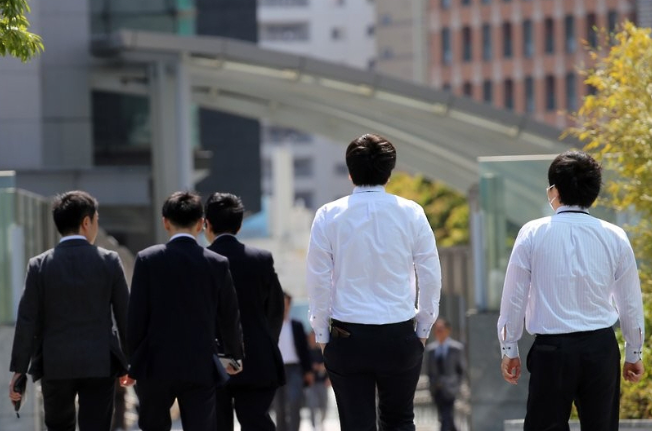
As Japan’s hiring climate and economic environment change, the severance pay system, which was one of the symbols of lifelong employment practices, is also changing.
The Nihon Keizai Shimbun reported that Oji Holdings, Japan’s largest paper company, will implement a plan to abolish the temporary payment of severance pay and allocate the share of severance pay to the basic salary.
Although Japan’s severance pay system is not mandatory under the Labor Standards Act, Japanese companies have widely introduced it as a carrot to induce employees to work long-term. However, the form of severance pay cannot be avoided as the climate in which lifelong employment was taken for granted has changed and wage hikes have slowed compared to inflation.
The average pension amount of a two-person household consisting of an office worker’s husband and a full-time housewife’s wife, who paid welfare pensions for 40 years, was 237,279 yen per month, a decrease in real purchasing power (2.0%) less than the inflation rate (3.2%).
Although there were companies that eliminated temporary severance pay in the past, the choice of large companies such as Ozzy Holdings is unusual.
According to the Ministry of Health, Labor and Welfare’s comprehensive survey on employment conditions, only 0.1% of 3,768 companies abolished the temporary severance pay system between 2020 and 2022. None of them had more than 1,000 employees.
The Nihon Keizai Shimbun said, “The decision of Ozzi Holdings, a large company, to stop paying severance pay temporarily will serve as an opportunity for Japan’s employment practices to change further.” With the elimination of temporary severance pay from Ozzi Holdings, the company’s starting salary for college graduates this year is estimated to be about 280,000 yen, a 10% increase from the previous year. The Nihon Keizai Shimbun cited the reason why the company changed its severance pay system as the competition for talent is getting fiercer.
According to MyNabi, which runs a job information site, 25% of prospective graduates chose their salary level as the most important condition when choosing a company, the highest since the 2001 related survey was conducted.
SALLY LEE
US ASIA JOURNAL

