


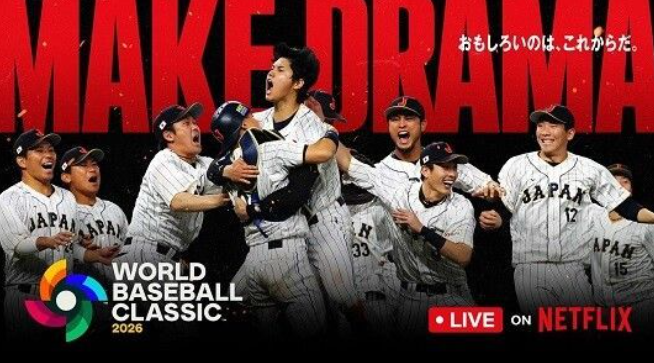
When the Japanese national baseball team, which tried to win its second consecutive World Baseball Classic (WBC) title in 2026, was eliminated from the quarterfinals, an unusual scene was created in which the movement to “release the Netflix subscription” spread online in Japan.
Japanese media including Nikkan Sports and Sponichi said the Japanese national baseball team ended the tournament by losing to Venezuela 5-8 in the quarterfinals of the WBC held at Rondipo Park in Miami, Florida. Japan was considered a strong contender for the championship thanks to the participation of top major league players including Shohei Ohtani and Yoshinobu Yamamoto. However, the team’s earlier-than-expected elimination shocked Japanese baseball fans. Immediately after the game, posts related to the cancellation of Netflix were posted on Japanese social networking sites. Some fans took screenshots of cancellation of subscriptions and shared them, expressing regret over the loss.
Online, “I signed up for Netflix to watch WBC, but Japan lost, so I canceled it now,” “Japan is eliminated, Netflix subscription is over,” and “I canceled it right away because I was angry.”
There was a reaction from the back. On the other hand, there were also a number of joking responses, such as “Cancelling it now is the most inefficient act,” and “You should watch the dramas and movies you wanted to watch before the cancellation.” Local media view it as a kind of happening caused by Japanese fans’ disappointment.
This phenomenon is related to Netflix’s exclusive broadcasting of all WBC games in Japan. Netflix has secured the right to broadcast all 47 games in Japan. Japanese terrestrial broadcasters, which have been in charge of broadcasting the WBC, have failed to broadcast the competition, losing ground in the competition to secure broadcasting rights. According to the Mainichi Shimbun board, Netflix has reportedly secured WBC broadcasting rights worth about 15 billion yen in Japan. This is about five times the previous competition’s broadcast rights of about 3 billion yen. As a result, controversy is spreading in Japan over whether it is appropriate to allow people to watch sports events that have high public interest only on paid platforms. Meanwhile, some European countries have a Universal Access system that allows people to watch major sports events such as the World Cup or the Olympics for free. Since there is no related system in Japan, there is a possibility that discussions on the system will take place in earnest with this exclusive broadcasting of WBC.
Global online video service (OTT) has recently entered the competition to secure the right to broadcast sports with massive funds, and is now competing with traditional broadcasters. The latest case in Japan is also an example of a cross-section of the sports broadcasting market, which is being reorganized around OTT.
Such controversy has already been raised in Korea. Recently, JTBC has secured the right to broadcast 2026 Milan and Cortina d’Ampezzo Winter Olympics, sparking controversy in Korea. As JTBC, a general programming channel, has secured the right to broadcast the Olympics, concerns have been raised that major competitions can only be watched through certain channels, not through terrestrial broadcasting.
SAM KIM
US ASIA JOURNAL

