


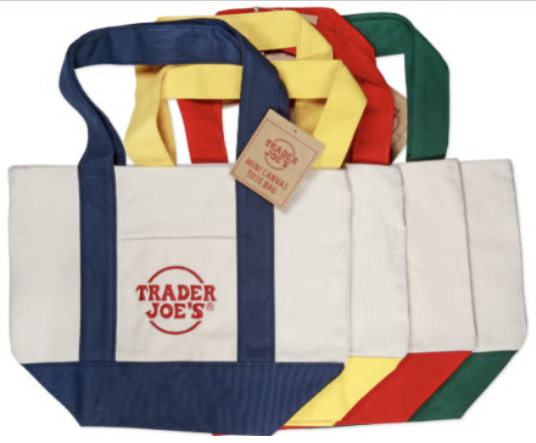
It is a simple shopping cart, but lines are lined up even before the store opens, and people are running out right after the sale begins. Some say that it is harder to get than a Chanel bag as it is traded for hundreds of dollars in the online used market. Until now, the keyword explaining its popularity has been “scarcity.” Analysts say that the lack has been created by a structure in which only a limited number of offline stores in the U.S. without online sales have created a shortage. The U.S. business magazine Forbes also pointed out that “it is not easy to have one has stimulated the desire of the younger generation.” Another background has been added recently. This bag is not just a product but is being consumed as a token of experience. Like souvenirs that can only be bought at tourist destinations, the Trader Joe bag has become an object that symbolizes the experience of visiting the U.S. Among Korean tourists, “I’ve been to a mart in the U.S.” is a kind of cultural authentication method.
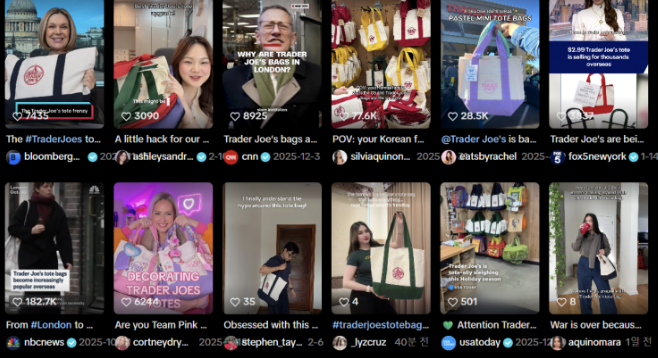
The spread of social media has also acted as a catalyst for its popularity. With the popularity of “howl” videos on TikTok and Instagram, tote bags have been repeatedly exposed as background props for shopping contents. Naturally, the brand logo is imprinted, and a structure is formed that leads to the question, “Where did you buy that bag?” It is a more powerful spontaneous viral effect than advertising. Another notable point is the combination with the ‘resell culture’. Some consumers purchase with resale in mind rather than actual use. Bags are sometimes recognized as a ‘micro-investment product’ as the pattern of prices soaring every time a new color is released in a situation where supply is limited. It is also ironic that affordability reinforces symbolism. This is because it contains a message that it aims for rational consumption rather than showing off luxury goods. Some say that the phenomenon of everyday brands representing lifestyle is being reproduced, such as Levi’s and McDonald’s, which were considered as American cultural icons in the past.
Recently, expectations are growing as they have even gone to design facilities for the new season. Although there is no official announcement, there is a possibility that a similar craze will be repeated this time as the open run has been reproduced only by rumors of new products in the past.
A phenomenon in which less than $3 is consumed as a “culture code” across borders. Beyond simple trends, it is gaining momentum as an iconic example of changes in brands and ways of consumption.
SALLY LEE
US ASIA JOURNAL