


Entrepreneur Rebekah Kang has a dream that one day, technology will make politicians obsolete.
“It’s really hard to communicate and hard to raise your voice. That’s why you don’t trust (politicians) and … a lot of people are not voting anymore,” she said. “If we’re not happy about what they’re doing, why do we need them?”
Just as Google Nest manages a smart home, citizens will use a service to scroll through the legislation that is important to their lifestyle, such as whether they have a kid, a car, a house or a pet, their income level and marital status. Then the service analyzes how each bill will impact their life, and users can vote for it themselves ― eliminating the need for the middle man.
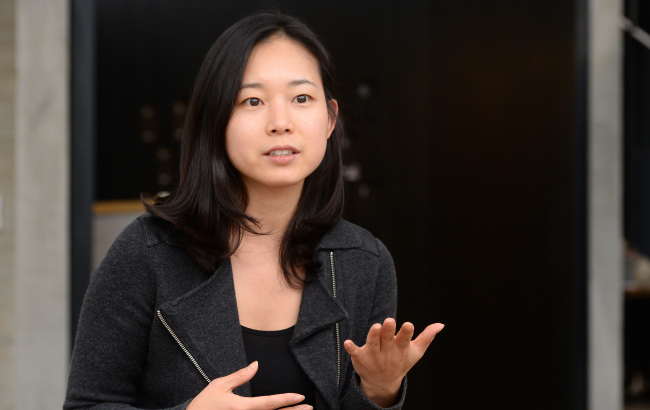 |
| Rebekah Kang, founder of MyCandidate and Asian market development manager for Washington-based FiscalNote, poses at a coworking space in Seoul on Friday. Ahn Hoon/The Korea Herald |
That is still a dream. But as one of the few start-up entrepreneurs standing at the intersection of technology and politics, Kang is doing what she can.
Her mission is to connect voters with their political representatives through technology.
From an outsider’s perspective, she said, Korea’s election process is archaic. She spent hundreds of hours in 2010 helping with her father’s election for a city council seat in her hometown of Seongnam, Gyeonggi Province, passing out brochure cards to passersby. The trucks that candidates rent to display giant LCD screens and play horrific jingles cost some $70,000, according to Kang, and if the candidate loses, the entire family is unemployed as everyone would quit their job to work on the election.
She realized that even with these gimmicks, all the information that citizens know about who they’re voting for can fit on a business card.
By the time her father ran for his third term last year, Kang had expected the National Election Committee to make information more accessible to voters. When nothing changed, she took matters into her own hands and created MyCandidate, which presents NEC data and media news on candidates in a user-friendly way, and features a message board for users to communicate with the aspiring representatives.
The app garnered a frenzy of popularity ahead of the June 2014 local elections, attracting 50,000 users and media attention. Nonetheless, she struggled to raise funding as people questioned her motives. After rejecting offers from individuals she discovered had political ambitions, she realized she had to look outside of Korea.
This year, MyCandidate partnered with FiscalNote, a Washington-based legal information technology start-up that mines and analyzes legislative data from the federal to local levels so organizations including Uber, Aetna and Planned Parenthood can track bills that are relevant to them.
With the financial and logistical support from FiscalNote ― which raised $10 million from Chinese social network Renren, U.S. serial entrepreneur Mark Cuban and others in February ― Kang is now heading its Korean operations and Asian market exploration, while revamping MyCandidate with more community engagement features and launching it as MyPolitician in time for next year’s National Assembly election.
“We can dream about anything, right?” she said. “I hope that in 10-20 years, because of FiscalNote and MyPolitician, all politicians work transparently and honorably ― the way politicians should be.”
For more information, visit fiscalnote.com.
By Elaine Ramirez (elaine@heraldcorp.com)

Start-up Seoul is a series featuring players in Korea’s emerging tech start-up scene. This is the 13th installment. ― Ed.

