


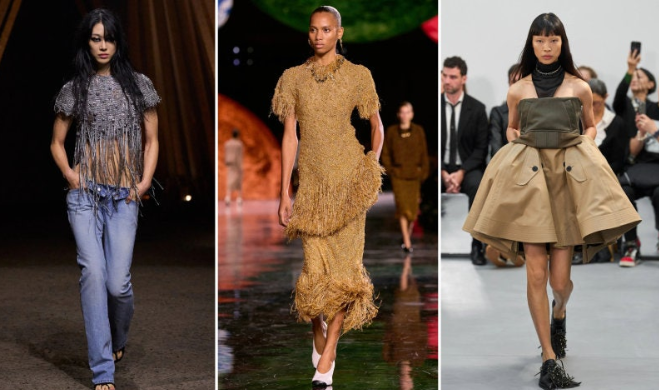
Modern people are living in the age of pixel life. People are living in a trend of small, large, and short consumption, like pixels, the smallest unit of a digital screen. Technology has narrowed down time, shortened content, and greatly increased options. People living in the digital age want instantaneous focus rather than long immersion.
Fashion, on the other hand, is an area where you can touch and feel things yourself, unlike digital ones. It presents dynamic sensations incomparable to those of still screens or short videos. This season, designers took out fringe designs that are close to showy art. The fringe, which means a decoration of alcohol on the bottom of a dress, showed hundreds of lines creating curves according to the model’s steps. The fringe is a three-dimensional interface that reminds viewers of body sensations and shows beautiful movements that are in contrast to digital ones. The reason why the fringe draws more attention this season is that it does not remain in the traditional directing method such as Bohemian and Western. It is not just where the fringe is attached but also where the most dramatic movement can be made. The silhouette is made much more dramatic without much decoration by focusing the fringe on points where the movement is large, such as shoulders, sleeves, abdomen and hemline. There is no more efficient device to display presence.
Alexander McQueen, for example, brought the fringe to the center of his body. The fringe, which is stretched below the knit crop top (short top), shakes according to the movement of the abdomen and naturally focuses the gaze on the upper body. It shows that the fringe is no longer an element that decorates the edges, but a tool that emphasizes specific parts of the body. Yoji Yamamoto also highlighted the silhouette and gave a certain rhythm to the entire look by focusing the fringe on the cropped jacket and skirt hemline.
Fringe shoes drew more public attention. Alaia’s Nihai boots give the impression of wearing a fringe skirt. The rich fringe decorations surrounding the leg line flew wide from side to side with each step, creating different afterimages. Sakai’s fringe loafers also added dynamics to the style without damaging the overall atmosphere, making walking look like a performance.
Designers’ choice of materials is also different from previous seasons. Beyond being limited to heavy materials such as leather and suede, a large number of light and flexible materials such as silk and organza appeared. The fringe made of flimsy material showed immediate reaction to small movements of the body. The long and slender fringe on the soft silk dress of Ferragamo gave a neat silhouette a life by creating subtle waves as if a paper firecracker was exploding. Chanel chose to place the fringe on the sleeves and hemline of the gold-tone dress. The voluminous fringe decoration reacted delicately to the models’ movements, giving them a more dramatic silhouette. Rohebe added a fringe on top of practical items based on workwear to create an interesting contrast where firmness and softness coexist. Louis Vuitton and Givenchy used the fringe as a tool for color. The colored fringe, which was smeared like watercolors, left a deep visual afterimage by mixing and dispersing colors according to the model’s breathing and walking.
Few decorative elements are as artistic as the fringe. It gives vitality by revealing the shaking and speed of the body as it is. This is why designers called the fringe again in an era when digital images dominate the world. This season’s fringe decoration, which is more dynamic than ever, allows us to realize the value of beauty that is completed only when we see, feel, and move.
SALLY LEE
US ASIA JOURNAL

