



Recently, amid the rapid growth of the perfume category in the beauty market, “Nich Perfume,” which contains unique philosophies or concepts, is gaining popularity among the 2030 generation. This is the result of the product containing the brand’s philosophy and personality rather than popular scents, coupled with the consumption tendency of the younger generation who like to reveal themselves.
According to Euromonitor, a market research company, the size of the domestic perfume market last year is estimated to be about 1.18 trillion won, up about 6.7 percent from the previous year (1.106 trillion won). Related demand has also increased significantly in fashion platform 29CM, which has a high proportion of customers in their 20s and 30s. According to the company, transactions in perfume categories have increased by more than 84 percent year-on-year in the past three months (from October to December last year).
In particular, demand for Niche perfumes is on the rise. Unlike ordinary products, Niche perfume refers to a perfume made with the brand’s steering philosophy or concept rather than popularity. Industry sources say that the market is growing mainly among young consumers who value individuality and story rather than standardized scents.
The background of Niche’s perfume is the consumption propensity of the MZ (millennial + Z) generation, who want to reveal their taste and personality with every belongings.
According to a beauty trend survey of 1,000 women nationwide conducted by the research firm Open Survey last year, 67.9% (priority responses) answered that “it suits my taste” as an important factor to consider when purchasing perfume. It was followed by 39% of the respondents who said they considered “whether the product fits the image I am pursuing.” It is interpreted that perfume is perceived as a means of expressing one’s identity beyond just beauty products.
Consumer response also supports this trend. “The process of finding a scent that suits me is interesting,” said a 20-something college student who visited a perfume store in Myeongdong, Seoul last weekend. “I sometimes mix two or three scents to create my own atmosphere rather than just using a single scent.” The retail industry is also seeking to attract customers in line with the growing demand. Due to the growing importance of offline stores due to the nature of experience through direct testing, the number of stores opening by related brands is also on the rise.
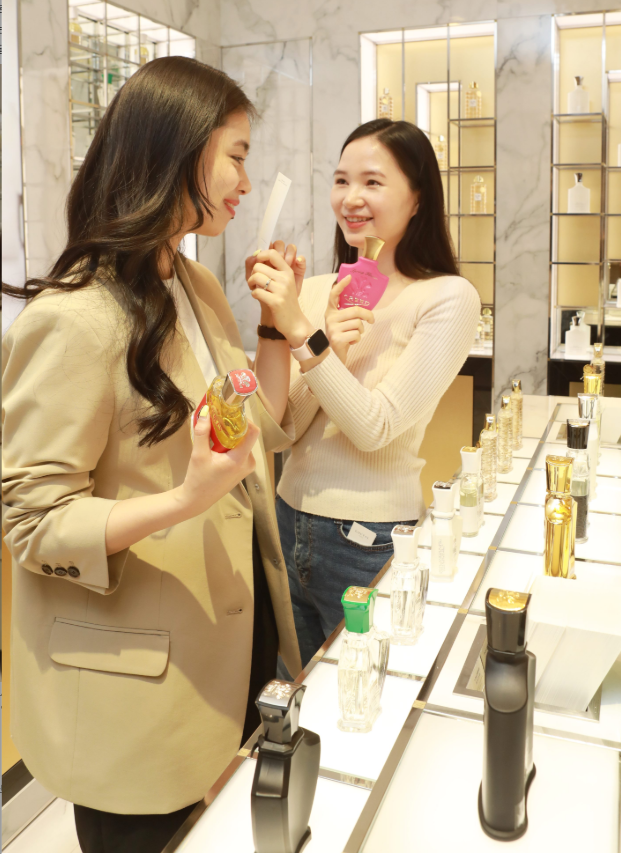
Recently, Spanish perfume brand Loebe Perfume, imported and sold by Shinsegae International, opened its first flagship store in Seongsu-dong, Seoul earlier this month. Unlike ready-made perfumes aimed at popular tastes, the brand is introducing products with a steering concept inspired by nature. According to Shinsegae International, the average daily number of visitors since the opening of the store has reached about 400, attracting customers.
An official from Shinsegae International explained, “Loebe Perfume judged the Korean market as a key market leading global trends and opened its first flagship store in Korea by paying attention to the growth trend of the domestic perfume market.”
Not only luxury fragrances but also relatively reasonably priced brands are also expanding their offline contact. SW19 opened its store in Seongsu-dong in April last year and opened an additional store in Myeongdong last month. Hetras, well-known for its diffusers, is aggressively expanding its offline presence by opening stores in Myeongdong in April last year and Seongsu in July of the same year.
The perfume market is expected to continue to grow. Euromonitor forecasts that the market will grow by an annual average of 4.4 percent over the next three years, reaching a value of 1.357 trillion won by 2028.
Lee Eun-hee, a consumer studies professor at Inha University, said, “For the younger generation who have a strong tendency to value individuality or ‘my own’, no matter how famous and expensive the brand is, it is often not fun to share the same scent as others. In particular, incense seems to be gaining more popularity in that it can imprint its image on others through the sense of collection.”
SALLY LEE
US ASIA JOURNAL

