


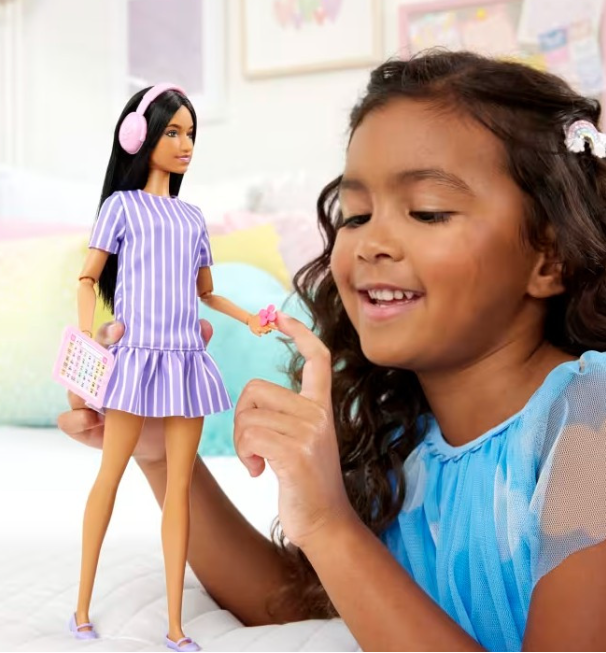
Mattel, a global toy manufacturer, has introduced its first Barbie doll reflecting the autism spectrum. The doll aims to help children naturally understand the diversity of society. According to the Guardian, Mattel has added the first Barbie doll to its line of fashionista. The doll, which was introduced six months after the release of Type 1 diabetes Barbie, is designed to help children discover themselves in Barbie and play realistic games. Autism spectrum disorder is a disorder characterized by impairment of social interaction, impaired communication of speech and non-verbal communication, homologous behavior, and interest in childhood. Individuals have different characteristics, but according to the World Health Organization, more than one in 100 people is estimated to belong to the autism spectrum.
The Barbie was created in collaboration with the American charity Autistic Self Advocacy Network. It is designed to reflect the various ways autistic children experience, perceive, and communicate with the world.
The doll’s eyes are looking slightly to one side, which expresses the characteristics of some autistic people avoiding direct eye contact. The elbows and wrists can be bent freely, implementing repetitive movements that help process sensory information or express excitement, so-called stimming or hand flapping movements.
Pink fidget spinners (finger toys) are fitted to the fingers to help relieve stress and to wear pink noise-blocking headphones to reduce sensory overload. In addition, he is holding a pink tablet, and the screen displays symbol-based complementary and alternative communication (AAC) buttons to help him communicate on a daily basis.
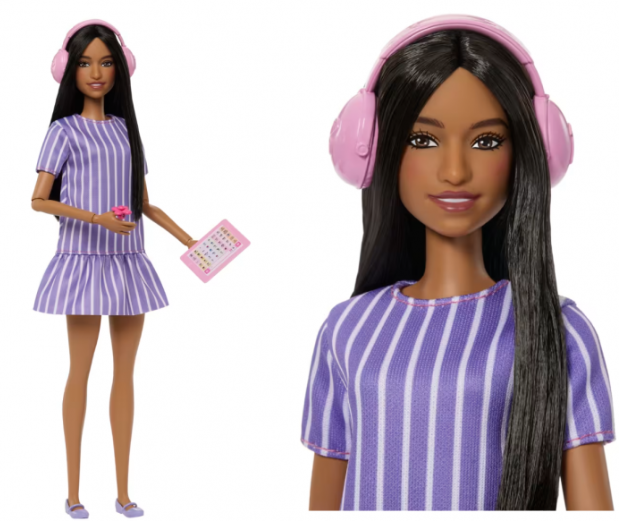
The outfit was a purple stripe A-line dress with short sleeves and a flowing skirt design to minimize skin irritation. The purple shoes with flat soles considered stability and comfort in movement.
Barbie was first released in 1959, but Barbie with disabilities did not appear until 2019. Since then, Barbie with a blind wheelchair, Barbie with Down syndrome, Barbie with prosthetic legs, Barbie with vitiligo, and Barbie with hearing aids have been released. Barbie’s boyfriend, Ken, also comes in a version with prosthetic legs, a wheelchair-based version, and a version with hearing aids. Jamie Sigilman, head of Mattel’s global doll division, said the autistic Barbie is an extension of the company’s efforts to expand representation and inclusion. “Barbie has always tried to reflect the world that children see and the possibilities they imagine,” he said. “I’m proud to introduce my first autistic Barbie as part of this effort.” “This doll will play a role in expanding what inclusivity is, not only on the toy stand but also beyond,” he added. “Every child has the right to see himself in the Barbie.”
“In theory, any Barbie can be reinterpreted as autism,” said Jolanta Lasota, CEO of Ambient About Autism, a U.K.-based autism awareness and support organization. “It’s because there’s not just one figure in autism,” he said. “Barbie is a symbolic toy, so it’s meaningful to be representative.”
“Some autistic teenagers are reluctant to use aids such as earplugs and steam toys because they are afraid of being noticed at school,” he said. “The more these visible markers are normalized, the more positive effects will be.” “Girls are three times less likely to be diagnosed with autism than boys, and this doll also draws attention to the often overlooked experiences of autistic girls,” he added.
JULIE KIM
US ASIA JOURNAL

