


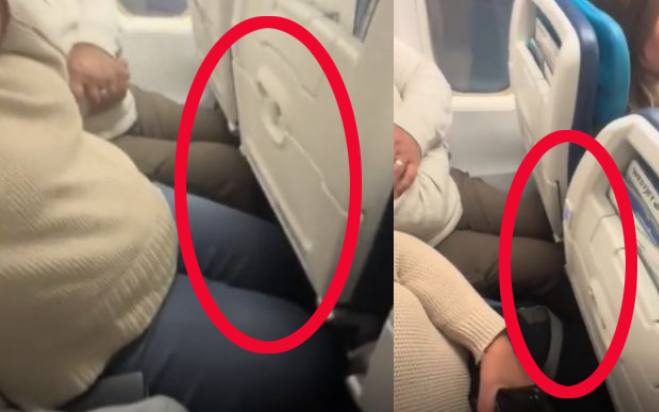
Controversy is growing over the disclosure of the cabin environment at a level where passengers cannot even move as Canadian airlines have drastically reduced the gap between seats. It was reported that a video taken by a passenger using a Canadian airline WestJet flight was posted on the online community “Reddit,” sparking controversy. The video showed the elderly couple’s knees almost attached to the back of the front seat due to the too narrow gap between the seats. The writer, who shared the video, complained strongly, saying, “Since WestJet changed the seat structure, the leg space of the flight booked at the basic fare is only this much.” Netizens who saw this responded, “It can lead to a big accident in an unexpected emergency landing situation,” and “The plane is not a poultry farm, and it looks narrower than a single chicken space,” pointing out safety issues.
Earlier in September last year, WestJet changed the seating arrangement of 43 Boeing 737 aircraft to reduce the gap between seats and add one more line. This increased the total number of seats, but significantly reduced the space for passengers to stretch their legs. According to the New York Post, despite a series of protests, Westjet management maintains its position that it is a “decision to satisfy customers of various budget ranges.” Westjet Vice President Samantha Taylor explained at the time of the policy announcement, “It is a carefully designed seat composition to provide warm service to all customers.” Across the airline industry, the reduction of economy-class seats has been around for a long time. According to the American Economic Freedom Project, the gap between seats of major airlines such as American Airlines, Delta Air Lines, Southwest Airlines, and United Airlines has decreased by an average of 2 to 5 inches since the 1980s. Currently, the average seating interval for a typical economy class is about 30 to 32 inches. The average seating width is 17 to 18 inches, which varies depending on the airline and the model. In particular, the seating environment of low-cost airlines (LCCs) such as Spirit Airlines in the United States and European Wiz Air is known to be even worse. The gap between the seats of these airlines is said to be only 28 inches. This is a level where adult men can feel uncomfortable even when they bend their knees. Some aviation experts pointed out that it is necessary to prepare standards at the level of regulatory agencies, saying, “Reducing the seat gap can lead to safety problems in case of emergency escape beyond simple inconvenience.”
SALLY LEE
US ASIA JOURNAL

