


Just before an emergency such as the start of war or overseas operations at the Pentagon, pizza delivery orders from overtime Pentagon employees can be crowded to pizza restaurants, predicting an emergency situation in advance.
The Pentagon Pizza Index, which received attention shortly after the “Operation Rising Lion,” in which the Trump administration bombed Iranian nuclear facilities in June last year, has become a hot topic again since the “Operation Absolute Resolve,” in which U.S. Special Forces Delta Force arrested Venezuelan President Nicolas Maduro in the early morning of the 3rd. I visited a pizza restaurant on the 5th, which was pointed out as one of the bases of the Pentagon’s Pizza Index in the U.S. online.
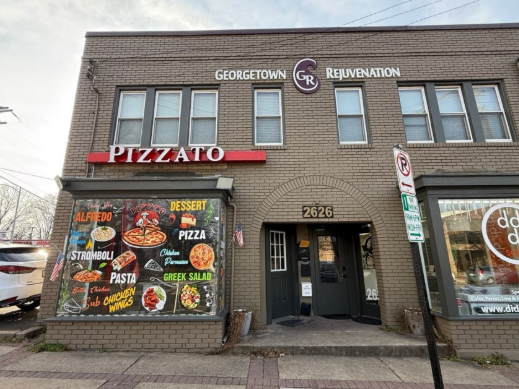
“Pizzato Pizza” is located in a residential area about 3.5 kilometers from the Pentagon in Arlington, Virginia. It took four minutes by car to get to the Pentagon. It was an ordinary local pizza restaurant with a hair salon next to the store. In online reviews, it was already famous as a “good place to deliver pizza for late-night snacks from the first class until late at night.” It was open until 3 a.m. on weekdays and 4 a.m. on Fridays and Saturdays. After the store opened at 11 a.m., there were only two small tables inside. Fidel, a Guatemalan employee, took orders, made his own pizza, and even served it. He said deliveries will be made through delivery companies such as Upparents and DoorDash. On Monday morning, there were no customers or phone calls to order for the meal for about 30 minutes while he stayed at the store.
However, Fidel remembered Saturday night when the Trump administration launched airstrikes in Venezuela. Trump finally approved the order for airstrikes in Venezuela at 10:46 p.m. on Tuesday. The operation began at 1 a.m. on Thursday, and there were further breaking news that more than 150 U.S. aircraft, including fighter jets and bombers, appeared over Venezuela around 2 a.m., and serial explosions began to be heard.
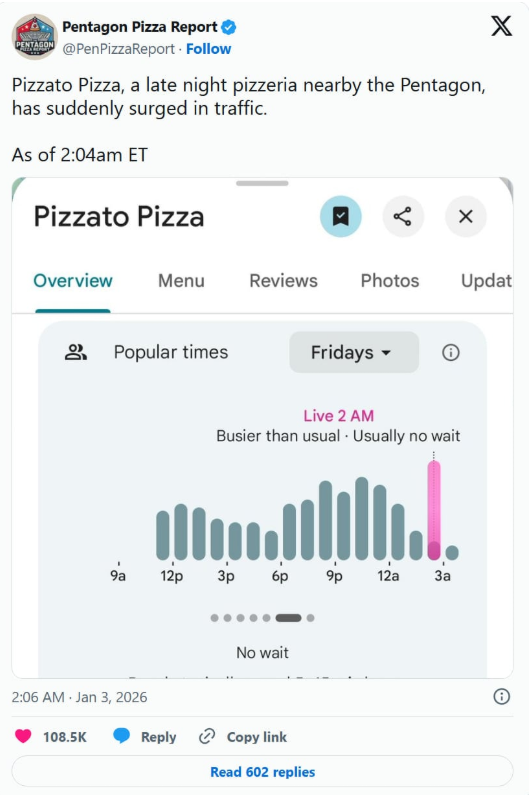
Fidel, who has been working at the store for seven months, said, “I was particularly busy that evening with orders from the Pentagon,” adding, “I continued to work until 5 a.m., later than usual, because I kept making pizza.” When asked how many pizzas he made on the day, he said, “About 300 pizzas,” adding, “Five employees rushed to the kitchen and all of them were just baking pizza.” There were still a pile of about 100 pizza boxes on one side of the kitchen. Even if some regular orders were mixed, orders surged more than usual. The Pentagon Pizza Index is a collection of online public information that anyone can see on social media accounts created by anonymous engineers. A representative example is a graph of visitor congestion on Google Maps. The principle is that if the number of users of Android phones or Google Maps apps in the store increases more than usual, Google Algorithm detects their smartphone signals and causes the congestion graph to soar higher than usual. This is a mechanical phenomenon that occurs when delivery drivers or customers who want to take pizza temporarily flock to the store.
In particular, it is argued that it is difficult to explain the general demand for late-night snacks if the graph of a pizza restaurant between 2 and 3 a.m., where orders are difficult to gather, is more crowded than usual. It is only possible when overtime workers work in the Pentagon on a large scale and order is concentrated at a pizza restaurant in the area. Coincidentally, the graph of the congestion of pizza chains such as Papa John’s and Domino’s around the Pentagon was “very crowded” late at night during the strike on Iran’s nuclear facilities in June last year and the Israeli-Iran drone strike in April 2024, and the news of the actual strike was reported to be breaking news shortly afterwards. On the contrary, there are times when nearby bars frequented by Pentagon employees are said to be less crowded and quiet than usual, which is also argued to be evidence of an emergency situation in which Pentagon employees are still working overtime instead of drinking after work. In response, the Pentagon denied the Pentagon Pizza Index and refuted, saying, “There are several stores in the building, so you can solve late-night snacks on the premises.”
However, the origin of the Pentagon Pizza Index goes back to the early Gulf War in 1991, when there was no smartphone information that Google algorithms automatically capture around pizza stores. Frank Mix, who ran several Domino’s pizza restaurants in downtown Washington at the height of the Gulf War, said in a media interview, “The number of pizza deliveries has soared since the outbreak of the war. The White House delivered about 50 p.m. a day, but now it is 125 p.m.,” adding, “Before, we didn’t deliver at all after 9 p.m., but now we have to maintain additional personnel to handle late-night orders from the White House.” “The Pentagon was about 50 p.m. a day, but now it is about 300 p.m.,” he said. “A large part of the increase is concentrated in the late-night hours.”
Since then, the U.S. media has said, “If you want to quickly grasp the world situation, it is enough to order pizza delivered to the Pentagon.”
SAM KIM
US ASIA JOURNAL

