


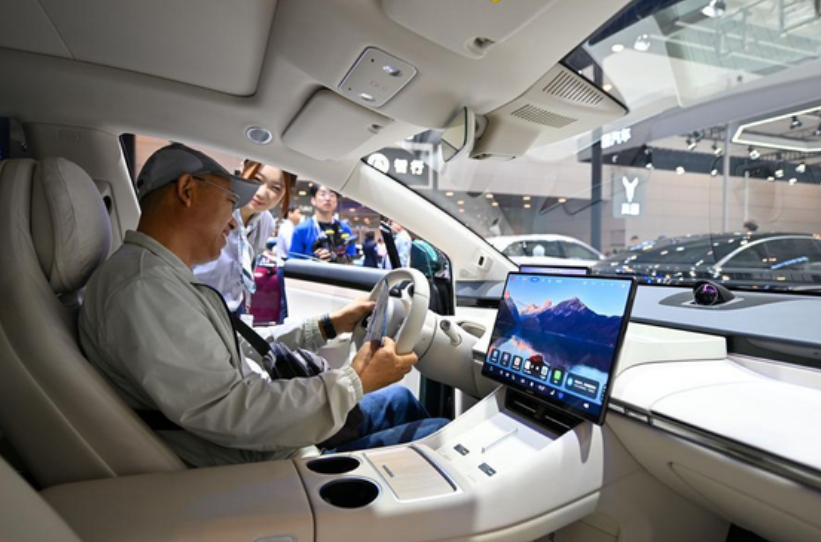
China’s self-driving car technology is entering a full-fledged commercialization stage.
This year, as more and more vehicles are equipped with driver assistance functions such as smart parking and lane keeping, “one-click” parking and automatic avoidance of obstacles are now becoming a daily routine beyond demonstration.
According to data from China’s Ministry of Industry and Information, new car sales with L2 (partial autonomous driving) function increased 21.2% year-on-year in the first three quarters of this year, achieving a penetration rate of 64%. This means that more than 6 out of 10 new cars have basic intelligent driving capabilities such as smart parking, adaptive cruise control (ACC), and lane keeping.
DEEPROUTE.AI has confirmed that users’ interest in intelligent driving is shifting from monotonous highway driving scenarios to complex urban environments. This is because driver assistance systems that can cope with urban gridlock or intersections are more preferred.
This year, the smartization of Chinese cars has taken a step further from the additional distribution of L2, and L3 (conditional autonomous driving) and L4 (designated area autonomous driving) continue to develop, and intelligent driving is spreading in all directions.
Recently, the Ministry of Public Affairs and Trade issued conditional permits for two types of self-driving cars. In response, China’s first official license plate for self-driving cars of the L3 class was recently issued in Chongqing. The license plate will be attached to the “Deepal” car and test-road driving will be carried out in some sections of roads in Chongqing.
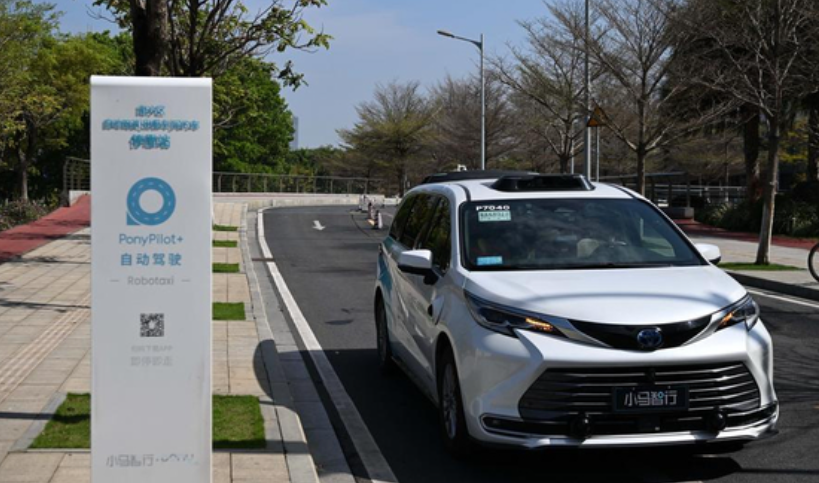
This year, in Guangzhou, Beijing, Shanghai, and Shenzhen, people who use unmanned robot taxis as a means of commuting have emerged. “The user’s acceptance of RoboTaxi is shifting from the experience stage out of curiosity to the stage of daily use,” said an official from Xiaomi (Pony.ai ). Technological advances and falling costs are further accelerating the trend of this automobile’s smartization transition. An official from NIO said that technologies such as end-to-end foundation models, visual-language-behavior (VLA) models, and world models have made progress one after another this year, while carmakers and third-party technology suppliers have also realized a wide range of applications by raising technological maturity.
An official from a third-party intelligent driving company predicted, “Hardware costs related to intelligent driving will be halved every two years and related experiences will be improved 10 times.”
Yao Inguo, a senior analyst at the CCID Consulting Automotive Industry Research Center, evaluated that China’s intelligent driving market has reached an important turning point this year, accelerating from the “technological verification” stage to the “scenario realization” stage.
“As mass production functions are rapidly spreading and technology levels are greatly improved to reduce the weight of maps or to drive without maps, intelligent driving technology is being scaled up for the first time, and L2-class driving assistance is rapidly spreading to the basic specifications of all models,” he said.
In addition, major leading companies are intensively introducing end-to-end foundation models this year, and as L3-class autonomous driving goes beyond the “first year” to enter the practical application stage, and the test range of advanced autonomous driving expands, the size and operation range of Robotaxi are also expanding.
JENNIFER KIM
US ASIA JOURNAL