


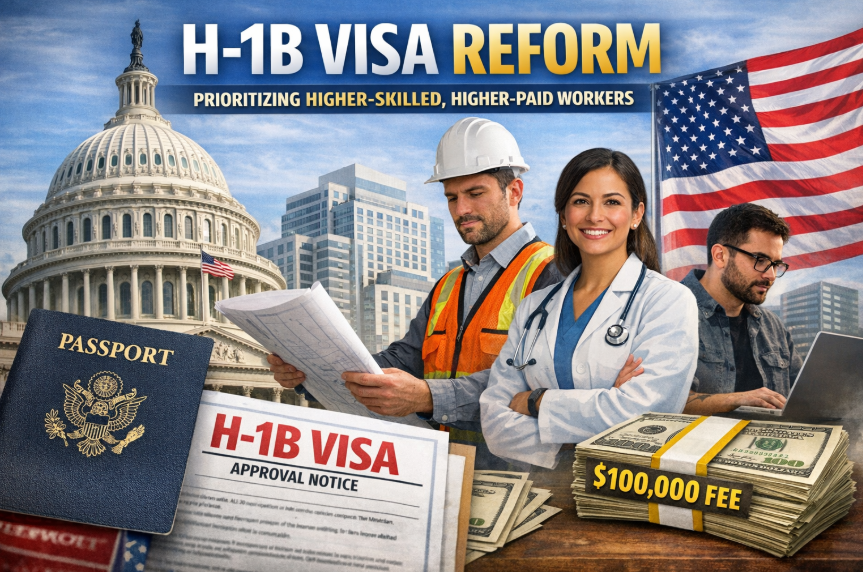
The U.S. Department of Homeland Security announced on its website that the H-1B visa will be allocated first to high-skilled and high-wage foreigners. “The key is to give more weight to applicants with higher levels of proficiency and wages.” He also stressed that if a large number of low-wage, low-skilled foreign workers are introduced through random lottery, the U.S. government should effectively manage them as they threaten wages, working conditions and job opportunities of U.S. workers and are not good for the economy. The new operation plan will be published in the Federal Register on Tuesday and will take effect on February 27 next year.
Accordingly, if a worker is included in the lower-paying level 1 worker, his or her name is registered once in a kind of “selection pool.” On the other hand, a worker in level 4 with higher wages is registered four times in the lottery. This means that the probability of a worker in level 4 getting a visa is four times higher. According to a simulation by the U.S. immigration authorities, the probability of a worker in level 1 getting a visa is 15 percent, while that of a worker in level 4 has increased to 61 percent.
The H-1B visa, introduced in 1990, aims to secure high-quality foreign workers with expertise in various fields, including finance, medicine and culture, centering on STEM (science, technology, engineering and mathematics). Sixty-five thousand cases are issued annually. In addition, 20,000 cases are allocated to master’s and doctoral degrees in the U.S., and a total of 85,000 people receive benefits every year.
This allowed major U.S. companies to hire talent from all over the world at relatively low cost. According to U.S. immigration authorities, Amazon is the company that sponsored H-1B visa applications the most. It is followed by Meta, Microsoft, and Google.
Since last year’s presidential election, President Trump has claimed that low-wage overseas labor flows in through the H-1B visa, depriving Americans of their jobs and posing a threat to national security. In September, he raised the H-1B issuance fee 100 times from 1,000 dollars to 100,000 dollars. The U.S. Chamber of Commerce and others filed a lawsuit claiming that the H-1B application fee increase conflicts with the federal immigration law, but it was rejected on Sunday.
The second Trump administration has been pushing for a tough anti-immigration policy and tightening regulations on U.S. arrivals. On the 3rd of this month, the U.S. State Department said it would expand the social media review requirements for H-1B visa applicants and asked applicants as well as their families to “disclose” personal information settings on all social media profiles.
JULIE KIM
US ASIA JOURNAL

