


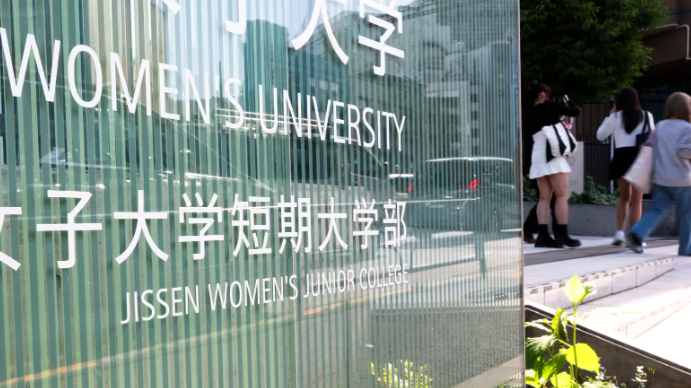
The university explained that the concept of “family studies” is narrowly recognized amid changes in the times, and that it is a reorganization to strengthen the expertise of each major. According to a report by the Mainichi Shimbun on the 17th, the Japanese Women’s University in Bunkyo-gu, Tokyo, announced a plan to officially abolish the family department established at the same time as the opening of the school in 1901, and to make the five departments independent in the form of colleges by 2028.
Japan Women’s University is a representative prestigious women’s unrivaled tradition in Japan, especially in the fields of family studies, housing and nutrition. The Department of Family Affairs is a leading department aimed at “improving the quality of life,” and has produced more than 40,000 graduates so far.
However, as time has passed and the tendency of “family studies” to be reduced to “studies that learn housekeeping skills,” the university is said to have decided that the professionalism and identity of each department should be clearly revealed. Currently, five departments are set up in the family department: children’s studies, botany and nutrition management, residential studies, cladding studies, and family economics. Among them, the Department of Housing Studies has already completed its independence as the Department of Architectural Design in 2024, and the Department of Botany and Nutrition Management as the Department of Food Science in 2025.
The remaining three departments will also be reorganized sequentially. The Department of Home Economics will be converted to the Department of Economics in 2027 and the Department of Children’s will be converted to the Department of Human Sciences in 2028, and the Department of Clothing will be newly launched as the Department of Fashion Design in 2028.

President Satoko Shinohara said, “With the expansion of the social field in which women work, the demand for learning that requires a high degree of expertise such as practical studies and science and engineering, which are directly connected to careers, is increasing.”
In Japan, the situation in which the existence of women’s universities is shaken itself serves as the background for the reorganization decision. According to the Japan Women’s Education Research Institute, the number of women’s universities decreased by about 30 percent from 98 in 1998 to 66 in 2025. Among them, more than 70 percent of schools are not meeting the quota, and restructuring such as conversion to co-educational, consolidation of undergraduate schools, and suspension of student recruitment is followed.
Japanese media analyzed that the female college crisis accelerated due to the increase in female students’ preference for engineering and engineering, and the change in preference centered on general universities. The decision to abolish the family department is interpreted as a strategy to improve the constitution of Japan Women’s University to respond to changes in the times.
JULIE KIM
US ASIA JOURNAL

