


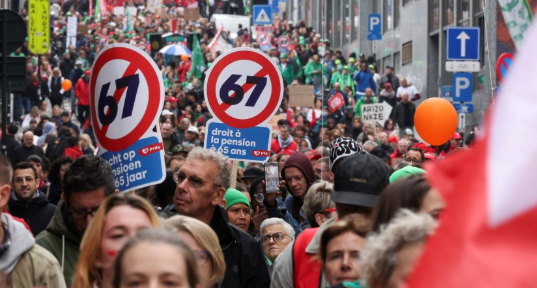
On the same day, 80,000 protesters, estimated by police and 140,000 by labor union, strongly protested the government’s tightening policy. They expressed anger at the government’s reform that raised the legal retirement age from 65 to 67 and restricted early retirement of civil servants.
They held colorful balloons with whistles and set off smoke bombs. Placards with the number “67” marked with a prohibited line and hand signs reading “Right to receive a pension at age 65” were also visible.
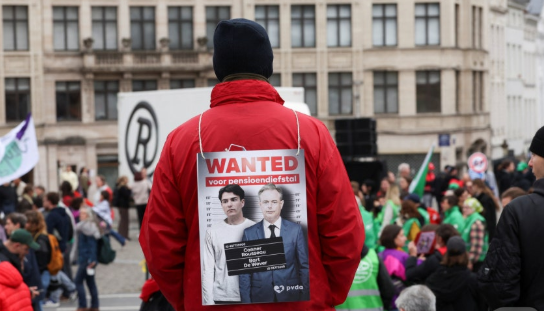
One protester marched with a poster on his back that read “Wanted as pension thief” underneath a picture of Prime Minister Barth de Weber. The protests were largely peaceful, but some young protesters wearing masks broke away from the assembly line and clashed with police. Some protesters vandalized the entrance to the Hilton Hotel near the offices of the ruling Sinplams Federation, and some were seen throwing empty beer cans or wooden bars at police.
The general strike was also carried out, which paralyzed traffic across Belgium. Brussels Airport, the largest airport, canceled all departing flights due to a strike by security personnel. Charlua Airport, which is mainly used by low-cost airlines, also said all flights were not possible due to a lack of manpower.
Public transportation services such as subways, buses and trams in Brussels have also been suspended. As a result, citizens and tourists suffered great inconvenience, and some schools and public service operations were disrupted. The Belgian government is pushing ahead with tightening its budget due to severe fiscal shortages. Belgium’s forecast for its fiscal deficit as a percentage of its gross domestic product this year is about 5.5 percent, the fourth highest among EU member states.
On top of that, external pressure to raise defense spending to 5% at the request of U.S. President Donald Trump, which is currently about 1.5% of GDP, is also a factor accelerating fiscal tightening.
Labor circles are protesting that the government’s reform plan only transfers the burden to workers. Thierry Bordson, chairman of the Belgian Confederation of Trade Unions (FGTB), which has 1.5 million members, made it clear that the biggest driving force behind the general strike is pension issues.
EJ SONG
US ASIA JOURNAL

