


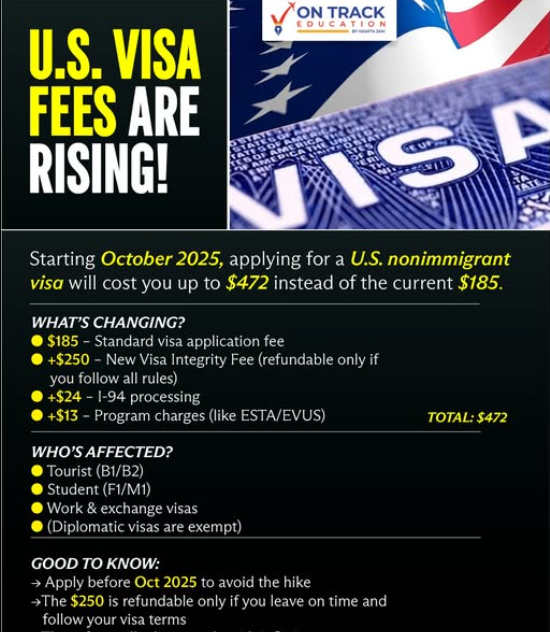
Regarding the U.S. government’s announcement on the 21st that it would increase the H-1B visa fee, which is called a “professional visa,” the Ministry of Foreign Affairs said, “We are paying attention to the U.S. announcement and are looking into details such as specific implementation procedures.”
“The government will comprehensively grasp the impact of this measure on the advancement of our companies and professional personnel into the United States and take necessary communication with the U.S.,” a Foreign Ministry official said.
Earlier on Wednesday, U.S. President Donald Trump signed a decree raising the H-1B visa fee to 100,000 U.S. dollars, which is 100 times the current 1,000 dollars. The new fee rule will take effect from 00:01 on September 21.
Given that the latest incident shows Washington’s tough visa policy, there are concerns that it will not be easy for Seoul and Washington to discuss ways to improve the visa system in the wake of the detention of Koreans.
However, as the priority of the Korea-U.S. consultation is expected to focus on improving regular visas for short-term dispatched personnel, and the U.S. also agrees on the need to improve the visa system, it is widely expected that there will be no significant impact.
The H-1B visa is applied to professional occupations in the fields of science, technology, engineering, and mathematics, and the number of annual issuance through lottery is limited to 85,000, and the proportion of Koreans is small in the first place.
In addition, in the case of domestic companies with U.S. subsidiaries, most Korean workers who will work there are required to obtain L-1 or E-2 visas for expatriates, so the direct impact of this measure is likely not significant.
It is known that people who go on business trips to carry out short-term projects are more likely to use short-term commercial B-1 visas or ESTA (US visa-free electronic travel permit system) instead of H-1B visas, which are difficult to issue.
Meanwhile, the U.S. authorities have decided to raise the ESTA fee from the current $21 to $40 from the end of this month, following an increase in the H-1B visa fee.
The visa-free electronic travel permit system was introduced by the U.S. for citizens of countries that allowed visa-free entry. For Korea, you can stay in the U.S. for up to 90 days if you use the system to go sightseeing in the U.S.
However, if you have applied for a visa-free electronic travel permit and obtained approval, you do not need to pay additional fees.
SAM KIM
US AISA JOURNAL

