


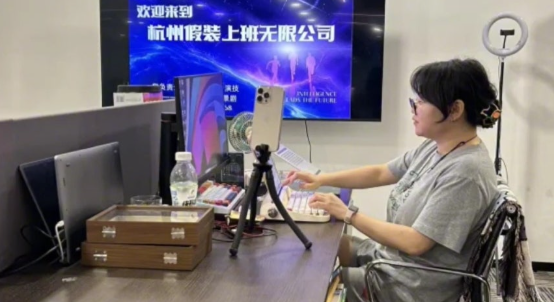
The Chinese economy has been in recession and the job market has been frozen. With youth unemployment at a high level of over 14 percent in China, young unemployed people in the country are recently becoming more and more popular pretending to work at companies. As a result, more companies are providing such services. As it becomes increasingly difficult to find a real job, more and more people want to come to the office even if they just pay instead of staying at home. “What we sell is not space, but self-esteem,” said the head of a company that runs the company. BBC reported on the 12th that the phenomenon of paying to go to work is gaining popularity among young unemployed people in China. Fake offices, which are similar to shared offices, are now popping up one after another in major cities in China, including Shenzhen, Shanghai, Nanjing, Wuhan, Chengdu, and Kunming. Most of them are equipped with computers, Internet connection services, conference rooms, and pantry, which are no different from actual offices. Rather than just sitting and spending time, visitors check job postings on a given computer or shape their own start-up plans. The daily fee is about 7,500 won. Some offices offer lunch, snacks, and drinks.
This is a young man who tried his hand at Sui Zhou’s restaurant business but failed last year. In an interview with the BBC, he has been going to work for 30 yuan a day at a fake office run by a company called Pretending to Go to Work in Dongguan, Guangdong Province, about 114 kilometers north of Hong Kong since April this year. “I’m very happy,” Zhou said. “I feel like we’re all working together as a team.”
The reason why these facilities are growing in popularity is the high youth unemployment rate, which exceeds 14%. In other words, it is difficult for graduates of highly educated universities to find jobs. According to official statistics, there are 12.22 million college graduates entering the job market this year. “The pretending to work (in China) has become very common now,” said Christian Yao, a Chinese economist and professor of business administration at Victoria University in Wellington, New Zealand. He then analyzed, “The economic structure has reached a transition period, and the education and job markets are inconsistent, so young people need to think about the next step or do something temporarily, so this fake office is a solution for this transition period.” The actual owner of the “Pretending to be at work” office in Dongguan City is Feiyu (pseudonym) who is 30 years old this year. “I’m not selling workspaces, I’m selling my self-esteem that I’m not a useless person,” he said in an interview with the BBC. Feiyu also became unemployed as retailers operating in the past closed due to the COVID-19 pandemic. He recalled at the time, “I was very depressed, and I was a little self-impulsive. I wanted to change the situation, but I was helpless.” Then, in April this year, he opened a fake office and started advertising “Pretending to be at work.” All the workspaces were full in one month. New subscribers have to wait. Feiyu said 40% of his customers have just graduated from college, and they come to take pictures to prove their internship experiences to their supervisors. Some of them come from here because they are wary of their parents. The remaining 60% are mostly digital nomads, including freelancers, workers at large e-commerce companies, or writers working online. The average age is about 30.
However, Payu explained that it is questionable whether the business will be profitable in the long run. He said he would rather see it as a kind of social experiment. “On the surface, it’s a place to keep face falsely, but some people find the truth here,” Payu said. “If it’s just helping customers extend their postponement, it’s just sympathizing with passive deception.” Finally, he added, “This social experiment is meaningful only when this fake job is the real starting point.”
SOPHIA KIM
US ASIA JOURNAL

