



The U.S. representative hamburger brand In-N-Out Burger is leaving California, which has been rooted for 77 years since its foundation.
The management of In & Out announced that it would relocate its headquarters, citing increasingly stringent state government regulations and worsening security. As policy experiments led by progressive groups collide with the logic of corporate survival, some say that the Democratic Party’s stronghold is becoming a graveyard for large companies. On Monday, In & Out drew attention from the U.S. industry due to the so-called relocation of its headquarters. Lynsey Snyder, the granddaughter of the company’s founder and current owner, appeared in a podcast interview and announced that she would move her headquarters to Tennessee.
“There are many good things about California, but it’s not easy to raise a child or do business here,” Snyder said.
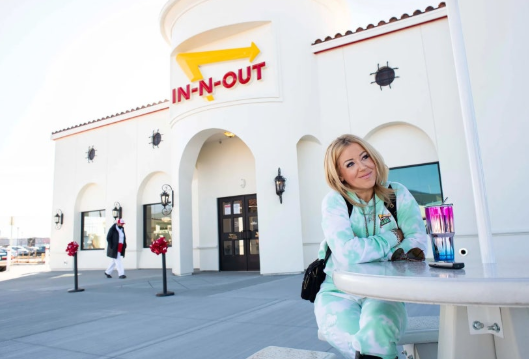
Snyder is the only granddaughter of the founder and his wife. After her father and uncle died one after another, she became president in her 20s in 2010. She has successfully led In & Out since then. She is considered one of the most successful young entrepreneurs in the U.S., going beyond being just a second-generation manager. In 2013, Snyder was named the youngest female billionaire in the U.S. According to the Bloomberg Billionaires Index, she has a net worth of 7.3 billion dollars. When she moves to Tennessee, Snyder instantly becomes the richest woman in the state. The reason why the young female management leader declared her decision to move to California is because of tougher regulations on the state government and soaring crime rates.
Snyder cited the city of San Francisco’s mandatory vaccination proof measures during the pandemic in his podcast. At the time, In & Out declined to verify the certificate, saying it “fiercely opposes government orders that force private companies to discriminate against consumers.” The city government responded by temporarily closing the store. Snyder expressed antipathy, saying the government was overly involved in how businesses operate. It is argued that it was a matter that goes beyond quarantine guidelines and is directly related to management philosophy.
Worsening policing has sealed the previous decision. In&Out has opened more than 420 stores across the U.S. in the past 77 years, while not a single one has closed. In March, however, In&Out made the difficult decision to permanently close its Oakland location for the first time since its foundation. In 2023, the number of violent crimes in Oakland jumped 38% from the previous year, with vehicle theft jumping 44% from the previous year. In an interview, President Snyder said, “Bullets came through the glass of the store, and there was a stabbing incident in the store,” adding, “It was an inevitable decision for the safety of employees and consumers.” The decision is not irrelevant to the unique conservative and Christian management philosophy that In & Out has long maintained. In & Out is a pro-Christian company that is devout enough to engrave Bible verses such as John 3:16 on the bottom of hamburger wrappers and beverage cups. In 2017 and 2018, he was caught up in a boycott in California, where the Democratic Party is strong, as his history of donating political donations to Republicans was revealed.
Despite the controversy, In & Out was considered a good company that provides the highest level of pay and welfare in the industry. According to Glassdoor, the largest employment information website in the U.S., In & Out ranked sixth in the list of the top 100 companies that want to work. Forbes also consistently put In & Out on the list of the best jobs in the U.S.

However, In&Out has come under intense pressure to maintain its capital health after the state of California sharply raised its minimum wage this year. Since April this year, California has implemented a bill (AB 1228), which increases the minimum wage for large fast food chains by 25% at once from $16 an hour to $20 an hour.
California was once called a land of opportunity even in the United States. Silicon Valley near San Francisco has flourished as a startup cradle.
California is now turning into a “grave of businesses.” Companies are fleeing from California to avoid high taxes, excessive regulations and horrible living costs. California’s newly coined term “Calexit+Exodus” combining exodus and exodus has become a trend. IT giants such as Tesla, Oracle, and Hewlett-Packard have already moved their headquarters to Texas. Recently, even leading manufacturing powerhouses such as Japan, Toyota, and North America have turned their back on California.
“California is the hardest state to do business in the United States,” Stanford University’s Hoover Institute said in a report. “High taxes and excessive labor and environmental regulations are driving companies to competitive states such as Texas and Tennessee.” The report pointed out that the state is prevalent in anti-business sentiment, which sees companies not as growth partners but as targets to pay taxes and control. Tennessee is a red state (a strong Republican state) with the opposite tendency to California. Unlike California, which has the highest corporate tax rate in the U.S., it has no corporate tax or personal income tax. It is considered a good state for businesses as it has relatively few environmental and employment regulations. In & Out built production bases and distribution centers in southern Texas in 2011, and expanded stores in other states including Texas, Nevada, Arizona, Utah, Oregon, Colorado and Idaho.
California is still an overwhelming core market in terms of the number of stores and sales even after moving its headquarters to Tennessee. Out of 418 stores in In & Out, there are 281 stores, or 70 percent, in California. “(California) remains the core market,” Snyder said. Some experts say that the relocation is a strategic move to hedge some of the management risks concentrated in California and establish a new growth base.
Fortune, a U.S. economic media outlet, quoted an expert as saying, “It is a symbolic example of how the deepening political and economic environmental differences in the U.S. affect corporate long-term strategies beyond simple headquarters relocation.”
SALLY LEE
US ASIA JOURNAL

