


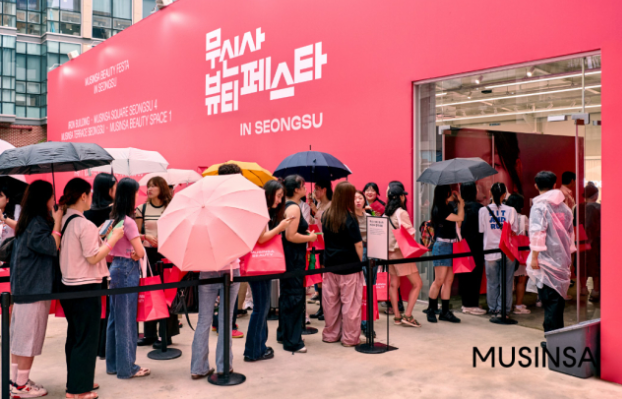
Due to the nature of cosmetics, it is important to “experience” to try them on and smell them, but it is a step to overcome the limitation that it is difficult to provide them with only a platform structure.
In particular, in the K-beauty market, which has a high proportion of small and medium-sized brands, opportunities to experience are an important factor in the spread of new products. The fact that beauty events, which were previously held mainly for online discount events, have recently been converted to offline events and are rapidly spreading is in line with this background.
They are not only expanding their cosmetics line-up, but are incorporating sophisticated designs that consider securing app-based users and collecting customer behavior data along with providing experience opportunities. The method of inducing customer movement that connects online and offline is rather evolving into a digital-friendly operating model than existing distributors.
The actual beauty pop-up store consists of data collection-type events such as application favorite registration or Kakao Talk channel friend addition. Visitors to the site can participate only by performing a specific mission within the app, and in return, they can receive beauty samples, goods, and dessert collaboration products. It is a structure that simultaneously induces app traffic inflow and brand exposure, and it is a strategy that even considers securing loyal customers.
As a result, fashion platforms have been accelerating rapidly this year. Previously, last year, Curly held “Beauty Curly Festa,” which sold a total of 4,000 beauty products at a discount, and presented a curation-oriented exhibition including 1,000 high-end luxury brands. Musinsa also held “Mushin Beauty Festa,” in which 41 brands participated, in September last year in Seongsu-dong, Seoul, and put its company-wide capabilities into the beauty sector.
This year, Zigzag and Coupang confirmed the schedule for the April event, and CJ Olive Young and Musinsa are preparing for a large-scale Festa in May.
The first place to open is Zigzag, a women’s fashion platform run by Kakao Style. Zigzag held the first offline pop-up store of “Jikjack Beauty,” a beauty expert, at XYZ Seoul in Seongsu-dong, Seoul from the 11th to the 13th.
This event is an offline extension of the online discount event Beauty Festa, with about 2,100 beauty brands participating. Major brands such as Etude, Innisfree, Dalva, and Rainbow Mansion, as well as products at reasonable prices such as “Tags” and “Pia” sold at Daiso, attracted attention.
Coupang will hold a “Mega Beauty Show Virtual Store” from the 18th to the 20th at the same place. It is an on-site event linked to Coupang’s beauty event “Mega Beauty Show 2025,” which marks its fifth anniversary this year. Coupang also aims to simultaneously recognize brands and induce purchases through product experiences, sample provision, and social network service (SNS) authentication events.
Olive Young will also hold “Olive Young Festa 2025” from May 21 to 27 around the Nordle Island in Seoul. The event, which was held at the existing DDP, has been expanded to an outdoor space of 3,500 pyeong, and the area of the event will more than double and the number of customers will increase by 1.5 times.
Olive Young’s expansion of the Festa to a large-scale outdoor event is attributed to the growing need to differentiate itself as online platforms’ beauty attacks have intensified. As it has a strong offline channel, it is a strategy to continue its competitive advantage by establishing a large-scale contact point that can increase brand loyalty and experience immersion.
Unlike fashion platforms that focus on app-based pop-up stores, Olive Young tried to differentiate itself from competing platform events by rebranding it with the concept of “beauty entertainment” that combines performance, content, and entertainment.
From the platform’s point of view, beauty is a category with both high profitability and expandability. The turnover rate is fast and the regular purchase rate is high. According to the industry, the customer unit price per session is lower than that of fashion, but the annual purchase frequency is up to twice as high, so the fixed demand base is solid. According to the cosmetics industry, the average margin rate is also relatively stable at 40-60%.
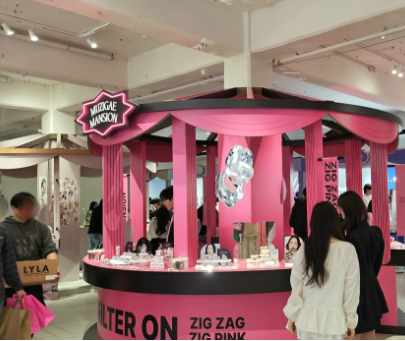
Market growth is also being supported. According to Euromonitor, the size of the domestic beauty market in 2023 is 17.3412 trillion won. Exports are also strong. The Ministry of Food and Drug Safety said that Korea’s cosmetics exports rose 14.5 percent year-on-year to $2.6 billion as of the first quarter of 2025. It is the highest-ever quarterly performance.
The expansion of beauty on fashion platforms is also reflected in year-on-year performance. Musinsa turned into a surplus last year with sales of 1.2427 trillion won and operating profit of 102.8 billion won, while Zigzag recorded sales of 24.4 billion won and operating profit of 2.2 billion won. ABLE increased about 30% year-on-year with 2.5 trillion won in transaction and 334.3 billion won in sales, while W Concept was in the black for four consecutive years since its incorporation into Shinsegae Group with 572.2 billion won in transaction and 1.65 billion won in operating profit, all of which achieved the highest performance.
Now, the “offline experience design” that online-based platforms try in beauty is becoming an essential strategy, not an exceptional event. It is expected that complex strategies to overcome the limits of the platform will be fiercely developed, ranging from physical experiences to eliciting brand trust, designing online and offline structures that link customer data, and securing revenue models based on repeated purchases.
“From the perspective of fashion platforms, beauty is an opportunity area to naturally expand categories to similar target groups,” an industry official said. “In particular, the method of increasing offline contact points is providing practical effects of increasing awareness and improving performance for both brands and platforms.”
SALLY LEE
US ASIA JOURNAL

