


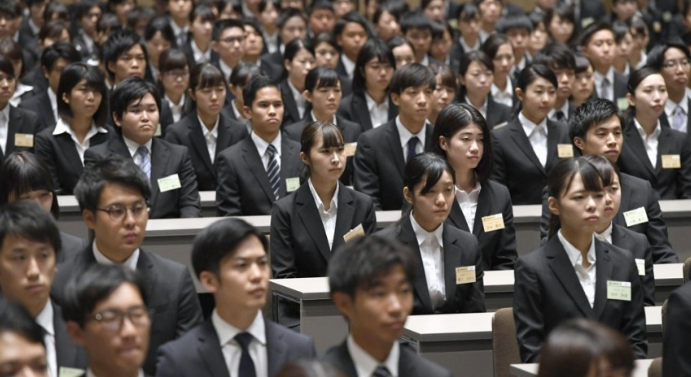
The figure of 300,000 yen is drawing attention as a keyword of the Japanese college graduate recruitment market this year. As major conglomerates have significantly increased the starting salary of new college graduates, cases of entering the 300,000-yen range for the first time are emerging one after another. According to the Yomiuri Shimbun on Wednesday, Daiwa House, a large housing construction company, has decided to raise the starting salary of its new college graduates to 350,000 yen a month this spring, about 40 percent from the previous 250,000 yen.
Mitsui Sumitomo Bank also decided to increase the starting salary of college graduates to 300,000 yen in April, 17.6% from the previous 255,000 yen.
Fast Retailing, famous for its Uniqlo clothing brand, has decided to raise its starting salary for college graduates from 300,000 yen to 330,000 yen from March.
The starting wages of Japanese college graduates have been on the rise in recent years amid the downturn in the Japanese economy, symbolized by the “Lost 30 Years,” but have risen more steeply amid the trend of wage increases by large companies.
In a survey by the Nihon Keizai Shimbun, the average starting salary for major companies in 2024 was about 240,800 yen, up 8.8% from 2021, 1.4 percentage points ahead of the average wage growth rate of workers (7.4%).
As a result, the starting salary of some large companies will enter the 300,000 yen range for the first time this year.
Nikkei said, “The move to raise the starting salary for college graduates has accelerated since 2022,” adding, “We are rushing to improve treatment as the battle for talent with general corporations or consulting firms famous for their high annual salaries intensifies.”
However, the starting salary of 300,000 yen is still noticeable enough to be covered by the media in articles, and it is not yet common in the Japanese college graduate recruitment market.
In fact, Mitsui Chemical, a famous conglomerate, decided to raise wages for college graduates (based on general jobs) by 9.4% after April this year, but the starting salary was 280,000 yen. However, those who have completed a master’s program will enter the 300,000-yen range for the first time, up 8.6% to 302,000 yen.
EJ SONG
US ASIA JOURNAL

