


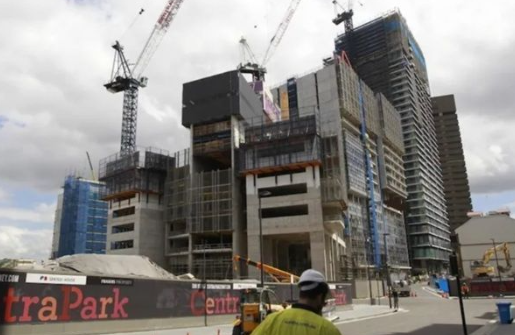
According to the Australian daily Sydney Morning Herald on the 4th (local time), NSW Planning Minister Paul Scully emphasized at the Sydney Summit held at the International Convention Center (ICC) that “residential development needs to extend across the outskirts, not just to the urban business district (CBD).”
“People’s expectations for housing are changing, and as a result, we need to actively introduce housing facilities while securing enough hotel, business, and office space in the city center,” he said, referring to plans to develop large-scale apartments near train stations in western Sydney, including Burwood and Croydon.
According to the 2021 Australian Census, there were only 103,334 apartments in inner-city Sydney and southern parts of the country. This was a significantly smaller number compared to downtown Melbourne, where the number of apartments reached 160,187 households.
As a result, the NSW state government is pursuing a policy to supply 377,000 new homes over the next five years. NSW Prime Minister Chris Minns frequently stated that in order for Sydney to grow into a global city, high-density development must be promoted not only outside the city but also inside the city center.
“We will not stop developing existing residential complexes entirely, but the supply of various types of housing in the city is essential,” Scully said. “There are still housing development opportunities in southwestern Sydney, such as Campbelltown and Wollondilly, and some residents will not have to commute to and from the city center.”
Meanwhile, a recent poll showed an increase in Sydney residents’ support for the development of high-density dwellings. According to a Life in Sydney survey jointly conducted by the Sydney Commission and polling company Ipsos, 46% of respondents said they supported expanding apartment construction in their area, up from 39% in 2023. In addition, there was a 10% increase in support of high-density development in urban and inland areas. Nevertheless, 50% of Sydney residents still said that apartments were not suitable for family living.
Philip Oldfield, dean of the Department of Architecture and Environment at the University of New South Wales (UNSW), said, “The additional construction of apartments in the city will revitalize the city,” but pointed out, “Once the apartment is developed in a strata (multi-family housing ownership system), the site is likely to be fixed for residential purposes for a long time.” “The city center of Sydney is still a commercial and business center, and there is room for additional residential facilities, but proper balance is important,” he added.
Sydney Mayor Clover Moore said, “Currently, the city of Sydney has the highest residential density in Australia and is ready to meet the state government’s required target of 18,900 new homes.” He said, “Currently, Central Sydney has about 17,500 residential facilities, 3,200 new units have been built in the past five years, and 5,000 more will be added.” He stressed, “We can create residential land in urban areas, but in the end, it’s up to the real estate industry to actually build housing.”
“Family residents are often excluded from high-density residential areas,” said Liam Abter, an urban planner with the Canterbury-Bankstown City Council, arguing that the NSW state government should come up with legislation to force developers to include at least three to four bedrooms.
SALLY LEE
US ASIA JOURNAL

