


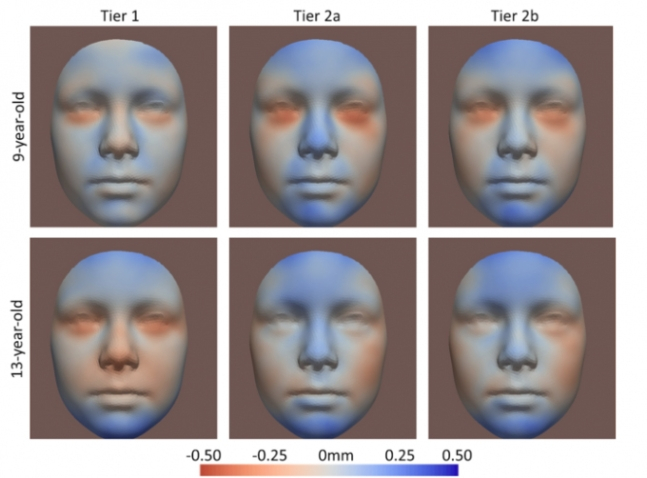
Studies have shown that alcohol consumed for three months before pregnancy can negatively affect the formation of facial shapes such as the direction of the child’s jaw and the length of the nose.Recently, a research team led by Professor Erasmus of Rotterdam Medical Center in the Netherlands published the results of a study that analyzed the effects of alcohol exposure during fetuses using AI (artificial intelligence) and deep learning technology in the international journal Human Reproduction.The research team first developed an AI-based algorithm that captures 200 features of the features after transforming the faces of 3,149 9-year-old children and 2,477 13-year-old children into three-dimensional images. Then, it was compared and analyzed with the mother’s survey on alcohol intake in the early, mid, and late pregnancy.The research team divided them into three groups: mothers who did not drink before or during pregnancy, mothers who drank for three months before pregnancy and stopped after pregnancy, and mothers who continued to drink before and after pregnancy.As a result of the analysis, it was found that the face shape of a 9-year-old child was affected by the mother’s alcohol intake.
When a fetus is exposed to alcohol during pregnancy, including three months before pregnancy, the nose becomes shorter or the tip of the nose is crooked. In addition, characteristics such as protruding jaws and eyelids falling down were also observed. However, these characteristics were found to weaken as a 9-year-old child turned 13.
Professor Rochefkin, who conducted the study, said, “As the child grows, the facial characteristics of alcohol exposure decrease or are covered by various factors, but the health impact has not disappeared,” adding, “It is desirable to stop drinking alcohol even before pregnancy.”
Meanwhile, alcohol consumption during pregnancy can cause ‘fetal alcohol spectrum disorder (FASD). This can damage the central nervous system of the fetus, causing a decrease in intelligence, and can cause adolescent learning disorders or attention deficit.
FASD is known to affect the development of the fetus regardless of the amount of mother’s drinking, the number of drinking, and the timing of drinking.
H.S HA
ASIA JOURNAL

