


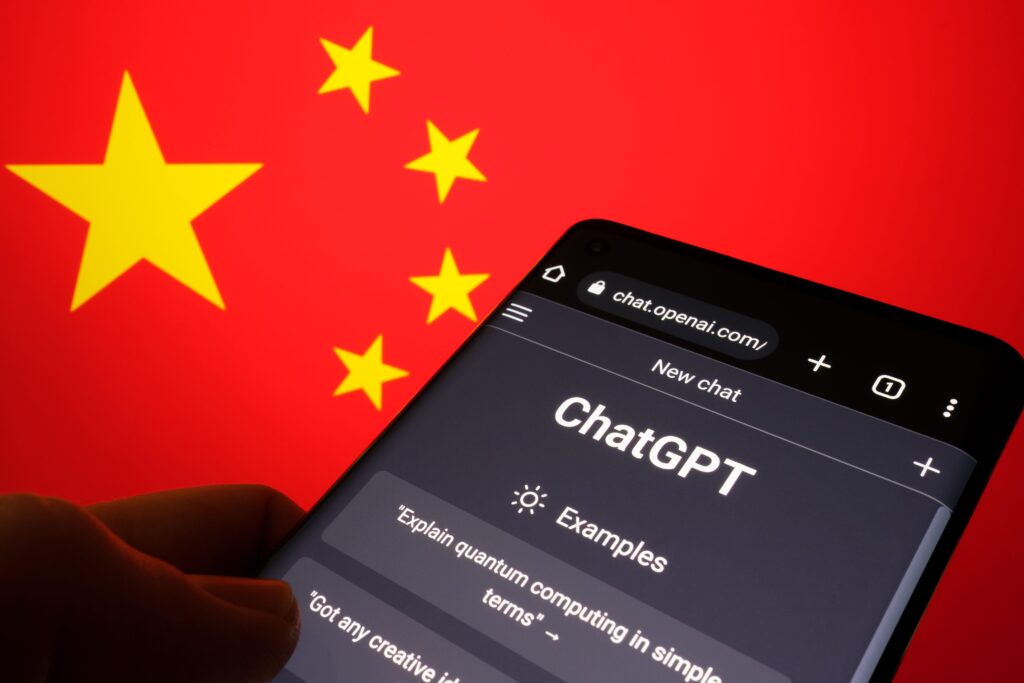
Citing anonymous sources, the Nihon Keizai Shimbun reported on the 23rd that the Chinese authorities ordered major IT companies such as Tencent not to provide “chat GPT services” provided by open AI by connecting them to each company’s search engines. Chat GPT is an AI-type chatbot released by Open AI, a company invested by Microsoft in the United States.According to sources, Tencent, a Chinese big-tech company, blocked access to Chat GPT on its social media service WeChat in December last year, which is also a measure according to the authorities’ instructions. The Chinese government also asked its IT companies to report to the authorities in advance if they provided similar services to Chat GPT to their IT companies, perhaps because they needed to break through the authorities’ censorship system with virtual private networks (VPNs).The Chinese government’s sensitive response is a measure to prevent the spread of critical information about the government due to Chat GPT. “Chat GPT acquires information based on Western papers and books, and these data contain a lot of critical information about China,” Nihon Keizai said. “It is highly likely to derive critical answers to the current leadership.”In fact, the AI-type chatbot “Chat Yuan,” launched by Chinese IT company Yuan Yu Intelligence on the 3rd, was suspended three days after its launch due to a violation of the law. Asked about his opinion on the Russia-Ukraine war, Chatyuan defined it as “Russia’s war of aggression,” which is contrary to the Chinese government’s position that has defended Russia, saying it is not an invasion of Ukraine. Asked about his thoughts on the Chinese economy, Chatyuan also replied, “There are structural problems such as lack of investment, housing bubbles, and environmental pollution, and it is difficult to look at them optimistically.”In line with the Chinese government’s policy, Chinese media have also begun to pour out critical reports on Chat GPT. China’s state-run media Securities Times (STCN) posted a comment on the 9th that it is dangerous to invest in a company that develops AI-type chatbots. “Chat GPT-related stocks seem to be overheating,” the Korea Securities Times said. “Some capital is attracting investors to lose money.”Shares of Chinese AI companies, which had been on the rise this year, plunged on the back of the global ChatGPT craze.
Shares of China’s AI-based facial recognition technology company “Cloud Work Technology” fell 14% after critical reports from Chinese media, and shares of “Beijing Haitian Yi Sung Science and Technology,” an AI-related stock, fell 13% in Shanghai.As the authorities pulled out the sword of regulation, Chinese IT companies’ development of AI-type chatbots is on the verge of being stranded. Baidu, China’s largest search engine, announced that it would launch “Unibot,” a service similar to Chat GPT, next month, but it is difficult to guarantee whether it will be able to provide the service stably after its launch. Chat Yuan developer Xu Liang told the Washington Post, “Even if Baidu releases the annibot as expected, it is likely to be suspended as soon as possible.” The key is whether the Chinese government censors AI-type chatbot services. IT industry insiders analyze that AI-type chatbots are difficult to apply the censorship system that the Chinese government has applied. Chinese regulators are censoring information by splitting all posts on the Internet into the smallest number of words. Under such a system, even if a search engine searches for the word “Uighur,” it only shows simple geographical information about Uighur instead of information on China’s human rights suppression.However, in the case of AI-type chatbot models that utilize large language models, probability and statistically predict which word will be appropriate after one word, and then create a complete language to deliver information to users interactively. It is difficult to apply the censorship method used by existing authorities because the language is organically composed by calculating numerous probabilities and statistics. WP explained, “China’s IT companies, including Baidu, are facing the task of censoring AI-type chatbots to see if they contain words that authorities prohibit.”Configuring the types of data that AI-type chatbots need to learn is also a representative challenge for Chinese companies. WP said, “Baidu’s AI-type chatbot ‘Anniebot’ was learning vast amounts of Western information, including Wikipedia and Reddit, an online community in the United States,” adding, “Chinese companies’ chatbots should only use information approved by the party as learning data.”Although the Chinese government has taken a strong response, it seems that the Chinese government is actually not in a good mood. Although the service was suspended due to a flood of raw information that was not censored, the authorities do not seem to have any disagreement with the prospect that the AI-type chatbot market will grow.Chang Ji-chang, a high-ranking official of China’s Ministry of Science and Technology, said at a press conference on the 24th, “Technology such as ChatGPT can make AI, society, and economy integration and can be applied to many industries.” The Global Times also reported that the Chinese government has expressed its intention to use AI technology as a new growth engine and that there will be specific support measures.Moreover, even for China, it is difficult to see the U.S., a hegemonic country, occupy all of the AI-type chatbot markets. According to International Data Corporation, a market analysis company, China’s investment to foster the AI industry is expected to reach $26 billion by 2026. This amounts to 9% of the world’s AI-related investment.If the Chinese government provides AI-type chatbot services through its own data, it can also be used as a propaganda tool for the party. For example, if all AI-type chatbots learn information based on data controlled by Chinese authorities, the authorities can only provide users with information that suits their taste. Mark Natkin, founder of Ma Bridge Consulting, an IT company based in Beijing, China, predicted, “If AI-type chatbots are developed in line with the Chinese authorities’ policy goals, they will serve as a window for more efficiently conveying information that the government wants to deliver to people.”
EJ SONG
ASIA JOURNAL

