


South Korea marked the anniversary of the promulgation of Hangeul more than five centuries ago on Thursday with various events highlighting the history and value of the Korean alphabet.
Considered one of the simplest and most logical language writing systems in the world, Hangeul was invented by King Sejong of the Joseon Dynasty (1392-1910) in 1443 and promulgated three years later to replace an older writing system based on the Chinese script.
The main ceremony to celebrate Hangeul Day was held at the Sejong Center for Performing Arts in central Seoul in the morning with 3,000 government dignitaries, foreign diplomats and leaders of Hangeul-related organizations attending.
Nine people were honored during the ceremony for their contribution to the development of Hangeul.
They include the late American missionary Homer Hulbert (1863-1949), who advocated for Korean independence from Japanese colonial rule.
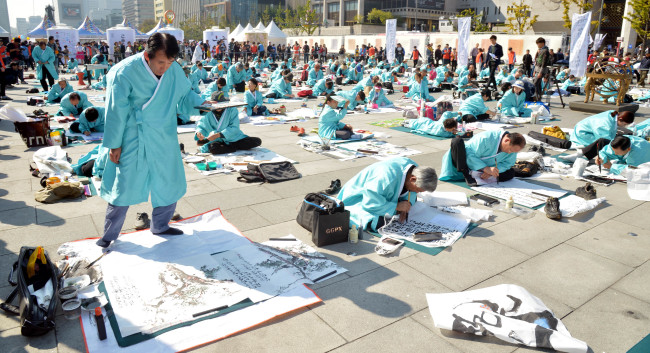 |
| People participate in a Hangeul calligraphy contest on Hangeul Day, which marks the 1443 promulgation of the Korean alphabet, at Gwanghwamun Plaza in central Seoul on Thursday. (Kim Myung-sub/The Korea Herald) |
He was chosen for the South Korean government’s Gold Crown Order of Cultural Merit for writing the first-ever Korean-language textbook in 1890 as an educational adviser to the Korean Empire and contributing to the study of Hangeul, the Ministry of Culture, Sports and Tourism said Wednesday.
Hulbert’s great-grandson received the medal on his behalf during the ceremony.
A variety of cultural events are underway or scheduled this week nationwide in celebration of Hangeul Day.
At Gwanghwamun Square, a ceremonial plaza in central Seoul, the culture ministry on Tuesday kicked off a Hangeul festival featuring various exhibits, performances, a fashion show and a Hangeul writing contest for foreigners. The festival is scheduled to run till Friday.
Five Seoul city buses carrying typographic Hangeul designs were to be put into operation for a month, according to the ministry.
Also on Thursday, the National Hangeul Museum opened its doors to the public after nearly three years of construction.
Located inside the compound of the National Museum of Korea in the Yongsan district, the museum consists of exhibition rooms, a library, a cafe and a Hangeul-themed playground for children and a room for teaching Hangeul to foreigners.
The Seoul metropolitan city opened an exhibition of some 50 hand-painted postcards depicting the beauty of the Korean alphabet at Cheonggye Plaza in central Seoul. The postcards were chosen from those sent for a contest hosted by the city government to help increase the public interest in their own writing system.
The governments of Daegu and South Chungcheong Province hosted competitions related to Hangeul.
Hangeul Day was initiated in 1926 by a group of Korean-language scholars as part of its efforts to preserve the written language under the Japanese colonial rule, during which Japan banned its use and implemented Japanese as Korea’s official language.
The day was designated as an official holiday in 1949, four years after Korea was liberated from Japanese rule but excluded from the list of public holidays in 1991 on the grounds that too many holidays would adversely affect the national economy.
The government re-designated the day as a national holiday last year with the rise of public attention toward the historical and international value of Hangeul. (Yonhap)

