


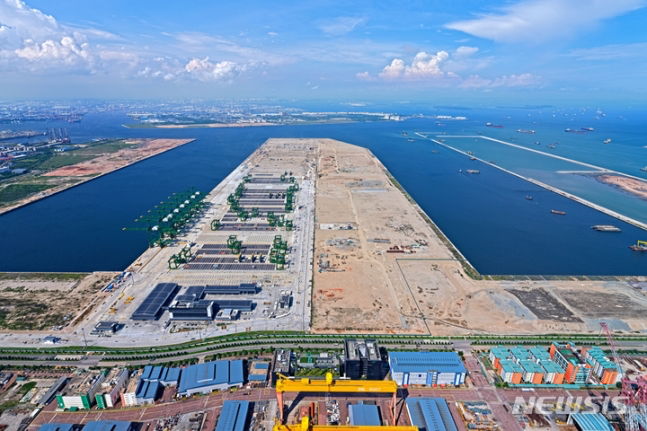
Singapore is working on a “Tuas Terminal” project to create the world’s largest port. When all four stages of the project are completed by 2040, it will be reborn as a super-large new port that can handle 65 million TEUs (TEU, one 20-foot container) per year. The Singaporean government plans to transfer existing port facilities and functions to Tuas Port and introduce various next-generation port technologies, including an unmanned automated operation system, to create the world’s best smart megafort.
DL E&C signed this construction contract with the Singapore Port Authority in April 2015. The total construction amount is 1.98 trillion won, and it has won an order with Belgian dredging company Dredging International. The stake in DL E&C is about 720 billion won. DL E&C was in charge of the construction of dock facilities, including the improvement of the landfill ground and the production and installation of caisson for the construction of the port’s inner wall.
Due to its geographical characteristics, Singapore is a place where most construction materials can be procured through imports from neighboring countries, which is heavily burdened with material costs. In particular, Tuas Port Corporation included a huge sea reclamation work 1.5 times the size of Yeouido, which required a huge amount of sand and sand, and high cost expenditures were expected.
DL E&C received high praise from the ordering company for its eco-friendly design that minimizes the use of sand and sand from the order stage. In order to minimize the use of sand, the dredged soil generated in the process of dredging the seabed was utilized as much as possible for reclamation. From the time of design, the latest soil theory was studied and safety was thoroughly reviewed, reducing about 6.4 million의 of sand compared to general reclamation methods. This is about one-eighth of Namsan Mountain (about 50 million cubic meters) in Seoul.
It also installed 221 caissons with a size of one 12-story apartment building. Cayson is a concrete structure that is built to build the foundation for reclamation work. The production and installation of caisson is a key process of large-scale reclamation work, and in the case of ports, it will serve as a shore wall for large container ships to dock. DL E&C prepared a caisson production site near the site and sequentially produced and installed a total of 221 caisson. The production process was subdivided and completed in 29 months, which was reduced by 7 months from the original 36 months.
Singapore is a place where construction companies around the world are fiercely competitive because the construction market is open. DL E&C participates in major large projects in Singapore and is recognized for its technology and business performance. The Thomson Line subway construction, which opened in November, was successfully completed, including the Tuas Terminal project. Currently, the expansion and connection work of the Jurong East Transfer Station is underway. We are looking forward to winning various project orders in the Singapore construction market in the future.
KS CHOI
ASIA JOURNAL

