


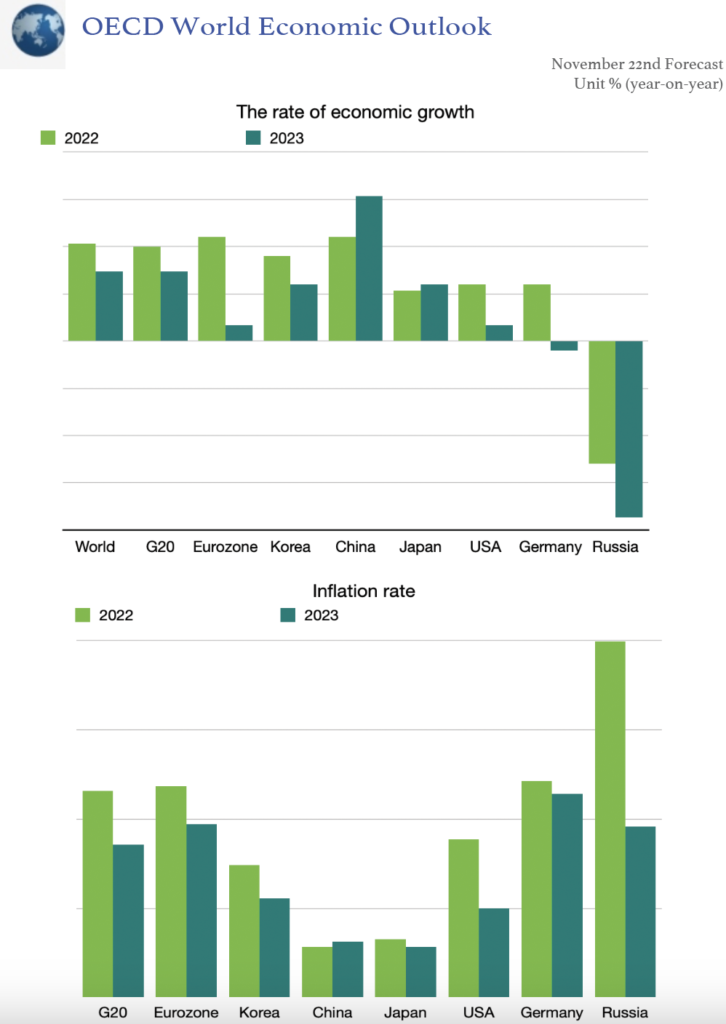
The Organization for Economic Cooperation and Development (OECD) wrote in the subheading of the economic outlook data released on the 22nd (local time), saying, “The Russian-Ukraine war has caused the highest level of energy crisis since the 1970s, causing high prices and low growth.” It has officially confirmed that fears of “stagflation” accompanied by inflation are emerging around the world amid the economic recession. The OECD forecast that next year’s global economic growth rate will drop 0.9 percentage points from 3.1 percent this year to 2.2 percent. The inflation rate of the G20 countries is expected to continue its high trend, recording 6.0 percent next year, following 8.1 percent this year. This means that the typhoon of the economic crisis formed by the Ukrainian war will grow into a perfect storm next year, hitting the global economy.
The OECD predicted that Korea’s economic growth rate will be 1.8 percent next year, 0.4 percentage points lower than the global average. The 2024 growth rate also offered 1.9 percent, only 0.1 percentage point higher than next year, warning that low growth at the level of economic slowdown will continue for the second consecutive year. The annual economic growth rate of less than 1% is the first, except for 2020 (-0.7%), when COVID-19 spread, 2009 (0.8%) when the global financial crisis hit, 1998 (-5.1%) when the International Monetary Fund (IMF) currency crisis hit, and 1980 (1.6%), which was affected by the second oil crisis.
It suggested high prices and sluggish exports as the reasons for Korea’s low growth in the 1% range. The OECD predicted, “Exports will not recover for the time being as the inflation rate continues in the 5% range, slowing the growth of disposable income, reducing private consumption, and shrinking demand for semiconductors around the world.” Accelerating housing price adjustment and expanding corporate insolvency due to increased debt repayment burden are also feared to serve as downward factors, he said. “Strengthening protectionism, such as rising U.S.-China tensions, the Russian-Ukraine war, and other geopolitical tensions, may cause Korea’s supply chain reorganization.”
Regarding Korea’s inflation rate, the OECD predicted that it would peak at 5.2 percent this year and then fall to 3.9 percent next year and 2.3 percent by 2024. It was judged that monetary tightening policies pushed by countries through interest rate hikes were effective in controlling prices. The Bank of Korea is expected to hold its last Monetary Policy Committee meeting this year on the 24th and launch a “baby step” to raise its key interest rate by 0.25 percentage points.
As the OECD lowered Korea’s economic growth rate to 1.8 percent next year, attention is being paid to whether the Ministry of Strategy and Finance and the Bank of Korea will also come up with a 1% forecast. As each institution oversees fiscal and interest rate policies, it is also expected to be more careful in determining its forecast than other institutions because it follows responsibility. If the forecast is high, it can be criticized for being optimistic, and if it is low, it can be embroiled in a theory of responsibility for policy failure.
The Ministry of Economy and Finance will include next year’s growth forecast in the 2023 economic policy direction, which will be announced around mid-to-late December. As the 2.5% proposed by Kyungbang in June has become much higher than other institutions, it is expected to drop sharply to around 2.0%. The Bank of Korea will announce its economic outlook on Monday. Lee Chang-yong, governor of the Bank of Korea, said, “It is likely to fall below the 2.1 percent forecast in August.”
KS CHOI
ASIA JOURNAL

