


There are only five “Made in Korea” products that are most loved in the world market, including smartphones and semiconductors.
Japan produced the world’s No. 1 in seven items. The world’s No. 1 item holder ranking has continued for two years, leading to the U.S., China, Japan, and South Korea. Korea is losing its market share to China in the high-tech sector, which is a major market, and it is expected that it will not be able to regain the third place for the time being.In the “2021 Major Product and Service Share Survey” released annually by the Nihon Keizai Shimbun on the 23rd, Korea ranked first in five items, including smartphones, DRAMs, OLED panels, NAND flash semiconductors, and ultra-thin TVs. All five items are Samsung Electronics’ products.
Japan maintained the world’s No. 1 position in seven areas: automobiles, motorcycles, digital cameras, laser multifunction devices, image (CMOS) sensors, lithium-ion batteries for mobile phones, and polarizing plates.
In the 2020 survey, Korea ranked first in seven categories and tied for third with Japan. However, it fell to fourth place last year as it gave up first place to China’s BOE and CSSC in large LCD panels (LG Display) and shipbuilding (Hyundai Heavy Industries).
China, which overtook Japan last year and ranked second for the first time, narrowed the gap with the U.S. The world’s No. 1 items in the U.S. and China are 18 and 15, respectively, reducing the gap to three. Last year, which surveyed 70 items, the number of items in the U.S. was 24 and China was 12 which was twice as different.Korea’s No. 1 item. Korea ranked first in five categories: smartphones, DRAMs, OLED panels, NAND flash semiconductors, and ultra-thin TVs. All five items are Samsung Electronics’ products. China has expanded its market share in 13 items, focusing on high-tech products such as electric vehicles, vehicle batteries, and insulators for lithium-ion batteries.
Among the 56 survey subjects, 32 items were ranked in the top five by Chinese companies. This is why some predict that Korea, which is losing its market to China, will not be able to catch up with Japan for the time being.
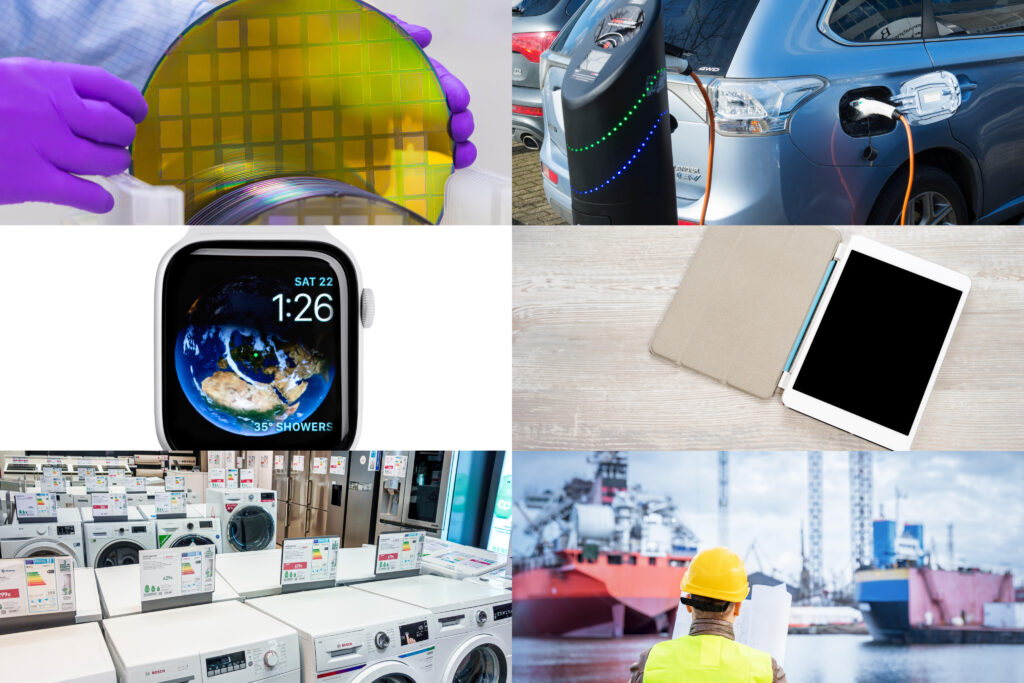
Korean companies ranked third in smartwatches (second in Samsung Electronics), tablet terminals (second in Samsung Electronics), large liquid crystal panels (second in Samsung Display), portable lithium-ion batteries (second in Samsung SDI), image sensors (second in LG Energy Solution), and polarizers (third in Samsung SDI).However, the gap between the top Chinese and U.S. companies is widening. Home appliances such as washing machines, home air conditioners, and refrigerators, which once dominated the global market by Samsung Electronics and LG Electronics, were all lost to China and did not even rank third.Except for Joseon, where Hyundai Heavy Industries (16.1%) is chasing China’s CSSC (17.6%) by 1.5 percentage points, it is difficult for new No. 1 items to emerge.
Korea’s top five items are also in a situation where it cannot be relieved.
The gap between Samsung Electronics (20.0%) and Apple (17.3%) in the smartphone market has narrowed to 2.7 percentage points. However, DRAM (60.1%) and OLED (60.1%) with a combined market share of 71.3% of Samsung Electronics (42.7%) and SK Hynix (28.6%) remained at the top.As the U.S.-China hegemony competition intensifies, global companies will have to reorganize their supply chains into markets other than China, said Masahisa Inagaki, a KPMG FAS partner.
JULIE KIM
ASIA JOURNAL

