


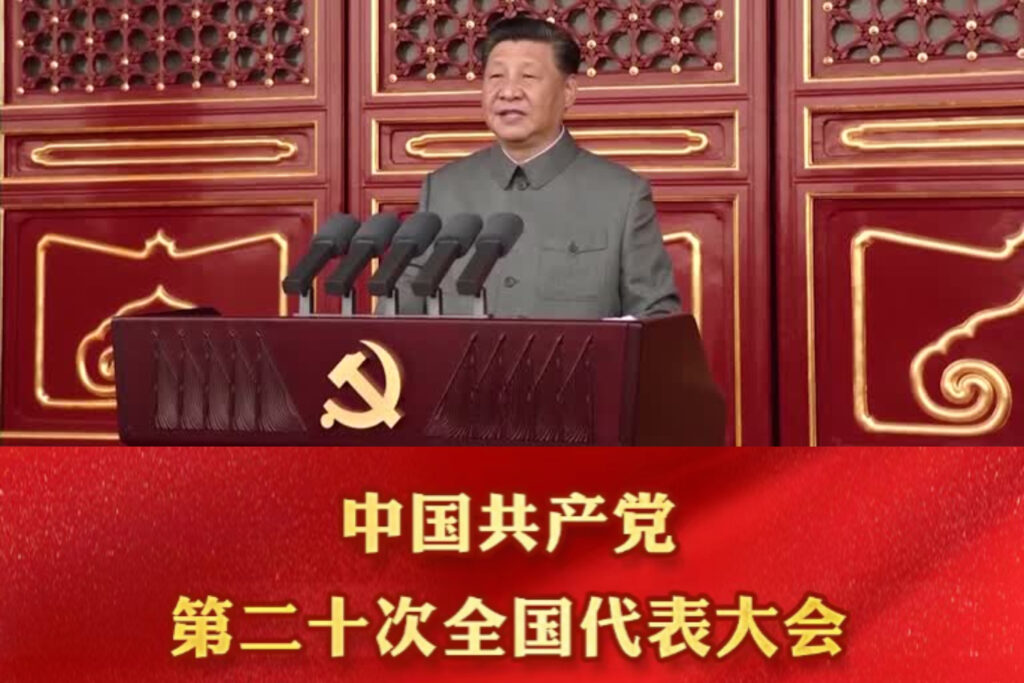
(Source from Reuters/Alamy)The 19th Central Committee’s 7th plenary session (the 19th Central Committee),
the final procedure for holding the 20th National Congress of the Communist Party of China,
which will be the third coronation of Chinese President Xi Jinping, opened in Beijing on the 9th. At the Seventh Plenary Session,
the schedule and agenda of the party congress proposed by the Central Political Bureau of the Communist Party will be finalized.
The party convention is a major political event that forms a new leadership that will lead the party and the country once every five years.
President Xi will enter the path of long-term rule through the party convention,
which will open on the 16th. As the president, general secretary of the Chinese Communist Party,
and chairman of the party’s Central Military Commission, he has served two terms as the most powerful person in the past decade.
He will be re-elected as general secretary and chairman of the Central Military Commission at the party convention, marking the start of his third term in office.
He said at a seminar on growth and ministerial officials held in July to prepare for the party convention that he would set a “five-year or longer-term” policy of state affairs.
This suggests that he is preparing for long-term power for the next five years and even longer.
Furthermore, the party is expected to give him the title of “the leader of the people” to pave the way for him to practically exercise his power for life.
President Xi will solidify his position as the leader with the strongest power and status after Mao Zedong,
who founded New China, through this party congress, but it is not just spread out in front of him. Internally,
it is necessary to immediately recover public sentiment that has been displaced by the slowing economic growth and the prolonged “zero-corona” policy.
Another big task is how Western countries will build a united front and break through the encirclement that is tightened from outside.
On top of that, the issue of Taiwan’s unification, which he considers a historical task,
remains an important justification for long-term rule and a hot issue that may have catastrophic consequences.
According to the 10-year rule of the former supreme leader, a full-scale power restructuring should take place this year,
10 years after Xi took power. However, as President Xi’s re-election has already become a fait accompli, the most interesting agenda in this party congress is the revision of the party constitution.
It is predicted that the revision of the party constitution will include the words “two establishments” and “two guardians” and change the “Chinese characteristic socialist idea of the new era of Xi Jinping” to “Xi Jinping idea.”
The establishment and protection of the two sides mean establishing Xi’s position as the core of the party’s central and main opposition parties, and defending Xi’s core position and the authority and leadership of the party’s central government.
In addition, compressing Xi Jinping’s ideas inserted into the party constitution at the 19th party congress from the current 16 to five letters means upgrading his ideas to the same rank as the Mao Zedong Thought in the party constitution.
The Party Constitution also contains the “Deng Xiaoping theory,” but it is an expression that does not reach the “idea.”
(Source from Reuters/Alamy)It should also be noted whether the term “people’s leadership” will be officially used at the party convention.
The title of the people’s leader formalizes that Xi is in the same class as Mao Zedong, who was called the “Great Leader.
” In the long run, it means that even if he does not hold an official position, he will be able to exercise his real supreme power behind the scenes for life.
Some observers say that the party’s presidential system could be revived.
The party presidential system disappeared to prevent the concentration of power after Mao Zedong’s death.
Reviving this means abolishing the current collective leadership system centered on the Standing Committee of the Politburo and formalizing a single leadership system, which is widely believed to be unlikely to be realized.
Even if it does not go as far as the revival of the presidential system,
it is clear that all signals of the party congress and the revision of the party constitution are geared toward strengthening Xi’s status and power.
Beyond Deng Xiaoping, President Xi will upgrade his status to the same rank as Mao Zedong. Through the party convention,
he is expected to reiterate his “Chinese dream” of the second 100-year goal and the great revival of the Chinese people.
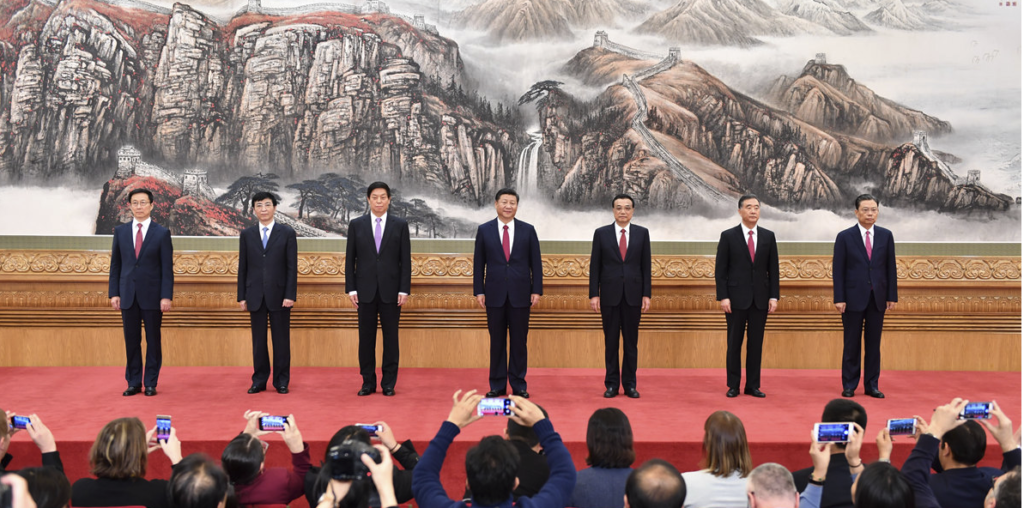
Ten years ago, he became the Communist Party general secretary at the 18th party congress and set “two hundred-year goals.
” And last year, the 100th anniversary of the founding of the Communist Party, it declared that it had achieved its first 100-year goal of escaping poverty, a full-scale “Shaokang” society.
The remaining goal is to build a full-scale socialist modernization power by 2049,
the 100th anniversary of the founding of the People’s Republic of China.
This means the completion of the Chinese dream and contains the ambition to overtake the United States and become the world’s strongest country.
President Xi is expected to present a specific roadmap through the party convention,
putting “joint wealth,” which focuses on distribution and narrowing the gap between the rich and the poor, as a key agenda for the third term of his administration.
However, there are many thorny bushes that President Xi has to overcome on his way to the Chinese dream.
Slowing economic growth is a challenge that is on the horizon.
The era of “population Hong-ri” based on 1.4 billion people has already ended, and the real estate market, which supported economic growth, has fallen into a slump.
This year, the worst economic report card is expected due to domestic and foreign unfavorable factors such as the blockade to prevent the spread of COVID-19 and the Ukrainian war.
In the future, economic growth will gradually slow down, and some predict that the timing of the U.S. economic overtaking, which was expected to be in the late 2020s, may be delayed or will not come at all.
Against this backdrop, the U.S. check to quell China’s rise is becoming more explicit.
The U.S. is moving to exclude China from supply chains in high-tech industries such as semiconductors, which have been struggling to resolve trade conflicts and called for technological independence.
Western countries, including the United States, have been tightening the siege of China by solidifying the values of human rights and democracy with a loop.
Amid the trend of decoupling between the U.S. and China and de-Chineseization, the task of securing new growth engines and seeking diplomatic solutions to improve relations is waiting for Xi Jinping’s third term in office.
The issue of Taiwan’s unification, which Xi considers to be the last puzzle to complete the Chinese dream, is a complex task.
Taiwan’s reunification provides Xi with an important justification for long-term rule.
In Taiwan, President Xi is expected to take a more aggressive attitude to make progress on the goal of reunification after his third consecutive term.
China emphasized peaceful unification in its first White Paper on Taiwan in 22 years ahead of the party convention,but said it would not promise to give up the use of force.
This is why some point out that 2027, the 100th anniversary of the founding of the People’s Liberation Army, and President Xi will decide whether to serve four consecutive terms after his third term, is the time for China’s armed invasion.
However, if the unification is carried out by force, it could lead to an all-out war with the U.S. and other Western countries,
and it is not an easy choice in that it must endure isolation from the international community, such as at least all-round economic sanctions.
In the end, these tasks can be an important variable for President Xi to run the road to long-term power beyond the next five years.
TED PARK
ASIA JOURNAL

