


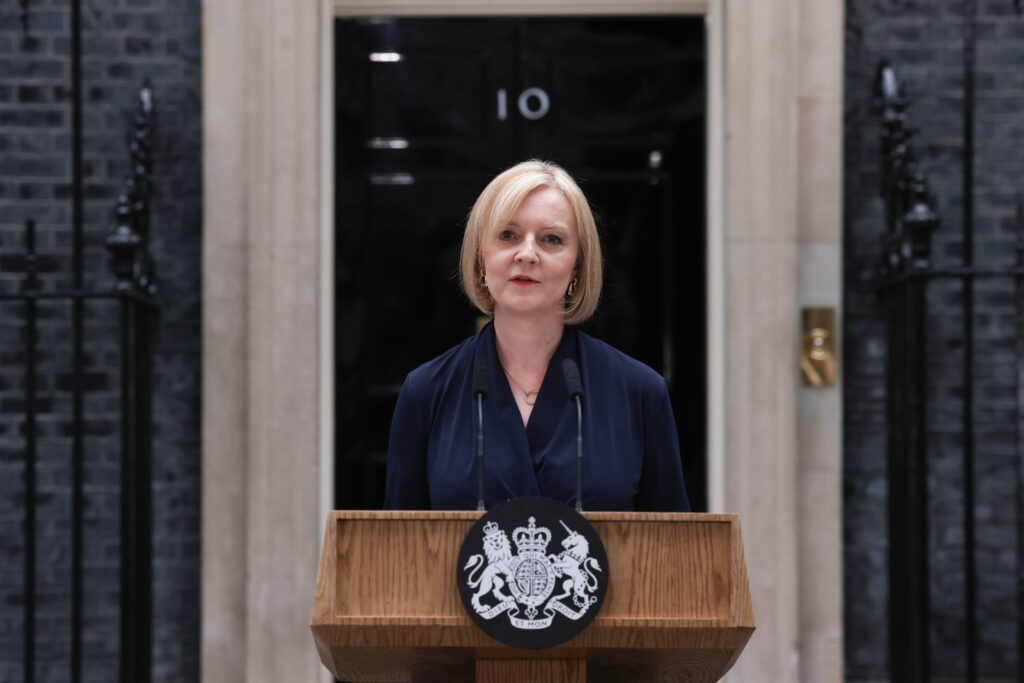
London(Reuters)However, there is also a warning that even the regime could be lost if the government insists on a tax cut policy facing strong opposition both internally and externally.
On the 23rd of last month, Prime Minister Truss came up with a bold, $48.5 billion tax cut, as predicted, but without a “tax revenue deficit measure.”
The U.S. and the International Monetary Fund have also criticized the British pound as it plunged due to soaring national debt and concerns over price instability.
Although the tax cut policy has even raised skepticism about the ability to manage national finances,
Prime Minister Truss has reaffirmed his policy adherence.The problem is that Truss’s policy stubbornness can pose a political risk.
In a recent poll, Prime Minister Truss’s Conservative Party has less than half the approval rating for the main opposition Labour Party.
There are already calls for no confidence in Prime Minister Truss among ruling Conservative MPs.
This raises expectations that Prime Minister Truss may be replaced before the next general election in January 2025.
Since the British government announced its tax cut plan on the 23rd of last month,
1,688 mortgage products have been recovered or suspended by commercial banks across the UK.
As a result, the FT predicted that housing prices could plunge by up to 20%.
On the 27th of last month, HSBC, a large bank, suspended new mortgage loans.
Not only large banks but also small banks that lack crisis management skills are suspending mortgage loans one after another.
Some financial institutions, including Nationwide, have raised mortgage rates at all.
This situation is due to the British government’s unreasonable tax cut policy.
Britain’s new finance minister Rt Hon. Kwasi Kwarteng announced the largest tax cut in 50 years on the 23rd of last month to revitalize the economy.
However, the market reacted sensitively, saying that the tax cut policy would only worsen inflation and fiscal deficits.
Eventually, the pound fell to $1.0382 per dollar. This is lower than the record low of 1985 under former Prime Minister Margaret Thatcher.
As a result, global credit rating agency Standard & Poor’s (S&P) lowered its rating outlook from “stable” to “negative” while maintaining its credit rating for the UK at AA on the 30th of last month.
The Wall Street Journal (WSJ) of the U.S. recently said, “British disturbances can be reproduced in other major economies,” adding, “The British situation is acting as a canary of coal mines (an early warning sign of disaster or danger).”
Similar situations could happen at any time in other developed countries that want to implement both central bank tightening (interest rate hikes) and government stimulus measures at the same time.
EJ SONG
ASIA JOURNAL

