


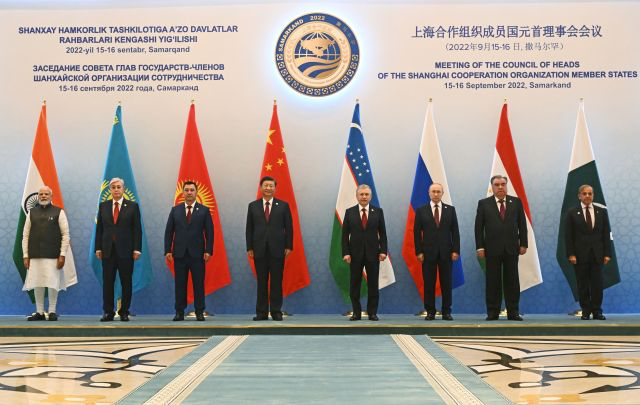
Iran, the largest anti-U.S. country in the Middle East, has become an official member 15 years after applying for membership, and Türkiye, SCO’s dialogue partner, has also announced that it will seek to join.
According to Reuters and others, President Recep Tayyip Erdogan Turkyeh said on the 17th (local time), “Our goal is to join the SCO,” adding, “Through this, our relationship with the member countries can be upgraded to a completely different level.” President Erdogan attended the SCO summit held in Samarkand, Uzbekistan from the 15th to the 16th as a special guest and held summits with Chinese President Xi Jinping and Russian President Vladimir Putin, respectively.
The summit also signed a memorandum of obligation to accept Iran as a member. Iranian President Ebrahim Laisi said, “The expansion of the SCO will help resist the U.S. unilateral disarmament theory and thwart harsh sanctions.” Analysts say that Iran’s participation shows the possibility of SCO emerging as an anti-U.S.
Founded in 2001 by six member states of China, Russia, Kazakhstan, Kyrgyzstan, Tajikistan, and Uzbekistan, the SCO additionally accepted India and Pakistan in 2017. These eight member states account for 41% of the world’s population and 24% of GDP. On top of that, Belarus, a Russian ally, is in the process of joining, and Mongolia and Afghanistan are participating as observer countries. Fourteen countries, including Turkyeh, Saudi Arabia, the United Arab Emirates, and Egypt, are dialogue partners.
The Chinese government cited SCO unity and expansion against the U.S. siege network as one of Xi’s achievements in Central Asia. According to China’s Ministry of Foreign Affairs, Wang Yi, the State Council and Foreign Minister in charge of foreign affairs, claimed in a briefing that “SCO is a new international organization covering 26 countries, showing an increasingly strong outlook for development.”
However, some point out that SCO has no continuous agenda to tie up member states other than the U.S. check. They say that the political intention to increase influence in relations with the U.S. is greater than practical cooperation. The interests of China, Russia, and India do not always coincide. China opposes Western sanctions against Russia for invading Ukraine, but does not directly provide weapons or funds to Russia. Xi expressed concern about the continued war during the summit with Putin. Indian Prime Minister Narendra Modi also said in front of Putin, “This is not the time for war.”
JULIE KIM
ASIA JOURNAL

