


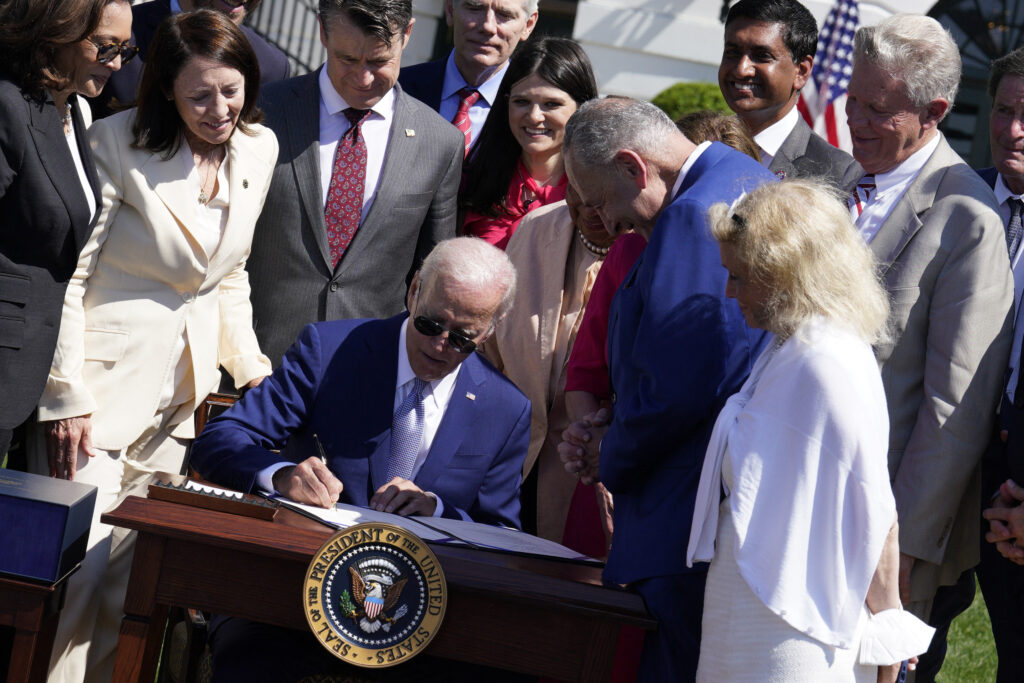
Washington(reuters)U.S. President Joe Biden has signed the Semiconductor and Science Act, or Semiconductor Act, to focus on investing in the semiconductor industry and research and development.
The main point of the bill is to increase the competitiveness of the semiconductor industry and solve the supply chain problem against the threat from China.President Biden says China and South Korea are making billions of dollars in historical investments to foster the semiconductor industry, and that the United States is now back.Joe Biden / President of the United States: The future of the semiconductor industry will be Made in America. We are the United States, and we are the only country of possibility. I’m going to sign the Semiconductor and Science Act now. Once again, we will lead the world again for decades to come.The bill, passed by the U.S. Congress last month, will cost $280 billion, or about 366 trillion won, to maintain the semiconductor industry’s development and technological dominance.Fifty-two billion dollars will be provided to the semiconductor industry, including 39 billion dollars to build, expand, and modernize semiconductor facilities in the U.S. and 11 billion dollars to develop research and manpower.A 25% tax credit is also applied to companies that build semiconductor factories in the U.S.Samsung Electronics, which has decided to invest 17 billion dollars in Taylor City, Texas, to expand its plant, is considered a beneficiary along with Intel in the U.S. and TSMC in Taiwan.Samsung Electronics has confirmed its incentives to be paid by the state and municipal governments, and it is expected to receive additional benefits from the passage of the bill.SK Hynix is also expected to benefit.In a recent video meeting with U.S. President Joe Biden, SK Group Chairman Taewon Choi announced a new investment plan worth 22 billion dollars and about 29 trillion won in the U.S., including a $15 billion high-tech semiconductor packaging manufacturing facility.The problem is the Guardrail clause, which is known to be included in the bill.It is about prohibiting the construction of semiconductor facilities in China or investing additionally in existing facilities for the next 10 years.If this happens, Samsung Electronics and SK Hynix, which have semiconductor plants in China, could be hit hard by local industries.This is because it becomes difficult to expand or upgrade facilities.According to Reuters, China has been lobbying against the bill.As the U.S. may expand its regulatory scope in the future, semiconductor companies may be deeply concerned.China’s electric vehicle sales are expected to reach a record high of 6 million units this year.
Bloomberg reported today that the China Automobile Market Information Association has raised its annual electric vehicle sales forecast to 6 million units from 5.5 million units, saying that the delivery of new energy vehicles has more than doubled to 486,000 units.He also said the new six million units are a relatively cautious estimate, adding that the forecast could be further raised in the early fourth quarter.Bloomberg explained that the forecast for 6 million units is more than double last year’s sales of 2.99 million new energy cars in China, showing rapid growth in demand for new energy cars in China.China defines three types of pure electric vehicles, hybrid electric vehicles, and hydrogen electric vehicles as new energy vehicles and provides various policy support.
Last month, China’s total sales of passenger cars rose 20 percent from the same period last year to 1.84 million, and electric vehicles accounted for 26.7 percent.China is trying to invest heavily in semiconductor production that will be used for automobiles rather than high-tech semiconductors. It seems to be preparing its own measures to counter strong U.S. sanctions.
JENNIFER KIM
ASIA JOURNAL

