


Artificial intelligence AlphaGo’s stunning win against Korean Go champion Lee Se-dol on Wednesday raised both hope and concern about the development of a computer system with intelligence and decision-making capability that surpasses that of the human race.
With a somewhat exhausted look on his face after the painful defeat, the human grandmaster participated in a press meeting.
“I was really surprised. I never imagined I would lose,” said the Korean Go player, adding “I really want to deliver respect to the team of developers behind AlphaGo.”
He said that some blunders in the initial phase of the game were the main cause of the defeat and that there were two focal factors that the AI program was able to use to turn the balance in its favor.
“The first was its ability to keep up its own pace during the game and another is one move it made, which I thought was almost impossible to play,” he said.
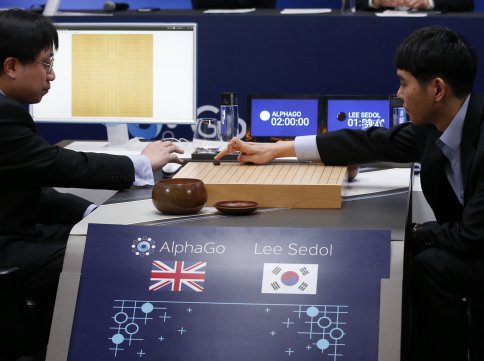 |
| Go player Lee Se-dol (right) places the first stone against Google’s artificial intelligence program AlphaGo during the Google DeepMind Challenge Match in Seoul on Wednesday. (AP-Yonhap) |
Ahead of the historic showdown between Go grandmaster Lee Se-dol and Google’s artificial intelligence program AlphaGo, tension filled the air of the venue, the Four Seasons Hotel in Seoul, on Wednesday.
Mirroring the worldwide attention, some 300 journalists from around the world gathered at the battleground to witness what would become a new chapter in history of both Go and AI regardless of the outcome.
Lee chose black stones to start the game first. It was an unexpected choice considering that a player with white stones receives 7.5 points for playing later, under Chinese Go rules.
Lee took 19 seconds to make the first move on the three-four point, which is the intersection of the third line from right and fourth line from top.
AlphaGo seemed more cautious. It spent 1 minute and 30 seconds to place the first stone on the four-four point. Its white stones were placed by DeepMind developer Aju Huwang, a sixth dan player in Go.
“Starting to focus on the battle at the top part of the board is a popular opening,” said Michael Redmond, the only western ninth dan player and commentator of the Wednesday match.
Lee, who holds 18 international titles, earlier said that he had weak opening strategies, according to the commentator, but his opening at the match was seemingly aggressive enough to make it hard for the computer to respond.
Lee also came up with irregular moves on and off in the early phase of the game, which a commentator said were “outside of the database.”
The two opponents were pitted against each other on the top right area in the early stage of the game. The AI challenger first focused on taking up the left territory of the board while the human champion attempted to increase his presence on the right side of the 19-by-19 Go board.
Things became complicated 40 minutes into the game as the black and white sides became aggressive in ramping up their attacks.
AlphaGo, which was previously thought to play conservatively, was not afraid of stepping up the fight against the human player who is considered much stronger than Fan Hui, the three-time European Champion who the computer beat six months ago.
The tug of war continued with neither player holding a commanding lead even 1 hour and 20 minutes into the game. Lee left his seat to take rest for five minutes.
“I don’t like the move that AlphGo just made,” said the U.S. commentator, referring to a rather clumsy move by the computer at one point.
Despite some mistakes here and there, the computer was stable in terms of its playing patterns and kept up the good work throughout the game.
“In the 40 years of me playing Go, I have never seen a computer program playing at this level. It just blew my mind,” said a co-commentator at the event.
“The strengths of both players were phenomenal,” he added.
AlphaGo truly made the human champion work.
Around halfway through the game, Lee Se-dol appeared to speed up his moves, trying to squeeze black stones out of the right bottom corner, and the AI player spent more time than the human opponent in making moves.
However, things did not go as champion Lee wanted. He seemed to lose his concentration as the game neared the end.
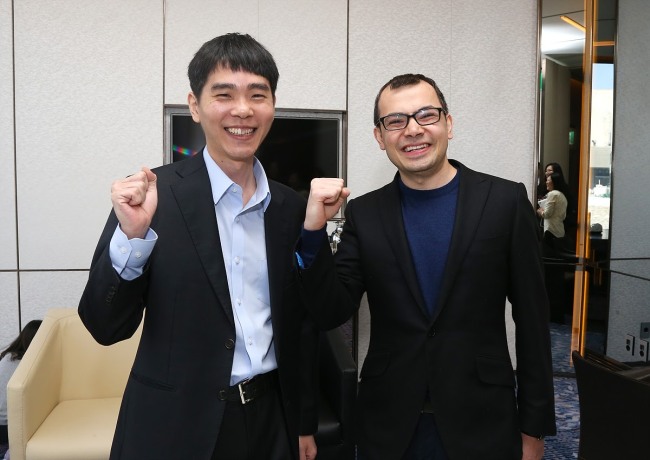 |
| Korean Go master Lee Se-dol(left) and Demis Hassabis, the chief of DeepMind, the developer of artificial intelligence AlphaGo.(Google Korea) |
After the 186 moves by both players, the human master threw down stones, meaning he gave up in Go terms, sensing there was no chance to win the game.
Referring to the comment made by Eric Schmidt, the executive chairman of Alphabet, the holding firm of Google, on Wednesday, one of the game commenters said, “Regardless of who wins the game it is victory of humanity. This is just superb.”
Speaking at a press meeting before the man-versus-computer Go match, Jeffrey Dean, a Google senior fellow, drew a rosy picture of the technologies behind AlphaGo, such as deep learning and machine learning, dispelling some worries raised by pessimists about AI.
“There could be both beneficial and sinister-like military applications. It is up to society to figure out how we are going to use technology,” the head of the Internet giant’s deep-learning research team Google Brain said.
“Machine learning for health care will be powerful and will improve the lives of many.”
Ke Jie, a rising Chinese Go star who is considered the nemesis of Lee Se-dol, is said to have been willing to have a match with AlphGo before.
“Why not me? I beat Lee Se-dol,” an official from the American Go Association, a U.S. organization to promote the ancient Asian game, cited Ke Jie as saying.
The 18-year-old Chinese Go master recently won an international Go championship after beating the Korean star.
He is slated to face off with an artificial intelligence software developed by a Chinese AI firm in the coming days.
“Many people in the U.S. have been intrigued by the match between Korean master Lee and AlphaGo,” said the official, adding that the match between the Chinese top player and the AI could further boost the popularity of the board game in the U.S. where the professional Go system was founded in 2012.
Echoing the AGA official, Andrew Okun, the AGA president, said that unlike the present situation, “human players will try to challenge the computer grandmaster in the near future.”
By Kim Young-won (wone0102@heraldcorp.com)

