


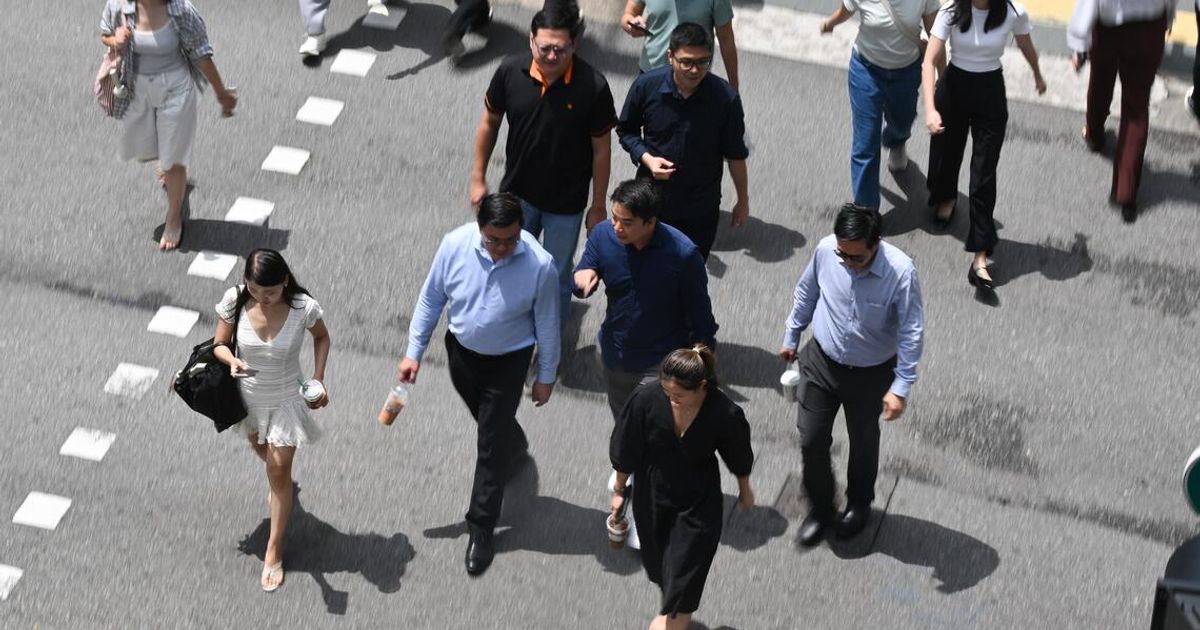
SINGAPORE – Workers in Singapore saw their incomes grow in 2026 but at a slower pace – after taking higher inflation into account.
Real median income of full-time employed residents rose by 2.2% in 2026, down from 4.1% in 2025.
For workers at the 20th percentile of the income distribution, real income growth slowed to 1.3%, from 3.6% the year before.
The figures are released by the Ministry of Manpower (MOM) on Nov 27 in its annual labour force advance report. They are preliminary as full-year inflation data is not yet available for 2026.
MOM said the slower growth partly reflected more cautious wage increases by firms and higher inflation. Consumer prices are projected to rise by around 2% in 2026, compared with 0.9% in 2025.
The ministry said despite the slower gains for lower-wage workers in 2026, their incomes have grown faster than those at the median over the recent five- and ten-year periods.
It added that they will continue to be supported by progressive wage measures.
Permanent jobs remain the norm
MOM noted that employment quality remained broadly stable even with softening manpower demand and continued external uncertainty.
Employees accounted for 88.2% of employed residents in 2026.
Among resident employees, 91% held permanent jobs, edging up from 90.8% in 2025.
The share of employees on fixed-term contracts remained stable at 7.1%, while casual or on-call employment declined further to 2%.
Over the decade, there was a shift among fixed-term contract employees towards longer contracts of at least a year, the ministry said.
Unemployment rates
While Singapore’s unemployment rate stay low overall, there were signs of greater pressure on workers in non-professional roles.
The unemployment rate among non-professionals, managers, executives and technicians (non-PMETs) rose from 2.8% in 2025 to 3.5% in 2026, returning to levels seen in 2023 and 2024.
In contrast, unemployment among PMETs remained broadly stable at 2.7%.
The long-term unemployment rate, which measures the proportion of workers that has been unemployed for at least 25 weeks, edged up to 0.7% for both groups.
Among non-PMETs, the increase was driven by workers aged 50 and above.
Residents in their 50s recorded the highest incidence of retrenchment, rising from 2.4 to 3.6 per 1,000 employees between the second quarter of 2025 and the second quarter of 2026.
Their six-month re-entry rate was also consistently below the overall average.
MOM said at a briefing on Nov 27 that the increase in unemployment rate for non-PMETs can be attributed to difficulties faced by older non-PMETs in securing employment.
The hiring conditions in certain sectors also softened. The long-term unemployment rate in sectors more exposed to the global economy, such as manufacturing and wholesale trade, rose from 0.7 per cent in 2025 to a five-year high of 0.9 per cent in 2026.
Overqualification
As the Singapore workforce becomes increasingly educated, the share of resident workers in PMET jobs rose to 65.2%.
But the overqualification rate has declined for the third consecutive year from 19.4% in 2025 to 18.7% in 2026, while the involuntary overqualification rate remained low at 1.6%. The latter suggests that a few workers were in jobs below their qualifications because they could not find suitable alternatives, MOM said.
The profiles of the voluntarily and involuntarily overqualified were “broadly similar”, with about half of the tertiary-educated working as associate professionals and technicians at 47.7% and 50.8% respectively. This reflects younger workers taking up entry-level jobs to gain experience for higher-skilled jobs, MOM said.
Labour under-utilisation, which refers to the unemployed and under-employed, remained low at in 2026.
The number of discouraged workers, which refers to people who gave up on their job search, remained low at 7,100 or 0.3% of the resident labour force.
There’s a slight dip in the proportion of part-time workers who want to do additional work but are unable to find a job, with time-related under-employment rate declining from 1.9% in 2025 to 1.7% in 2026.
Ageing workforce
Singapore’s labour force participation rate eased further for the fifth consecutive year since 2021, but remains largely stable despite its ageing population, hovering at 67.9% in 2025 and 67.8% in 2026.
Higher participation among women has helped to offset some of the pressures of an ageing population.
The rose across most five-year age groups, with larger increases among seniors.
Coupled with seniors’ growing share in the population, the proportion of residents aged 60 years and over in the labour force rose from 13.1% in 2016 to 19.5% in 2026.
Singapore’s labour force participation rate also remained among the highest – ranking 7th across Organisation for Economic Cooperation and Development countries – ahead of countries such as Switzerland, Estonia, and Australia, MOM noted.
The findings in the advance labour force report were drawn from the annual Comprehensive Labour Force Survey, which covers a representative sample of 33,000 households. A total of 27,292 households responded to the survey conducted between March to July.