


SINGAPORE – Singapore will continue to negotiate with the United States on lowering tariffs that threaten to hit about $9.4 billion worth of the Republic’s exports, said Deputy Prime Minister Gan Kim Yong, adding that any deal, however, will require some give and take.
The proposed new tariffs of up to 20% would raise the effective tariff rate on Singapore goods from 7.8% to 10.3%, said DPM Gan, who is also Minister of Energy, Trade and Industry (Trade).
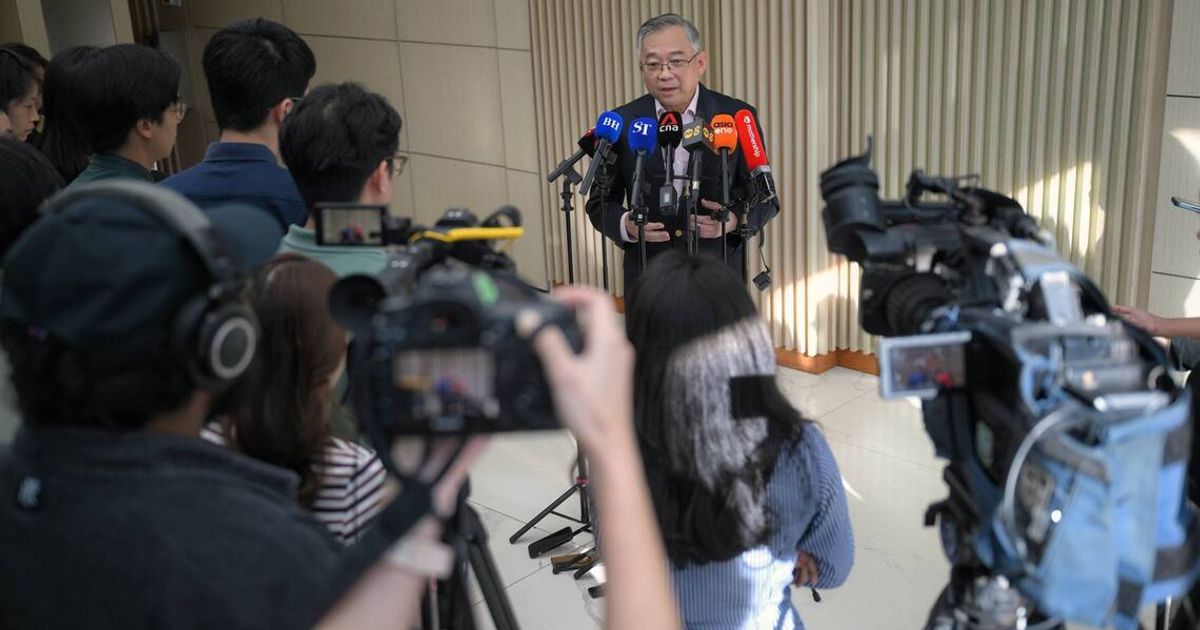
Even so, Singapore will negotiate any trade pact with the country’s interests at the centre of the discussion, he told a media briefing on Nov 26.
“We also have to bear in mind that whatever agreement we arrive (at) and achieve in the US, there will be give and take. There will be compromises. There will be trade-offs that we need to be prepared to accept,” he added.
“So I think, in this process, it’s always important to remember that we will always be visible and always have Singapore’s interests at our heart.”
The briefing was held a day after the United States Trade Representative (USTR) proposed to impose tariffs of up to 20% on Singapore and 13 other trading partners under Section 301, accusing them of producing more goods than they would under normal, market-oriented conditions.
The duties could take effect in early 2027, though USTR Jamieson Greer offered to consider lowering the proposed rate to 10% if Singapore reaches an Agreement on Reciprocal Trade (ART) with Washington.
While the new tariff will not be stacked upon the previously announced Section 301 tariffs of 12.5% related to forced labour concerns, without an ART the new tariff rate could reach up to 20%.
He said the government is engaging local companies to understand and assess how to assist them.
Gan said he was surprised by the US trade office’s actions and report, which raised many sticking points with Singapore’s economy.
“I am very surprised that this has happened, because this not something that we expected from an important, major trading partner,” he said.
Apart from the statement that announced the new tariff, the USTR also issued a 168-page investigation report listing and explaining US concerns that follow the investigation the agency started in March.
According to the USTR’s investigation report on Singapore’s industrial policies, the specific acts, policies and practices related to structural excess capacity and production include the Singapore Manufacturing 2030 plan and the Research, Innovation and Enterprise 2030 plan; as well as financial support to the manufacturing sector and firms in the electronics and semiconductors, health and petrochemicals industries.
The report also cited the “encouragement of or failure to address foreign direct investments from non-market economies (NMEs), particularly China, which permits further development of structural excess capacity and production, and encouragement of or failure to address imports from NMEs, which enables Chinese firms to offload excess production”.
The USTR report also targeted Singapore’s Central Provident Fund (CPF), a social security mechanism for retirement savings, saying the Republic uses it to promote savings and depresses consumption to boost its current account surplus.
A current account surplus occurs when a country earns more from international transactions – such as exporting goods and services, collecting investment income abroad, and receiving transfers – than it pays out to the rest of the world over a given period.
The USTR also deemed several financial support schemes for Singapore firms and the agreement with Malaysia on the Johor-Singapore Special Economic Zone as government interventions that promote structural excess capacity and production.
Singapore and the US inked a free trade agreement in 2003. In 2024, the US’ overall trade surplus with the Republic amounted to US$27 billion (S$34.8 billion). In 2025, this trade surplus with Singapore grew to US$33 billion.
However, the USTR report states: “Although Singapore has run a sizeable bilateral goods trade deficit with the United States for nearly all of the past decade, this does not outweigh the negative effects of Singapore’s outsized manufacturing sector and comparatively low consumption.”
Singapore, despite its small size, is the third-largest Asian investor in the US, behind Japan and South Korea. Bilateral trade and Singapore investments in the US support some 350,000 American jobs.
About 6,600 American companies are based in Singapore, while more than 250 Singapore companies operate across 45 US states, in sectors from logistics and agribusiness to aerospace and shipbuilding.
The USTR investigation into structural excess industrial capacity that is flooding world markets with cheap exports was conducted against a total of 16 US trading partners, including Washington’s close allies Japan, the European Union (EU) and South Korea.
The USTR has not proposed tariffs on goods from Mexico and Norway at the moment.
The affected trading partners other than Singapore are China, Bangladesh, Cambodia, the EU, India, Indonesia, Japan, South Korea, Malaysia, Switzerland, Taiwan, Thailand and Vietnam.
Some Singapore exports are also subject to US sectoral tariffs – with rates ranging from 25% to 50% – on steel, aluminium, copper and automotive parts.