


The Bank of Korea (BOK) resumed raising interest rates while sharply increasing its growth forecast for 2027, in a sign that the tightening cycle may last longer than previously expected as a historic semiconductor boom powers the economy.
The central bank increased its seven-day repurchase rate by a quarter percentage point to 3.25% in a 5-2 decision on Nov 26, a move predicted by 21 of 23 economists surveyed by Bloomberg. The hike follows a pause in October after back-to-back increases in July and August, bringing the tightening in 2026 to 75 basis points.
South Korea’s export-driven economy has been powered by an exceptionally strong memory-chip cycle tied to the global artificial-intelligence build-out. Alongside the rate decision, the BOK raised its growth forecasts for 2026 and 2027 to 3.9% and 4.1%, respectively, from 3.3% and 2.9% in August.
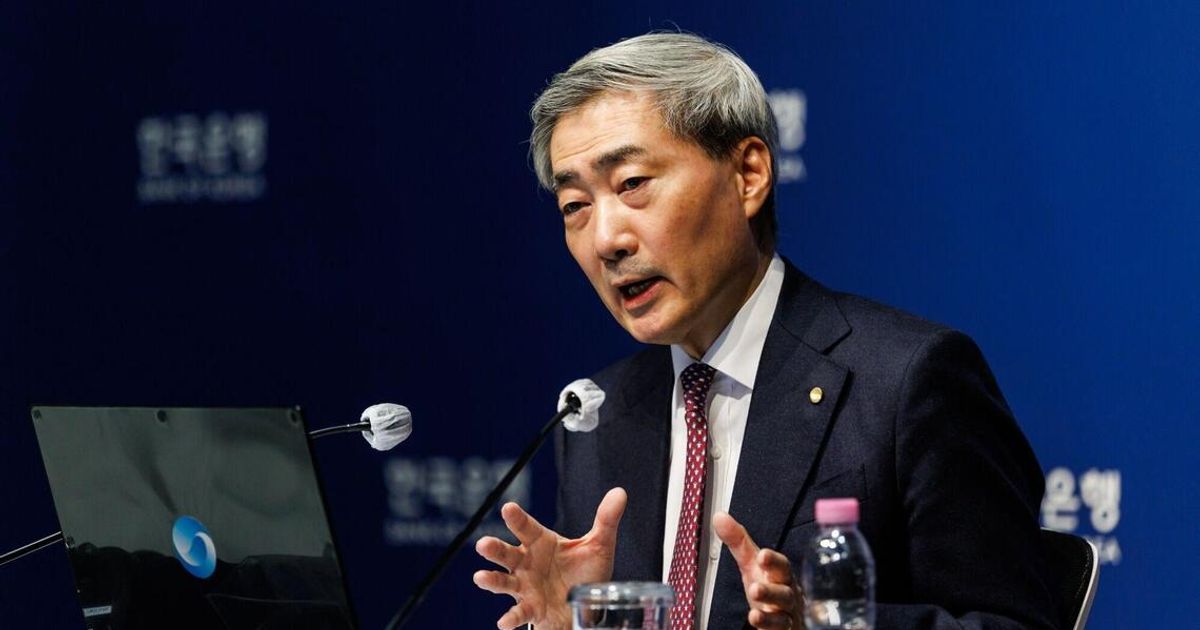
“By acting pre-emptively, we can limit the degree of tightening needed later and reap the benefits of acting early,” BOK governor Shin Hyun-song told reporters after the board meeting. “We expect consumer-price inflation to converge to our target only in 2028.”
The Nov 26 move underscores the central bank’s focus on containing inflation as the semiconductor boom pushes growth beyond expectations. By resuming tightening after a one-meeting pause, policymakers are signalling that inflation and the strength of the export-driven expansion outweighs concerns about sluggish consumer spending and the recent stock market rout, at least for now.
“Next year’s growth forecast has topped 4%, which I attribute largely to the semiconductor sector’s rapidly expanding weight in the economy,” Kong Dong-rak, a fixed-income strategist at Daishin Securities, said by phone. “By that measure, the 2027 outlook suggests the current tightening cycle could last longer and reach a higher peak than previously expected.”
The board’s updated six-month rate projections showed a median of 3.5%, up from 3.25% in August, pointing to scope for another rate hike. The outlook, covering December till next May, shows how policymakers are balancing persistent inflation against an uneven recovery.
The nation’s policy-sensitive three-year yield was up 4 basis points on the day at 3.63%, after rising as much as 6 basis points earlier as the central bank’s dot plot indicated the possibility of further policy tightening. The won remained largely unchanged at 1,343.35 per US dollar.
Governor Shin has repeatedly said the bank will maintain a restrictive policy until it is confident inflation is converging towards its 2% target. He has likened the BOK’s approach to using a “homi”, a small Korean hand plough, rather than a larger “garae” or shovel, describing the earlier back-to-back hikes as pre-emptive moves to keep inflation from becoming entrenched.
The BOK raised its 2027 inflation forecast to 2.4% from 2.3%, reflecting expectations that price pressures will remain elevated as stronger economic growth feeds into domestic demand. It kept its consumer price index forecast for 2026 unchanged at 2.7%.
Consumer prices rose 2.8% in October from a year earlier, slowing from 2.9% in September while core inflation, excluding food and energy, edged up to 2.8%, leaving both measures above the BOK’s 2% target.
Kwon Hyo-sung, economist at Bloomberg Economics, says: “The stock-market rout didn’t stop the Bank of Korea from raising its policy rate by 25 basis points to 3.25%, as we expected.
“With inflation still stubbornly above target, strong growth gave the board room to act. We expect another hike to 3.5% in February 2027, though a slowdown in global AI-related investment would put that call at risk.”
South Korea’s economy expanded 1% in the third quarter from the previous three months, exceeding economists’ expectations for a 0.8% gain as exports and investment surged. Still, private consumption contracted unexpectedly, underscoring how little of the chip-driven boom has filtered through to households.
The export boom has shown little sign of losing momentum since then. In October, shipments adjusted for working-day differences jumped about 76% from a year earlier, with semiconductors continuing to drive the gains. South Korea also surpassed US$1 trillion (S$1.29 trillion) in cumulative goods exports last week for the first time, becoming only the fourth country to reach the milestone in a calendar year.
Shin argued that the benefits of the chip boom will eventually spread through the broader economy, even if the transmission to household consumption remains weak for now.
He estimated semiconductor companies’ operating profits at nearly 700 trillion won (S$672.2 billion) in 2026, more than a fifth of national income, with an unusually large share of income accruing to corporate profits rather than wages. Those earnings will ultimately filter through the economy via corporate taxes, bonuses, dividends and investment, he said, though the process may take time. BLOOMBERG