


SINGAPORE – As newlyweds a couple of years ago, my husband and I were determined to keep money talks to a minimum.
A piece of advice a mentor gave me then was to prolong our “honeymoon period” as long as possible – “before life happens”. I interpreted that as avoiding conversations about money.
It doesn’t help that my husband and I generally have conflict-avoidant personalities and so we don’t like to talk about money.
For at least the first two years of our marriage, we set aside a few hours in the last week of December, sitting across from each other at a cafe to discuss goals for the year ahead and write down financial commitments we each would take care of. And that was about it.
We have a neat plan, or so I thought.
But as we know, life often doesn’t fall neatly into the little “boxes” we plan for. This means there are always additional expenses we haven’t factored in, such as unexpected health check-ups or the thousands of dollars we might suddenly need for car and appliance repair or replacement.
Clearly, it does not make sense to review money commitments only once a year.
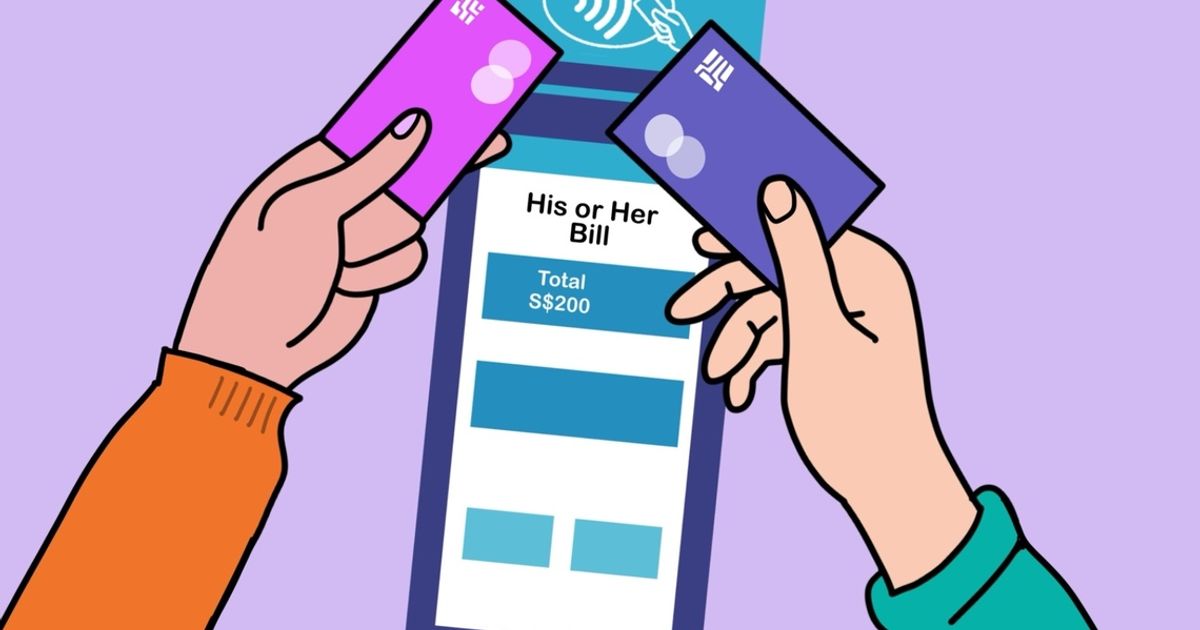
So who pays for what? What’s fair? What are some healthy ways to split finances while keeping the marriage intact?
US financial author and speaker David Bach aptly recounted the tension that arose from his first financial fight with his wife as a newly married couple in his book, Smart Couples Finish Rich.
Just back from their honeymoon, Bach thought paying the bills and managing money as a couple would be “bound to be a breeze” since they were both working as financial professionals. Instead, their differing ideals took them by surprise.
While Bach believed he could easily organise and separate the bills to see who would pay for what, his wife assumed they were going to put all their money into a joint account and pay everything together.
“We are married now, we love each other, and from now on everything we have is one and everything we do as one,” she said, as Bach recounted in his book.
Months later, they were still dealing with late fees because they couldn’t agree on who was responsible for what. They eventually created a system to manage their finances together – which was the whole point of the book – but more than that, I learnt it’s not a taboo to discuss money daily.
Most couples have never been taught how to plan their finances together, said Bach, so most of them rarely discuss money unless they are fighting about it.
Do ‘traditional’ notions still exist?
I may have chuckled at his wife’s assumption that everything they have is one, but isn’t there some truth to the adage that his money is my money and my money is his? If we are going to build a home together, it feels neater to put everything into one pot and settle the bills from there.
In Singapore’s context, however, the reality can be more complex, especially for dual-income couples with unequal earning power.
A more educated workforce and an increasing proportion of women with tertiary qualifications have challenged traditional notions of husbands paying for everything or giving their wives an allowance.
Furthermore, inflation and the rising cost of living in Singapore have made it imperative for women to contribute financially. Today, we are seeing a growing share of couples where wives out-earn their husbands, alongside more Singaporean fathers quitting their full-time jobs to care for their children.
Some male friends say they prefer contributing a larger share to the household finances rather than giving an allowance to their wives who work.
Gidon Jerome Kessel, group head of deposit and wealth management at UOB, told me that giving a spouse an allowance would depend on the couple’s circumstances and how they choose to manage their finances.
Couples must also consider the lower- or non-earning spouse’s longer-term financial security, he said. For example, a working spouse can make CPF top-ups for his or her partner to build savings and support future retirement payouts.
“If one spouse has no income because he or she is caring for the family or is earning less from part-time work, the important consideration is whether the couple’s financial arrangement adequately provides for that spouse’s day-to-day needs, personal spending and longer-term financial health,” Kessel added.
Different ways of splitting bills
Today, my husband and I have separate salary accounts along with a joint account that we both contribute to for big-ticket items like home renovation. He earns more than me, so he covers a larger share of our fixed household expenses, such as the car loan, insurance and utility bills.
I chip in for other miscellaneous expenses like house maintenance, and help track our tax-related obligations. I also look for ways to invest and grow our combined savings. For other expenses like meals, groceries and holidays, we don’t split the costs but instead take turns to pay for them.
There are five ways couples split finances, according to UOB’s financial literacy website. Our current arrangement is a mix between two ways: the “divide-and-conquer duo”, where each partner has a separate account, handling specific bills; and the “hybrid harmonisers”’, where a couple have a joint account for shared expenses and separate personal accounts.
It turns out my husband and I are not the only ones with such an arrangement. Some colleagues I spoke to said they too have separate accounts and credit cards, with each partner handling specific expenses.
Two of my colleagues said their husbands earn more and pay for most fixed household expenses like utilities, groceries, the car loan and school fees. The women, meanwhile, cover other costs such as their children’s tuition fees and helper’s salary. One said her husband transfers “household money” to their joint account for her to spend on day-to-day needs.
Another colleague shared that as a couple, they contribute proportionally according to their income. This is also known as the “fair-share partners” method, said UOB. The last two methods are “team ‘one pot’”, where all income and spending are fully shared in a joint account, and “best-of-both balancers”.
In “best-of-both balancers”, all the income is pooled in a joint account monthly, but a fixed amount of “play money” goes into each partner’s personal account. This might be a method I will be keen to explore, depending on the life stage I am at.
As time passes, my husband and I have grown increasingly comfortable communicating more about what we should do with our money. During bonus and salary increment periods, we appreciate being transparent about how we plan to spend, save and invest.
In his book, Bach also talked about how married couples with less money can feel much more fulfilled as long as their shared goals are met, and this can be done only with a lot of communication about it.
So we no longer rely on a once-a-year check-in to know each other’s financial activities as we agree to keep communication lines open.
While we may not finish rich, I hope when retirement comes, we can be contented knowing that we have achieved our shared financial goals together.