


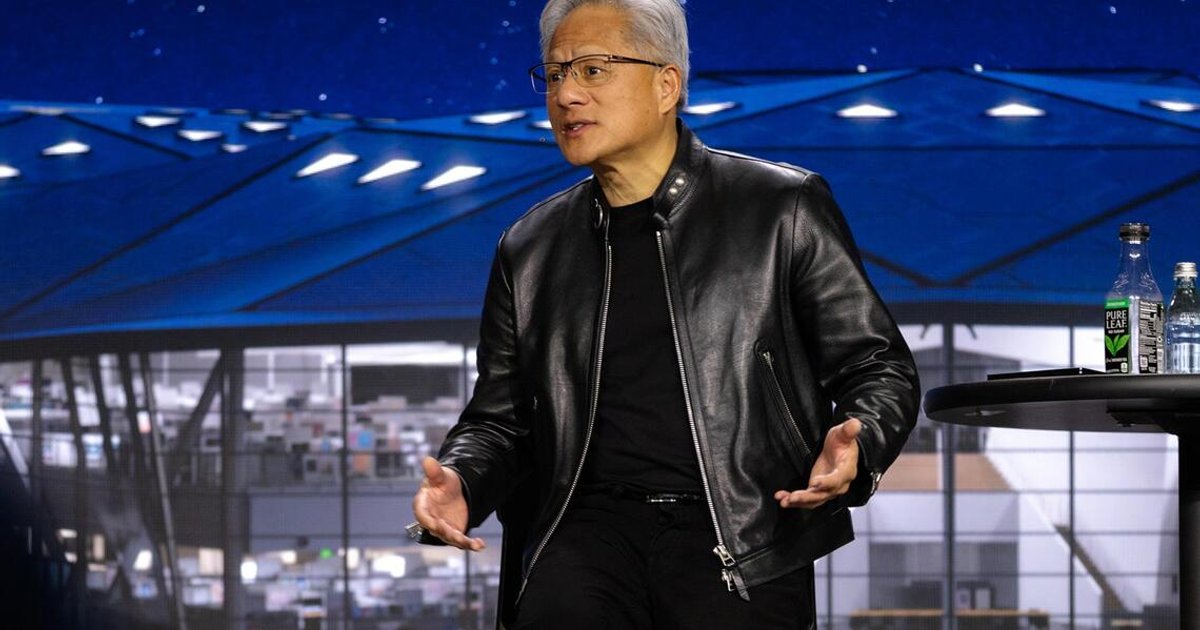
SINGAPORE – Nvidia’s chief executive Jensen Huang was sued on Nov 9 in a proposed class action following revelations of his affair with an alleged Chinese spy, fuelling uncertainty around the future of the chipmaker’s co-founder and worries over the likelihood of another Wall Street slump.
Markets had begun to recover from last week’s massive tech sell-off after the US mid-term elections, with both Nasdaq and the S&P 500 closing more than 2% higher on Nov 9. Asian tech stocks were also buoyed by the positive momentum, with both chipmakers and semiconductor equipment companies seeing gains on Nov 10.
But while fears of a Democrat-led pushback against AI advancement have cooled slightly, Nvidia is now under even more pressure as it faces accusations of defrauding shareholders by concealing Huang’s affair with an alleged Chinese spy.
The company’s shares closed 4.3% lower on Nov 9 after it announced a probe into the scandal the day before, resulting in its market capitalisation shrinking by around US$190 billion.
All eyes will be on Nvidia’s next moves, which could decide whether Huang – the company’s first and only CEO – will continue to lead the company, and the longer-term impact on its business.
At this point, existing investors may be wondering what to do with their Nvidia shares, while prospective ones might be watching for opportunities to buy the shares at a bargain.
Here’s what Singapore investors should know before deciding.
Nvidia’s fundamentals are still strong
While Nvidia’s share price has fallen by around 14% over the past week, analysts told The Straits Times that recent developments may not have a significant impact on the company’s trajectory as its core business fundamentals are still strong.
AI demand remains high and growing, with hyperscalers planning to increase capital expenditure spending on semiconductor chips over the next two years. Global AI applications are also built and optimised on the company’s proprietary CUDA platform, which enables graphics processing units to handle computing tasks beyond standard graphics rendering.
This means that Nvidia’s key customers will remain locked into Nvidia hardware out of technical necessity, said Chong Yik Ban, research analyst at Phillip Securities Research.
Ng Hui Min, senior investment analyst at investment advisory platform Beansprout, noted that investors should also keep a close eye on how Nvidia’s quarterly sales and forward guidance compare with market expectations.
Strong revenue growth may not be enough to reassure investors if its guidance suggests demand is slowing faster than expected. Conversely, stronger-than-expected sales and guidance would support the view that demand for AI infrastructure remains resilient.
The company had guided revenue of about US$108 billion for the third quarter of its 2027 financial year, around 12% higher than the previous quarter. It is due to announce its results on Nov 17.
“We would become more cautious if several indicators deteriorate together – for example, lower spending forecasts alongside weaker semiconductor demand and falling cash flow. Widening credit spreads, which can increase customers’ borrowing costs, would be another warning sign,” Ng said.
Potential delays and reduced chip demand
While analysts were largely optimistic about Nvidia’s third-quarter earnings amid recent volatility in the semiconductor sector, they cautioned that future performance could be affected by US policy changes that could potentially curb AI spending as a result of the Democrats taking over both chambers of Congress after the mid-term elections on Nov 3.
Opposition to building data centres in the US has risen, with Goldman Sachs estimating that 45% of planned US data centre capacity is located in states facing potential regulatory restrictions, temporary moratoriums, or changes to tax incentives.
This includes Texas, which already represents roughly 25% of this planned nationwide buildout and became a significant victory for Democrats, turning blue for the first time since 2002.
Tighter restrictions on data centre development could delay projects and affect major cloud providers’ capital expenditure plans. This could also push chip orders into a later quarter, with demand more heavily impacted by a broader reduction in investment plans in the longer term.
Amid rising energy costs, electricity affordability has also become an important policy consideration as data centres increase power demand.
However, the implications across the AI sector could differ, Ng noted. Lower capital expenditure could improve cloud providers’ free cash flow and reduce their financing needs, while slower construction could limit the risk of future infrastructure oversupply.
Chong added that about 75% of new data centre capacity scheduled for 2027, or around 24GW, is already under construction, and underlying demand remains strong.
What happens if Jensen Huang steps down?
A worst-case scenario for Nvidia would be Huang stepping down just as the company’s customers are beginning to slow down their orders, said UOB Kay Hian’s director of wealth management Kenneth Goh.
In theory, Nvidia’s board has the authority to replace him, though so far it has publicly supported the CEO and its investigation does not automatically imply any wrongdoing or a likely removal.
“A successor would need to retain the trust of major customers and officials in Washington and Beijing,” he said, adding that firm orders and clarity over who will lead Nvidia could help its shares recover.
Charu Chanana, chief investment strategist at Saxo Markets wrote in her note on Nov 10 that Huang is both Nvidia’s greatest strength and vulnerability. “When so much of a company’s success is associated with one individual, leadership becomes an investment risk.”
While the company has a deep management team, it has yet to publicly identify a successor to Huang, which could be a concern for investors. “An unexpected departure could create uncertainty around strategic continuity, customer relationships and execution.”
As the company’s co-founder and only CEO, Huang is the face of not just Nvidia but the entire AI ecosystem, having famously described the infrastructure stack as a “five-layer cake” which is now widely adopted by the industry.
Chong said that in the event of Huang’s departure, the company has sufficient leadership depth to ensure long-term business continuity. Key personnel include Colette Kress, chief financial officer since 2013; and Ian Buck, vice-president and general manager of hyperscale and high-performance computing (HPC), who has worked at Nvidia for over 22 years.
In his note on Nov 9, Morningstar’s senior equity analyst Brian Colello said Huang’s departure “could lead to less AI dealmaking and financing, greater regulation, and more political backlash around artificial intelligence”.

