


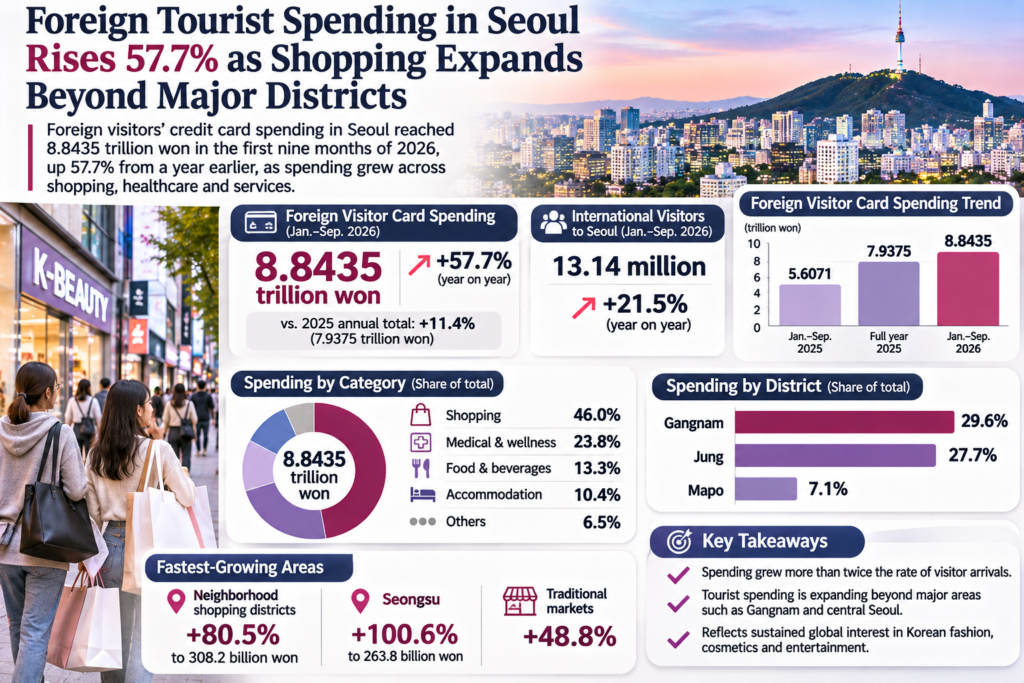
Foreign visitors’ credit card spending in Seoul rose 57.7% in the first nine months of 2026, exceeding last year’s annual total as tourists spent more on shopping, healthcare and services across the South Korean capital.
Spending reached 8.8435 trillion won between January and September, compared with 5.6071 trillion won a year earlier, according to figures published by the Seoul Metropolitan Government.
The nine-month total was 11.4% higher than the 7.9375 trillion won recorded throughout 2025.
Seoul received an estimated 13.14 million international visitors during the period, up 21.5% from a year earlier. Credit card spending grew at more than twice the rate of arrivals.
Shopping accounted for 46% of foreign visitors’ card spending, followed by medical and wellness services at 23.8%. Food and beverages made up 13.3%, while accommodation represented 10.4%.
Gangnam accounted for the largest share of spending at 29.6%, followed by Jung District at 27.7% and Mapo at 7.1%.
Although established tourist areas continued to attract substantial spending, the figures also showed strong growth in smaller commercial neighborhoods.
Foreign card spending in neighborhood shopping districts increased 80.5% to 308.2 billion won, outpacing the growth recorded in major commercial centers.
In Seongsu, a former industrial neighborhood that has become known for independent fashion brands, pop-up stores and specialty shops, spending nearly doubled.
Foreign visitors spent 263.8 billion won in the area, an increase of 100.6% from the same period last year.
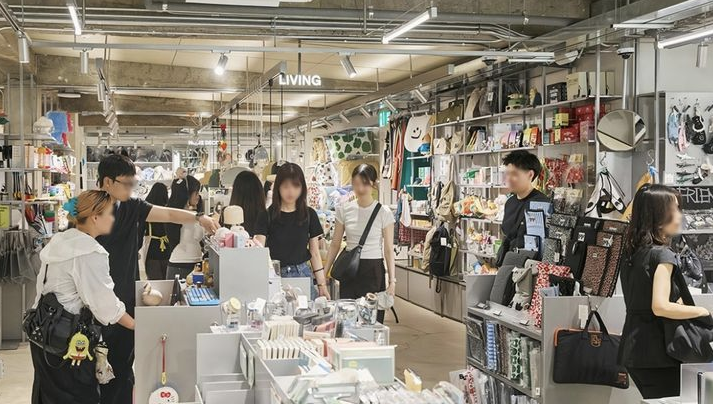
Traditional markets also recorded a 48.8% rise in card spending by international visitors.
The figures suggest that tourism-related spending is reaching a wider range of businesses, even as Gangnam and central Seoul remain the city’s largest commercial destinations.
The growth comes amid sustained international interest in Korean fashion, cosmetics and entertainment, which has helped bring attention to shopping areas outside the city’s conventional tourist routes.
The spending data, however, do not establish how much of the increase was directly driven by Korean popular culture.
Seoul has been seeking to encourage longer visits and direct more tourism activity toward local neighborhoods and traditional markets.
The city’s latest figures indicate that spending is growing faster than visitor arrivals, although card transactions alone do not capture every form of tourist expenditure.
With three months of the year remaining, foreign visitors’ card spending had already surpassed the previous annual total, underscoring the expanding role of international tourism in Seoul’s retail and service economy.
SOPHIA KIM
US ASIA JOURNAL

