


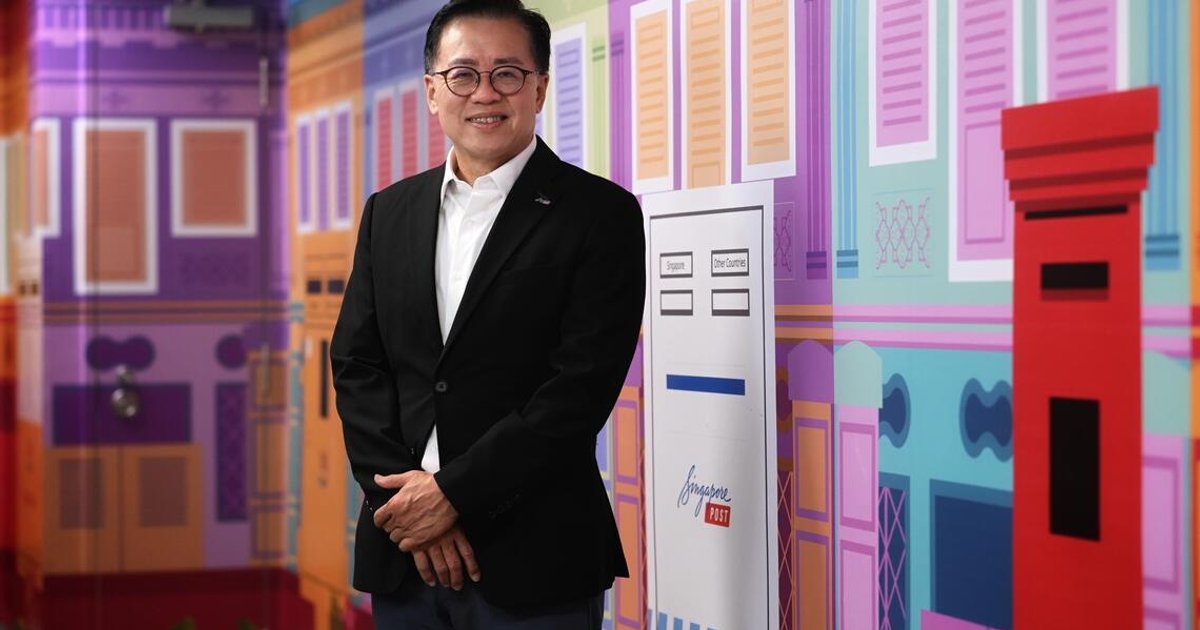
SINGAPORE – Letter volumes are shrinking as digital communication takes over, but the postal service remains necessary in Singapore – though it must reinvent itself, said Singapore Post chief executive Mark Chong.
“The rise of e-commerce actually gave postal agencies hope that they could play a role in the servicing of parcels, and that’s what SingPost had done,” noted Chong, who took over the role about a year ago.
“But of course, the decline of postal volumes also means that it impacts things like our network of post offices,” he told The Straits Times, in his first full interview since his appointment. He added that mail volumes declined some 40% from the Covid-19 pandemic period to 2024.
He believes the post offices and the main building, the SingPost Centre in Paya Lebar, can continue to be leveraged for revenue.
The sale of SingPost Centre was hotly tipped in recent years to unlock value for the company, but in May 2026, Chong firmly said that the building is not for sale.
Chong explained that he discussed the issue with the new SingPost board and scanned the surrounding environment.
One consideration was Paya Lebar Air Base’s eventual relocation from 2030 to make way for more homes in a mixed-use district.
Chong said: “There’s going to be upside. If we were to sell the building, how do you know what upsides you leave on the table?”
Upcoming developments in Paya Lebar could also increase the building’s value. “So it’s impossible to affix a value to the SingPost Centre at this moment, and we like the revenue streams that it gives us. Therefore, we decided to keep it,” he said.
Most of the building is now leased to other tenants, with SingPost occupying two floors for mail processing and office use, and the General Post Office taking a space on the ground floor.
Parcels are sorted in Tampines, at the Regional eCommerce Logistics Hub. The $30 million automated sortation facility was unveiled in June, with technology that has sped up the processing and sorting of parcels, while reducing costs, Chong said.
This approach to generating rental income while keeping its physical footprint also applies to SingPost’s network of post offices.
Generating income from post offices
At its peak, SingPost had around 60 post offices. Now, it has around 40 manned and unmanned touchpoints, SingPost said.
In May, SingPost said that it was working with the Government to come up with an operating model that is profitable and sustainable, especially for the post office network, and ruled out nationalisation.
Chong said the approach is to reduce the footprint of service counters and free up space that can be leased out to generate rental income.
In some cases where the post office is unmanned, SingPost services are provided through self-service kiosks, so the rest of the space can be completely leased out.
One early example of this was the Killiney Post Office, which first leased out its second level to KPO Cafe & Bar in 2010.
Digitalisation and the shrinking of post office spaces may displace staff, but SingPost has no plans to retrench employees and has taken a “conscious decision” to redeploy them to post offices with high traffic or to train others, Chong said.
But most post offices are still manned by staff. He noted that post offices in places like Raffles Place, Ion Orchard and Woodlands see very high traffic, so more workers are deployed there.
The post offices can also deliver services for other government agencies and organisations, Chong said.
He referred to the sale of Singtel’s Special Discounted Shares, where shareholders could speak to staff at post offices to get help in selling their shares. This was especially helpful for older shareholders, who found it challenging to navigate the task online.
Singtel said more than 117,000 walk-in inquiries and transactions were processed at 36 SingPost branches by Aug 31.
Transforming postboxes for parcel deliveries
While Chong believes that the postal service, which has been around for the past 168 years, will not become obsolete as long as people need physical deliveries, things need to change.
To make itself more relevant, SingPost is transforming its postboxes, including some 750 street-side letter boxes.
Instead of separate slots for local and overseas letters, the postboxes will have a slot for all letters and a second, larger slot for parcels. This is meant to make it more convenient for people who want to return goods, for instance.
In October, SingPost also became the first in Asia to introduce digital stamps. Users get a unique code when they buy a digital stamp on the SingPost app, which they write at the top-right corner of a letter or postcard, allowing them to send mail without physical stamps or postage labels.
Combined with SingPost@MyBlock – an islandwide mail and small parcel pick-up service from designated HDB and condo letterboxes, the digital stamps “close the loop of convenience”, as Chong puts it.
This also reduces the need for users to go to the post office, which means post offices can be downsized and the space used for something else.
“It’s a virtuous loop,” Chong added.
“This demonstrates where SingPost is heading. We are led by convenience for the consumer and the public. Secondly, we have to go digital – for convenience, for relevance, and also because it reduces our cost to serve.”
Separately, SingPost told ST: “SingPost is currently in discussion with the Infocomm Media Development Authority to explore relaxing the regulatory requirements in order to have more flexibility to manage the costs of operating the regulated business. We will share more when these are finalised.”
In the parcel delivery space, competition is intense, and some large e-commerce players are even able to offer shoppers free delivery through their own logistics arms.
Chong said: “We need to be able to compete. We need to have the right economics… We need the necessary volumes, but we will not chase volumes at the expense of profit.”
He added: “I just don’t think that the price can get lower and lower because the cost of delivering has not gone down.”
In fact, delivery costs have risen because of supply chain disruptions due to the conflict in the Middle East, and SingPost also faces the challenge of navigating tariff uncertainty.
SingPost’s strategy is to pivot towards delivering higher-value goods, such as medical devices and healthcare products.
“(Such services) will be for customers who appreciate quality, reliability, trust, and that’s why we are investing in all the digital technology to give customers the parcel tracking information they want,” he said.
Chong also expects the postal service to exist for years to come.
“Digitalisation can do lots of things, but the delivery of physical goods is still necessary. The Government still sends you certain bills and big corporate institutions are still governed by hard-copy letters, reminders and contracts. So there is still a service to be rendered,” he said.

