


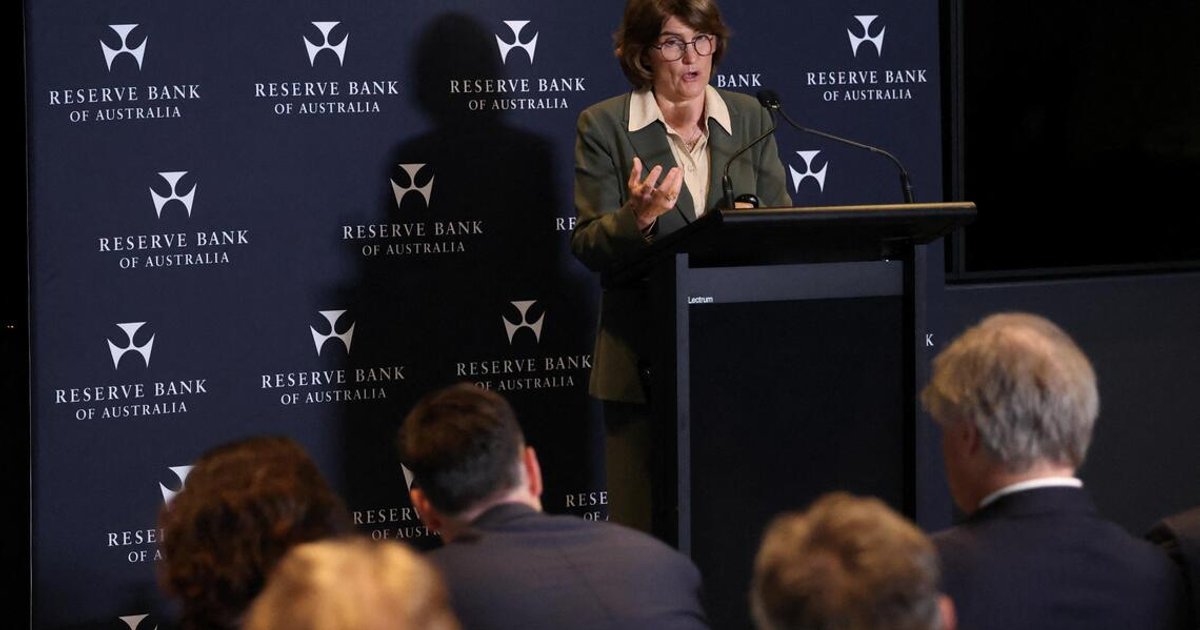
Australia’s central bank governor Michele Bullock signalled a wait-and-see approach to further tightening after policymakers lifted the benchmark rate to an 18-year high, in a split vote that sent the currency lower.
At a press conference on Nov 3 in Sydney, the Reserve Bank of Australia (RBA) chief highlighted that the tightening to date in 2026 has yet to feed through to the economy, while reiterating the ongoing inflation challenge. Her comments came after the nine-member policy board raised the cash rate by a quarter-percentage point to 4.85%, extending the most aggressive tightening among developed economies.
The RBA board voted 6-3 in favour of raising the key rate for a fifth time this year. It omitted a reference that it was willing to hike further if needed, a line that has been included in each statement since June.
“I’d not be interpreting this as saying we’re not going up. I wouldn’t be interpreting it as saying we definitely are going up,” Bullock said in response to a question on why that wasn’t kept. “We’re basically preserving our options.”
Emphasising that the impact of the latest rate increases have yet to be felt, Bullock said “the last couple haven’t even started to flow through yet”. She added tighter policy was already weighing on demand, which is starting “to slow relative to supply, and ultimately it’s going to come back into balance”.
Markets and economists read the governor’s remarks as dovish. The currency fell against the greenback as traders pared to about 30% the odds of the RBA raising the cash rate to 5.1% in 2027, compared with an almost 50% chance it would do so by next May before the announcement.
Australia’s move comes in a week when Sweden’s Riksbank may also hike and the Bank of England is expected to increase borrowing costs for the first time in three years, as economies struggle with the energy-driven inflation shock. While Bullock talked tough on inflation, she noted that the three dissenters on the board had put greater emphasis on the downside risks in the economy.
“We think the RBA will remain on edge as we enter 2027 but keep rates on hold,” said Belinda Allen at Commonwealth Bank of Australia. “The slowdown in the economy through next year, led by the consumer and the resultant lift in the unemployment rate should see inflation moderate from here and return closer to target in late 2027.”
Consumer prices have shown little sign of easing back to the central bank’s 2-3% target band. RBA officials worry that inflation expectations may be starting to untether, with deputy governor Andrew Hauser noting that a growing share of firms think 3-3.5% inflation is “a new normal”, a scenario he described as “the central bank’s nightmare”.
“Inflation is now expected to remain above 3% for the coming year and there is an increasing risk that higher inflation expectations will become embedded,” the RBA’s board said in its decision statement. “The board is conscious of the period in which inflation has been too high.”
The central bank also on Nov 3 released its quarterly update of forecasts in the statement on monetary policy. It showed underlying inflation will come back inside the RBA’s target band about six months later than assumed in August, with the economy seen slowing next year and unemployment tracking higher.
The RBA now judges financial conditions to be “restrictive” and said labour market conditions “remain a little tight”, despite a rise in unemployment.
Sally Auld, chief economist at National Australia Bank, warned the RBA left itself little room for error given the forecasts imply a “Goldilocks” disinflation.
This is “especially considering the RBA’s hawkish description of the inflation challenge at present,” she said. “While we are not forecasting further policy tightening from here, there is little doubt the RBA will be sensitive, and responsive, to any upside surprise in inflation in coming months.”
In addition to the impact of surging fuel prices, Australia has become more inflation-prone due to very weak productivity. That’s forced officials to scale back the potential growth rate, the level of expansion the economy can sustain before it generates inflationary pressures.
The RBA has failed to hit the 2.5% midpoint of its inflation target band since late 2021. Bullock also noted that inflationary pressures will be exacerbated by the vast investment pouring into artificial intelligence.
“The RBA is signalling rates will stay higher for longer, with further tightening on the table if energy prices or inflation expectations worsen. Our view is that the hiking cycle is probably over, though the risk of tighter policy remains,” said James McIntyre, economist at Bloomberg Economics.
In addition to a higher jobless rate, the RBA’s aggressive tightening has helped trigger a sharp slowdown in the housing market, which is a key transmission mechanism of monetary policy.
Home values in Australia’s major cities tumbled 1.4% in October and the once-booming sector is on track for the biggest decline in 40 years, according to property consultancy Cotality.
“For the housing market, restrictive rates will continue to impact the confidence and financial capacity of potential buyers,” it said in a statement after the decision. “It may take rate cuts, which currently look unlikely until the second half of 2027, to underpin a broad-based market recovery.” BLOOMBERG

