


SINGAPORE – Nearly one in five private homes resold in Singapore’s prime location market ended in a loss in the third quarter, even as the vast majority of sellers across the island stayed in the black.
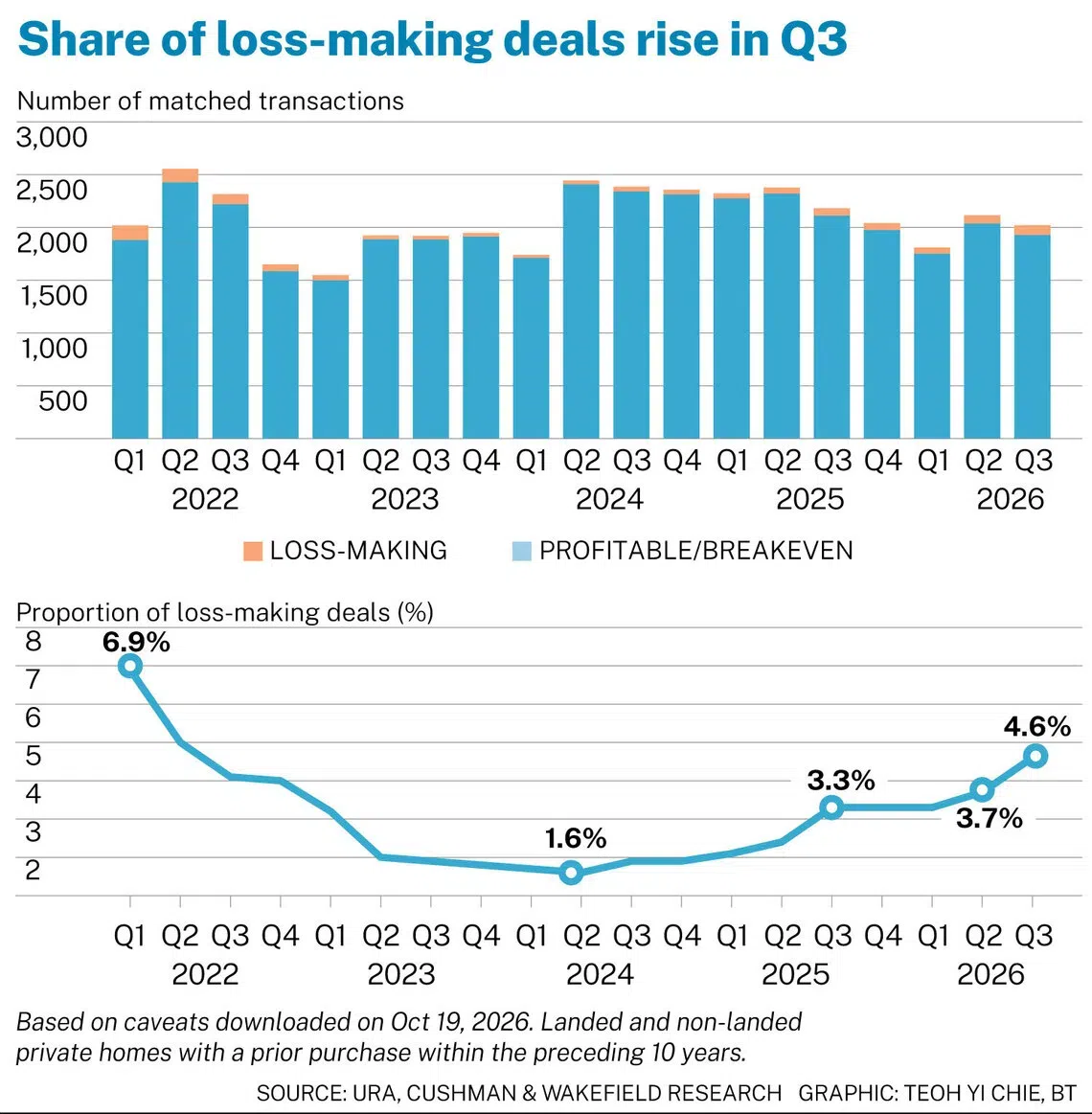
Islandwide, the share of loss-making deals crept up to 4.6% in Q3, from 3.7% in the previous quarter and 3.3% a year earlier, data compiled for The Business Times by real estate consultancy Cushman & Wakefield (C&W) showed.
This was the highest proportion since the last highwater mark in Q2 2022, when 6.9% of resale transactions were made at a loss.
C&W studied caveats for private homes with a prior purchase history within the preceding 10 years – over 40 quarters – that were transacted in Q3 2026. Of the 2,021 matched transactions, 93 were sold at a loss, or roughly one in 22 deals.
The Core Central Region (CCR) accounted for half – 49% – of all loss-making transactions, with 19.5% of deals in the submarket ending in the red. This was slightly higher than the previous quarter’s 17.7%.
In comparison, loss-making transactions accounted for 4.5% of deals done in the Rest of Central Region (RCR), up from 2.7%. In the suburban Outside Central Region (OCR), the tally edged up to 1.6% from 1.3% in Q2.
The RCR accounted for 30% of all loss-making deals and the OCR at 20%.
The five biggest loss-making non-landed transactions by both percentage and quantum were for 99-year leasehold properties in the CCR, C&W’s analysis showed.
The steepest percentage loss was recorded at Marina One Residences, where a 710 sq ft unit was sold for $1.25 million in August, about 32% less than the $1.83 million it was purchased at in July 2018.
Over a holding period of 8.1 years, this translated to an annualised loss of 4.6%.
By dollar quantum, the heaviest hit was an OUE Twin Peaks unit, where a 1,604 sq ft unit was sold for $3.88 million in August.
The seller had bought the unit for $4.9 million in March 2017 – taking a gross loss of about $1 million or 20%, which worked out to an annualised loss of 2.4% over a holding period of about 9.4 years.
Overall, profit margins continued to shrink. The median gain among profitable resale and sub-sale transactions fell to 24.8% in Q3, from a peak of 30.4% in Q2 2025.
Wong Xian Yang, C&W’s head of research for Singapore and South-east Asia, said: “With overall private residential prices at their historical highs coupled with current global macroeconomic uncertainty, buyers are expected to be more selective and future resale performance would vary more widely across developments.”
At the same time, three of the top five most profitable deals by quantum in Q3 were for CCR properties.
By dollar quantum, the biggest gainer was a Leedon Residence unit. A 4,704 sq ft unit changed hands for $14.3 million in July, earning the seller a profit of $3.75 million over the 2017 purchase price of $10.55 million.
The gain of 35.5% translated to an annualised return of 3.3% over a holding period of 9.5 years.
All five biggest profit-making transactions by quantum were in freehold developments, which Wong said “tend to command a premium”.
ECs continue to yield biggest percentage gains
Against the weaker showing in prime districts, executive condominiums (ECs) delivered the quarter’s biggest windfalls, again dominating the rankings of the most profitable resale deals by percentage.
All five top transactions were at Hundred Palms Residences in the OCR, with gains ranging from 138.9% to 163.9% over holding periods of around nine years.
The biggest percentage gain came from a 1,055 sq ft unit sold for $2.26 million in September.
The seller had bought it for $860,000 in July 2017, making a profit of about $1.4 million. That represented a gain of 163.9%, or an annualised return of 11.2% over 9.2 years.
Excluding ECs, the five biggest percentage gainers recorded profits of between 83.9% and 88.1%, with four of the five units in freehold developments.
Topping the list was a 1,410 sq ft unit at freehold condominium The Sea View in the RCR.
It was sold for $4.1 million in September, about 10 years after it was bought for $2.18 million in October 2016. The seller made a gain of 88.1%, or 6.5% on an annualised return basis.
C&W’s analysis excludes transaction costs and taxes such as buyer’s and seller’s stamp duties. THE BUSINESS TIMES

