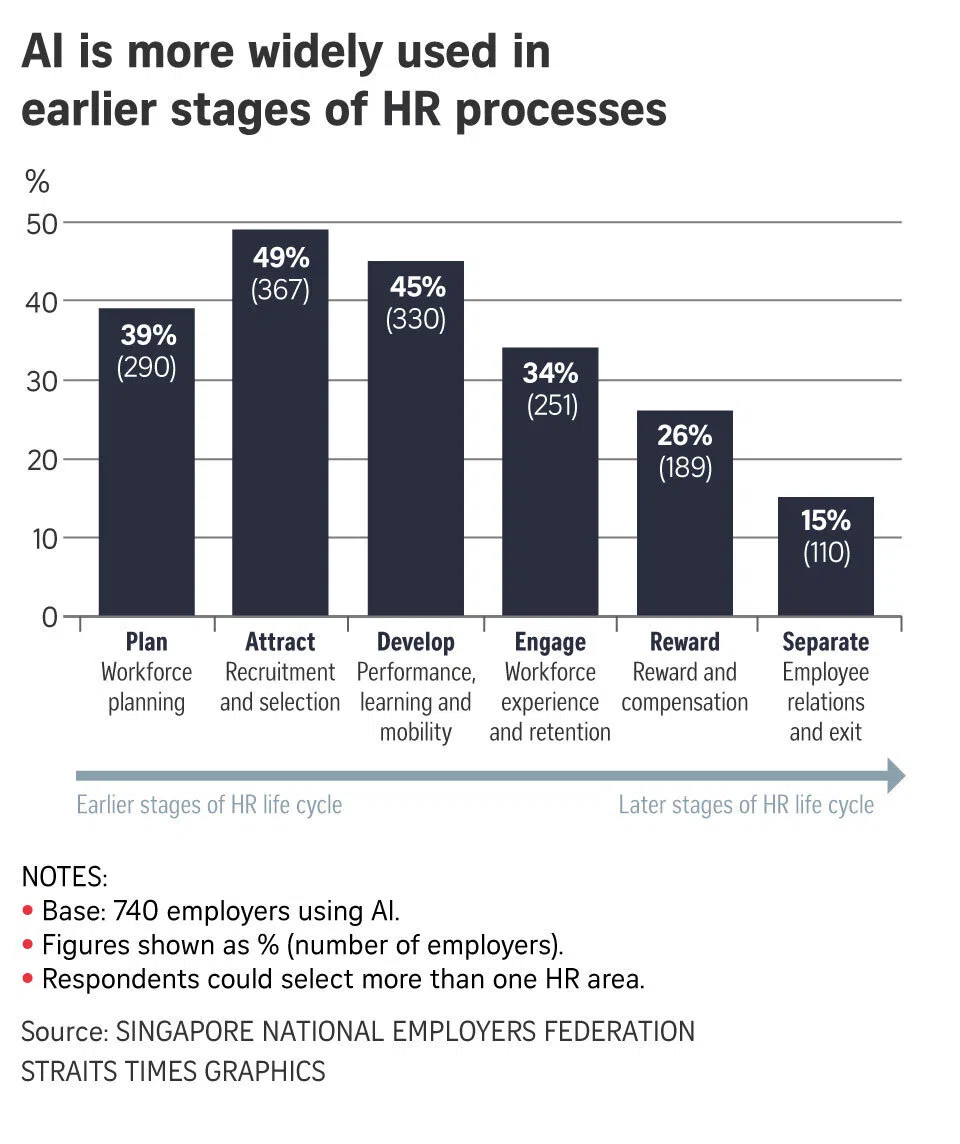
SINGAPORE – Almost half of Singapore employers use artificial intelligence for candidate recruitment and selection, according to a new Singapore National Employers Federation (SNEF) survey.
The poll of 1,000 employers conducted in June and July found that AI is more widely used in the early stages of human resources (HR) processes, such as recruitment (49%) and managing employee performance (45%), and less so in deciding compensation (26%) and managing employee exits (15%).
Larger firms employing more than 200 employees are more likely to adopt AI-powered HR tools such as Workday and SAP Success Factors, according to the survey.
Workday, for instance, offers HR professionals work solutions involving the help of a co-pilot – like that of an AI agent – such as a “recruiting agent” and “performance agent”. Meanwhile, small and medium-sized enterprises tend to rely more on all-purpose tools like ChatGPT and Microsoft Copilot.
The survey findings were unveiled at the inaugural SNEF Employers’ Summit on Oct 30 at Grand Hyatt Singapore, where eight organisations, including Singtel, Huawei Singapore and Nanyang Polytechnic, showcased AI solutions in an exhibition. Over 300 people including business leaders, senior HR practitioners and trade association leaders were in attendance.
At the summit, Acting Minister for Manpower Jasmin Lau launched an HR playbook which brings together “AI starter kits” for selected HR uses and training to build AI fluency among HR professionals. This is also meant to help SMEs access HR expertise more flexibly.
Lau also urged employers to include their unions and employees when redesigning jobs. “People are more likely to contribute to change when they have helped shape it.”
Maintaining human oversight
For firms which have adopted AI in their HR processes, human judgment remains central, said the federation in a press statement on Oct 30. Out of nearly 3,000 HR use cases reported by 655 employers surveyed, 85% still require human confirmation or sign-off for AI-automated processes.
For example, while AI can be used to provide data or filter options, a person’s judgment to accept, reject or override decisions will still be needed.
Meanwhile, in cases where AI executes decisions without human intervention, findings showed that the majority of these tend to be high-volume or routine tasks like resume-screening and skills assessment. Even so, nearly all employers (97%) have designated someone with authority, such as a supervisor or hiring manager, to intervene and change decisions if needed.
The top three concerns among employers using AI were an over-reliance that could erode HR capabilities over time, the challenge of knowing when to trust AI over professional judgment, and accountability when AI makes errors.
“The level of oversight should match the stakes: lighter for routine tasks, closer for decisions that affect people’s livelihoods. That is what responsible use should look like in practice,” said SNEF president Kuah Boon Wee in his welcome remarks at the summit.
“AI should enable our people to contribute at a higher level, not weaken the capability that our businesses depend on.”
The survey also found that the level of support employers want in adopting AI varies according to their stage of AI adoption. For example, those who are exploring AI are particularly interested in guidance on identifying AI tools that have been assessed for fairness, while employers already using AI want more clarity on responsible use, governance and liability considerations.
SNEF said it is important for employers to ensure that their HR decisions – including AI-enabled ones – are compliant with employment legislation and other pertinent guidance.
The survey found that 84% of employers surveyed indicated they were very or extremely familiar with at least one of the frameworks covered in the poll, including the Workplace Fairness Act and Tripartite Guidelines on Fair Employment Practices.
Under the Workplace Fairness Act, workers will have stronger protections against discrimination at work under new Workplace Fairness Legislation, which is being introduced through two Bills.
The first Bill, introduced in November 2024, specifies that employment decisions, such as in hiring, firing and appraisals, based on five groups of characteristics are unlawful. These are: age; nationality; sex, marital status, pregnancy status and caregiving responsibilities; race, religion and language; and disability and mental health conditions. The second Bill is expected to be passed in 2026 or 2027.
At the summit, Kuah also launched an “AI-HR pre-scoped solution” for employers to get a paid package comprising workplace planning advisory support, workforce diagnostics and skills analytics, and AI solutions. Instead of a standalone tool, the package aims to encourage employers to look at AI-driven transformation holistically.
“The package is pre-scoped so you have a clearer sense of cost before you commit to it,” he said, adding that SNEF is starting with a pilot and preliminary group of consultants supported under the Workforce Development Grant (Job Redesign+). The specialist consultants appointed based on their experience with AI-related HR projects include accounting firm BDO Singapore and manpower consultancy firm Elitez Group.
Under the grant, eligible employers can access funding of up to $150,000 for each company’s job redesign projects, including consultancy fees and worker reskilling costs.
“If you are exploring AI in HR, I encourage you to speak to (SNEF),” said Kuah.