


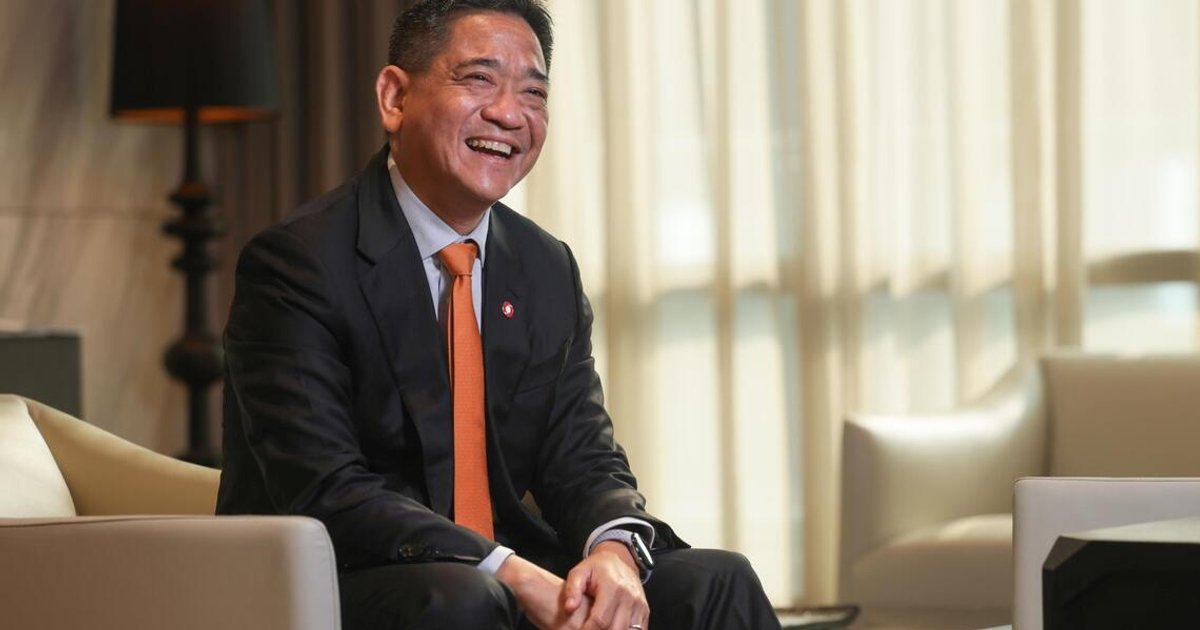
SINGAPORE – Success in the private banking profession is not defined by a particular personality type, but by the ability to build lasting client relationships grounded in trust, said Bank of Singapore (BOS) chief Jason Moo.
“In my almost 30 years of experience, there’s never a particular personality type that makes a great banker. At the foundation of it, it’s always trust,” Moo told The Straits Times in an interview at the BOS Centre in Market Street.
In his opinion, a banker often reflects the client’s personality. For example, a client who is quiet and passive may be less inclined to work with a banker who is overly extroverted, outspoken and loud.
Instead, the client may gravitate towards someone with a similar personality, or a younger client may be more inclined to work with a banker closer to their own age, as they may feel a greater sense of familiarity and relatability.
Therefore, it is important to have a diverse pool of bankers with different personality types to cater to the varying preferences and needs of clients, said the 53-year-old banking veteran, who previously held senior roles at Julius Baer and Goldman Sachs.
Moo said that a successful banker is one who can understand the client, identify his or her needs, build trust and provide appropriate solutions. Ultimately, a good banker is a solutions provider.
Further, he said that bankers may not be natural salespeople.
Moo, who joined BOS in 2023, illustrated this with the example of salespeople at a gathering of 100 people.
One salesperson might get to know 20 people and collect their contact details, while another might get to know just five people but follow up by meeting them for meals or coffee. A third one might spend the entire evening speaking to just one person, developing a deep understanding of their family background, likes and dislikes.
Moo said salespeople can succeed through different approaches to relationship-building.
While extroverts may thrive on meeting and connecting with a large number of people, introverts may focus on building deeper relationships with fewer individuals. Both approaches can be equally effective, he said, as success ultimately depends on the strength and depth of the relationships built rather than the number of contacts made.
“The client needs to be able to walk out of every meeting or every engagement saying, ‘Okay, he or she has my best interests at heart.’ That’s really the core of making a banker successful,” he said.
Asked what type of personality he has, Moo said he focuses on building relationships.
Pointing to the example of being at a gathering of 100 people, Moo said: “I’m probably closer to the one-contact or five-contacts person than I am to the 20-contacts person because it’s just not my natural inclination to go out and immediately start to sell. But I’m a people person, so I will try to get to know people first and build relationships,” he said.
Moo’s comments come as BOS, OCBC’s private banking arm, expects to add “hundreds of private bankers over the next few years” to fuel the bank’s next leg of growth.
BOS achieved its target of 500 bankers globally by the end of 2024, ahead of its original 2025 schedule.
The bank serves high-net-worth individuals with over US$5 million (S$6.4 million) in investable assets, as well as ultra-high-net-worth (UHNW) individuals with a net worth of at least US$100 million. It also caters to family offices and financial intermediaries (FIMs), also known as independent asset managers that serve multiple wealthy families.
BOS recorded strong business momentum in 2025, surpassing its target of US$145 billion in assets under management (AUM) set in 2023 and growing its AUM by over 20% year on year in 2025.
AUM from UHNW clients grew by 25% while AUM from FIM clients increased by more than 30% in 2025. Moo said that the bank is on a similar growth trajectory in 2026.
“Two out of our three main hubs are in Asia – Singapore and Hong Kong. You can count on a very large percentage of that growth in the UHNW segment really coming from Asia,” said Moo. The bank’s third key hub is in Dubai.
He noted that the UHNW segment is a key focus for the bank. Asia is home to many such individuals, most of whom are based in North Asia and South-east Asia.
“We feel we could do more with clients in that client segment. Their needs tend to be more complex by nature. Some of them have a single family office. Some of them will have multi-generational requirements,” said Moo, adding that the bank is developing bespoke platform products to cater to the complex needs of the UHNW.
The vast majority of Asian private wealth is built by the first generation over the past three to five decades through the post-industrialisation and tech booms.
“Most of the clients we talk to are still running a company or remain active in operating one,” he said. This means the bank must first understand and address their business needs before helping them manage their personal wealth.
North Asia has seen wealth accumulate at a faster pace than South-east Asia, said Moo.
North Asian wealth, particularly in South Korea, China and Hong Kong, tends to skew younger, reflecting the rise of younger entrepreneurs and founders in innovative, technology-driven industries.
But that does not make South-east Asia any less important to the bank, said Moo, pointing to growth opportunities in areas such as data centres in Malaysia and consumer tech companies in Thailand.
The affluent segment in South-east Asia is growing wealthier, while a generational transfer of wealth is also under way in the region, said Moo.
BOS’s strong Asian roots and global capabilities, as well as its ability to tap the strong franchise and regional reach of its parent OCBC, give it an edge over Western rivals in winning wealthy clients from Asia, he said.
“I keep telling clients that we are their neighbours. We grew up from the same background, so we understand what they are going through. And family values are so important to Asian culture, which is why all our advertisements and branding campaigns are around families and legacies,” he said.
“This is becoming more important as we grow, so that clients will start to align with and recognise themselves in our banking and values, and be able to appreciate our investment capabilities and global perspective.”
Hundreds of referrals have been made between OCBC and BOS as part of its “one group” efforts. In one case, OCBC referred an existing commercial banking client in the regional logistics and shipping sector to BOS. The client subsequently opened a family office account with the private bank, bringing in more than US$50 million in AUM.
Another important and fast-growing segment for the bank is the FIMs, a business that BOS has made significant strides in building over the past three years.
BOS’ digital capabilities also allow it to scale its financial intermediaries business more efficiently, said Moo. By allowing external asset managers to place orders on its platform, BOS can handle higher transaction volumes and serve more clients.
Asked what the bank can do better, he said it needs to “grow bigger” through increased hiring and a continued focus on enhancing its platform and offerings to meet client needs.
“The big growth will come from hiring. The incremental growth will come from offering more bespoke investments or something unique that clients don’t see from other banks,” he said.
“I call it inside out, outside in.”
Inside out means offering Asian clients global capabilities, while outside in means offering global investors investment opportunities in this part of the world, he said.
“That’s one thing I don’t think a lot of banks, including us, have done extremely well.”

