


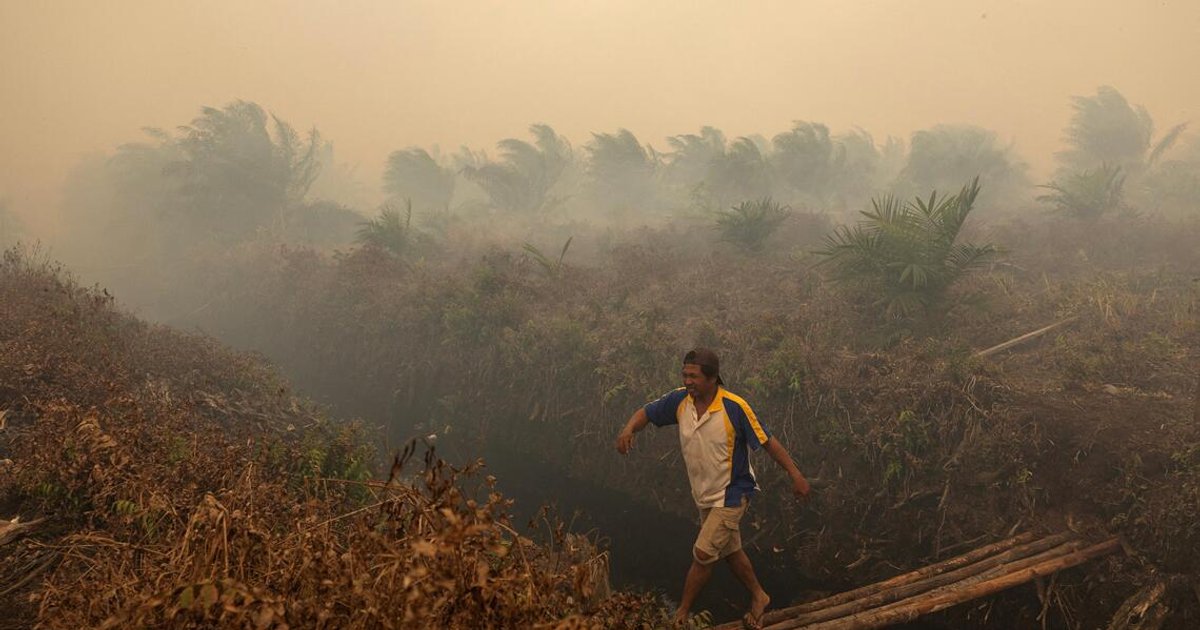
SINGAPORE – Two Singapore-listed palm oil companies, Bumitama Agri and First Resources, have been linked to plantation areas in Indonesia where fires and smoke were detected, according to an investigation by environmental group Greenpeace.
Another privately held company, First Borneo Plantations, which has ownership links to Singapore-incorporated companies, was also named in the Oct 5 report.
The report identified plantation concessions associated with the three companies where fires and smoke were detected between August and September.
Greenpeace said its findings were based on satellite data and an analysis of corporate ownership structures, which it used to trace the links between the affected plantations and the companies.
Mainboard-listed First Resources has disputed suggestions that the fires originated from its plantations, saying that some had started outside its concession boundaries before spreading into areas managed by the group.
A concession is an area of land that a company has been granted the right to use or develop, with the concession holder being the entity responsible for managing the land under the terms of the agreement.
In response to queries from The Straits Times on Oct 15, First Resources said the detection of hotspots or other satellite-based observations within or near a plantation concession does not “by itself establish the origin of a fire, responsibility for its occurrence, or any deliberate use of fire for land clearing by the concession holder”.
It said such conclusions require detailed investigations on the ground and an assessment of the circumstances surrounding each fire.
This includes examining when and where hotspots were first detected, as well as how subsequent fires spread over time.
“The presence of hotspots within a concession should not, in itself, be interpreted as an indication that the concession holder caused, initiated or condoned a fire,” it added.
First Resources also noted that while it detected hotspots near its plantation concessions in West Kalimantan, many were subsequently found to be outside its operating boundaries following verification.
The company said its plantations faced varying levels of fire risk, with those near concession boundaries, community-owned land and unmanaged areas being more vulnerable.
It added that its firefighting teams had been on standby at the perimeter of its concessions since hotspots were first detected nearby, providing support for firefighting efforts where possible, and coordinating with “neighbouring companies” where applicable.
In its report, Greenpeace identified a concession operated by Kayung Agro Lestari, an oil palm plantation operator in West Kalimantan, as one of the areas where fires and smoke were detected.
The company is a subsidiary of Indonesian palm oil producer Austindo Nusantara Jaya (ANJ), which was acquired by First Resources in May 2025.
First Resources initially acquired a 91.17% stake in ANJ for about US$330 million (S$423 million), before increasing its shareholding to 95.92% later that year.
ANJ holds a 99.99% stake in Kayung Agro Lestari, which has plantations spanning 13,878ha in Ketapang, West Kalimantan.
First Resources, which has a market capitalisation of $6.42 billion as at Oct 15, is majority-owned by members of Indonesia’s Fangiono family, with Ciliandra Fangiono serving as chief executive, and his brother Fang Zhixiang as deputy chief executive.
The Greenpeace report also identified Damai Agro Sejahtera, an Indonesian plantation company affiliated with Singapore-listed Bumitama Agri, as among the concessions where fires and smoke were detected.
Mainboard-listed Bumitama Agri, which has a market capitalisation of about $3.25 billion as at Oct 15, is linked to Indonesia’s Harita Group, a conglomerate with interests in mining and palm oil.
The company is controlled by the Lim family, with Lim Gunawan Hariyanto serving as its executive chairman and chief executive.
Bumitama Agri did not respond to queries from ST.
Greenpeace also identified Arjuna Utama Sawit as one of the plantation companies operating in areas where fires and smoke were detected, linking it to Indonesian palm oil group First Borneo Plantations, which it described as “originating from Singapore”.
First Borneo has historical ownership links to Singapore. According to a 2019 regulatory filing by Thai energy company PTT, Singapore-incorporated Chancellor Oil operated a palm oil business through First Borneo Plantations.
PTT disclosed that it sold its 77.56% stake in Chancellor Oil to Premier Palmoil Energy in April that year. Indonesian businessman Alexander Thaslim is currently listed as a director of both Chancellor Oil and Premier Palmoil Energy, according to corporate filings.
First Borneo has previously faced allegations of deforestation and the destruction of orangutan habitats.
In September, environmental group Mighty Earth accused First Borneo of continuing to clear rainforests and orangutan habitats within a plantation concession operated by its subsidiary, Equator Sumber Rezeki, in West Kalimantan.