


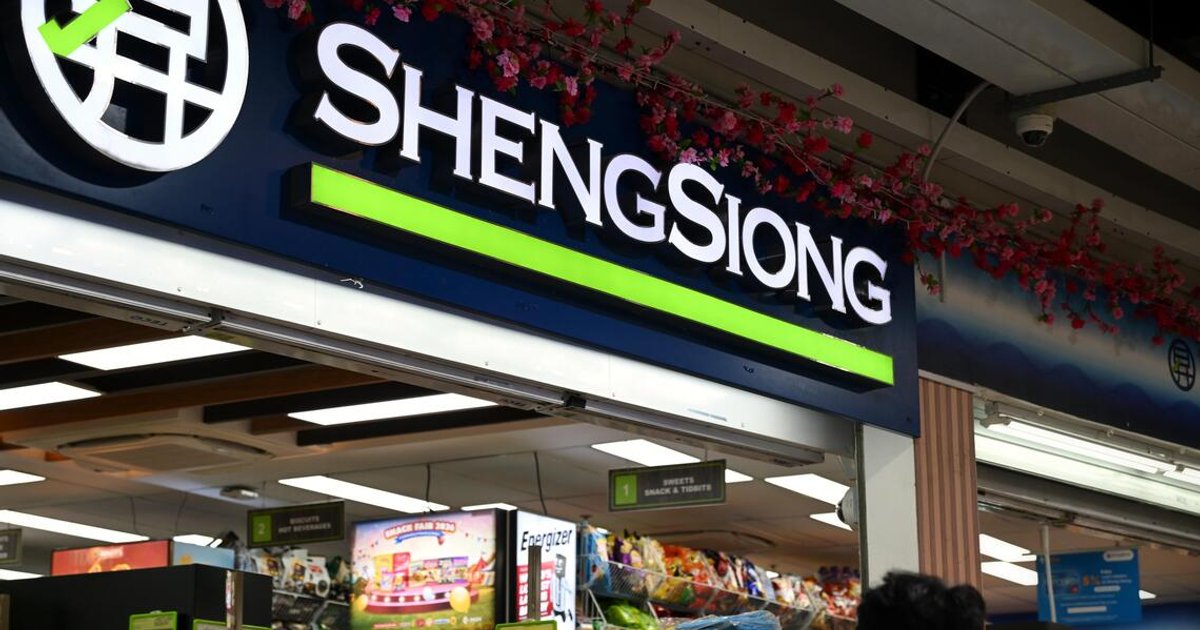
SINGAPORE – A few Singapore stocks received downgrades by analysts recently, including OCBC, Sheng Siong and the Singapore Exchange (SGX).
Maybank analyst Hussaini Saifee downgraded the supermarket’s stock to “hold”, leading to the stock sliding more than 2% on Oct 12.
Sheng Siong closed at $2.86.
Hussaini said Sheng Siong remains a high-quality operator, but its “strong share price re-rating now prices in much of it”.
He added that Sheng Siong has benefited from resilient consumption, market share gains and targeted vouchers that channelled spending directly to supermarkets, but that support is weakening as assistance is shifting to GST vouchers and cash payments.
“Supermarket growth has already eased to low single digits,” he said, adding that growth will track underlying income and population trends, instead of repeating the “unusually favourable” conditions of recent years.
He added that new challenges are emerging for the supermarket brand, while its previous competitive advantage might be fading.
Previously, Sheng Siong captured displaced demand when Giant and Cold Storage shut some stores.
Hussaini also noted that people may be crossing the border into Malaysia to shop, given the upcoming Johor Bahru–Singapore Rapid Transit System Link, or going online to get groceries, which might pose challenges to Sheng Siong.
“While neither appears disruptive enough to reshape the industry in the near term, both point to a less favourable backdrop than in recent years,” he added.
He downgraded the target price to $3.12, from the $3.22 he previously aimed for.
Meanwhile, Citi analyst Tan Yong Hong downgraded OCBC to “sell” and reiterated his call to sell UOB. However, he kept DBS at a “buy” call.
He said analysts see downside earnings risks to the third-quarter forecasted results, based on “market misplaced optimism on Singapore dollar rates and after an exceptional first-half wealth-related income”.
This is particularly the case with OCBC, which he said is trading at the tightest dividend yield spread over bond yield, followed by UOB and DBS.
This means that the market is pricing in most aggressive growth, he noted.
“Singapore banks have enjoyed a three-year re-rating cycle from 2024, starting from capital management hopes from 2024, wealth management growth from 2025, and recently crowding positionings amid the Equity Market Development Programme and ‘anti-AI’ trade,” Tan said.
The programme refers to a $6.5 billion initiative launched by the Monetary Authority of Singapore to boost the liquidity and vibrancy of the local equities market.
Tan also said there are risks that forecasters have been mispricing net interest income upside by assuming higher rates because of the resurgence in loans growth.
Higher Singapore dollar funding costs is a key risk to that, alongside fixed-rate loans repricing lower, he noted.
However, JP Morgan analysts recommended trimming OCBC and DBS, while relatively preferring UOB.
They noted that banks in the region may be impacted by the ongoing sharp increase in long bond yields.
All three banks saw share price gains on Oct 12 despite the downgrades.
DBS rose 0.8% to hit $73.94 on Oct 12, while OCBC rose 0.2% to $29.06. UOB gained 1.4% to close at $40.50.
Separately, SGX was also downgraded by Macquarie analysts a week ago. It was labelled as “underperform”, down from “neutral”, as analysts noted its monthly statistics were starting to wane.
Citi analysts noted that the SGX acts as a proxy to the Singapore market. If there is an improved economic outlook, SGX will see upsides. But if there is news of a slowdown, it could imply downside risks for the exchange.
The analysts also noted that turnover of securities and derivatives on the local bourse has been volatile, among other factors.
SGX closed 3% higher at $21.35 on Oct 12.