


SINGAPORE – Artificial intelligence is set to continue its growth and may even surpass some human capabilities, but what matters is how it can unlock value for businesses and society, said the chief executives of three major tech companies.
TikTok CEO Chew Shou Zi said there is a “non-zero chance” that AI could surpass humans in certain ways in the future, but he also noted the importance of human judgment and creativity even with increasing technology use.
Meanwhile, in response to a question by DBS CEO Tan Su Shan on whether the world is “overbuilding” AI, Broadcom CEO Hock Tan and Intel CEO Tan Lip-Bu said the demand for AI infrastructure will continue to grow in the next three to five years, limited mainly by supply constraints.
They were speaking on panels at the inaugural DBS Asia Future Forward Conference at the Suntec Singapore Convention and Exhibition Centre on Oct 12.
Organised by DBS, the new flagship event brings together global leaders across technology, business and investment to examine the forces shaping the region’s future.
Chew said AI models might currently be unable to do certain things that humans can, such as rapid visual learning or long-term memory retrieval.
But he added: “The technology is evolving, (and) you can see a world where silicon is just superior to carbon.
“You can see a world where it will last longer. It’s more scalable. It finds it easier to connect information together than us human beings.”
But Chew also said there is a place for human judgment in AI usage.
He noted that there are some extreme examples of how machines can behave without human alignment, such as the “paper clip analogy”, where a machine is asked to produce paperclips and goes completely overweight on paperclip productions at the expense of everything else.
“My view is that in the next two to three years, we’re going to have a real scientific breakthrough: physics, biotech, chemistry, material science, because of AI. It’s very, very, very possible,” he said.
“And if that happens, then you know the question will be: How do you align the models? How do you align the machines to be doing things that are obvious to us as human beings?”
Examples of this would be boundaries that humans have morally and ethically, which AI models may not have.
“I don’t think we have an answer, to be honest, at this moment in time. I think it really is a very complex issue, but it will matter in the age of AI,” Chew said.
Human creativity is also a very relevant question especially for TikTok, he added. He noted that AI content has not totally taken off yet, and views are in the low single-digit percentages.
“I think people still value authenticity when they see a video and it’s very obviously… artificially generated. I think there’s still a little bit of pushback in terms of consumption. So I agree that human creativity will continue to be important,” he said.
Chew added that in the long term, AI agents might be able to do more things autonomously, especially as the trust and guardrails are built.
But in the short term, referring to the next two to three years, Chew said that what matters is developing skills to be able to use AI effectively.
“I think that’s probably the most important thing for us internally. We are encouraging not just our engineers, but also our lawyers and people working in corporate functions, to have more first-hand experience,” he said.
“If you don’t use these products yourself, you cannot figure out exactly what it can or cannot do just by reading about it.”
He added it is about being curious and hands-on while understanding the boundaries of this technology.
Education is also important, he said, especially as AI does bring cybersecurity risks with it. This is particularly the case when users give agents permission to do things for them, like credit card permissions, without fully understanding what the technology does.
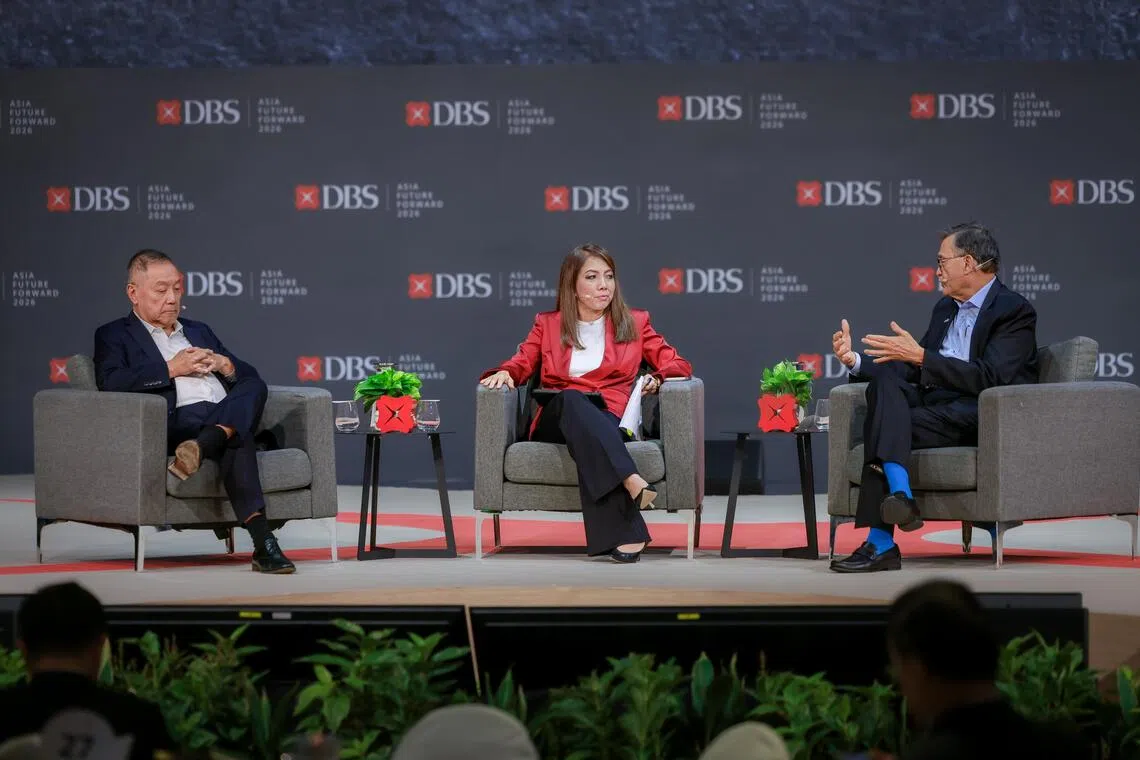
Intel CEO Lip-Bu Tan (right) and Broadcom president and CEO Hock Tan (left) participate in a panel discussion moderated by DBS Bank CEO Tan Su Shan during the DBS Asia Future Forward Conference at Suntec Convention and Exhibition Centre on Oct 12.
ST PHOTO: GAVIN FOO
At a separate panel, the Broadcom and Intel CEOs were grilled by DBS’ Tan on whether AI will end.
Broadcom’s Hock Tan said: “My presumption is this might continue. This would probably continue till 2029 and probably into 2030. But that depends to a large extent on things we are learning as we go along in this process.”
He added that there is much more demand now for compute infrastructure than there is supply. But whether that all continues depends on how fast frontier AI tools are diffusing into companies and if they are being deployed.
Whether the momentum continues five years down the road also depends on the kinds of outcomes businesses see in terms of their return on investments, he said.
Intel’s Tan Lip-Bu added that for enterprises, the most important thing is to adopt AI and use it to drive their return on investments, in terms of having new business models or efficiency.
He referred to the example of the internet and how it created big platforms like Amazon and Netflix.
“I think in this big wave of AI, you’re going to have a series of very successful platforms, and then they are the ones that really focus on creating value and broader adoption from enterprises. I think that’s where you’re going to define who the successful ones are,” he said.
He added that in the long run, people want to see the real impact and benefits of using AI.
But AI also faces challenges such as capital and cost limitations, as well as talent shortage. Intel’s Tan said only 3% of engineering graduates go into the semiconductor sector.
“We need more talent to come into the industry. We need at least about 150,000 engineers for the industry,” he added.
Looking to the future, DBS’ Tan asked the CEOs if there were things they might say they got wrong when they look back.
Intel’s Tan said: “We have a lot of stress as CEOs, but we just try to focus on doing the right things.”
He added that he was told that if he could make 70% right decisions, he would be a “damn good CEO”.
Meanwhile, Broadcom’s Tan said: “I think we’ve probably got everything wrong.
“It’s a good way, humble way to realise how little we really know about the technology we are creating.”