


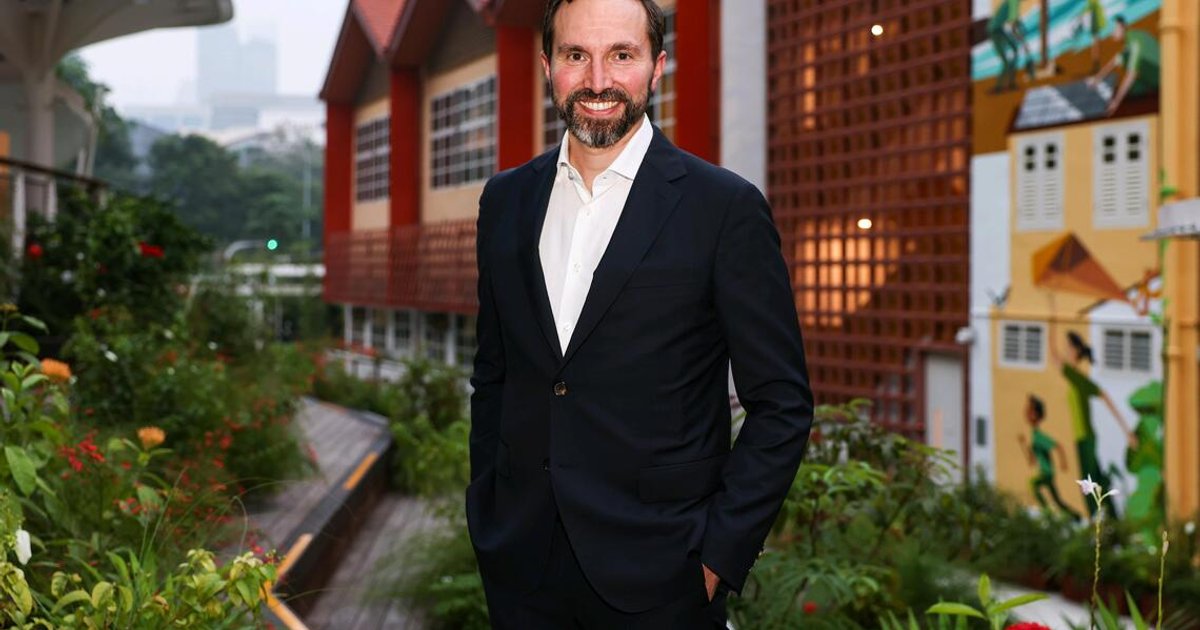
SINGAPORE – As a race strategist, Jacomo Corbo helped the Renault F1 team win back-to-back double world championships with driver Fernando Alonso in 2005 and 2006.
Now he is chief executive of a scale-up that offers a winning formula to accelerate industrial innovation.
Before a product is physically built – whether it is jet engine parts or a machine that makes semiconductors – engineers in manufacturing firms run computer simulations to replicate, predict and optimise the behaviour of materials, mechanical systems and factory workflows.
PhysicsX develops AI models that replace these slow, traditional numerical computer simulations with high-speed AI inference, where a trained AI model applies learnt patterns to new, unseen data to generate real-world predictions, decisions or outputs.
After winning customers across the Atlantic, Corbo’s London-headquartered PhysicsX is now in Singapore, establishing its Asia-Pacific hub and promising to overhaul what engineering and manufacturing look like today.
Corbo co-founded PhysicsX with his former F1 colleague, Robin Tuluie, a theoretical physicist.
PhysicsX’s customers span advanced manufacturing sectors that involve very complex engineering design and processes, including automotive, materials science and energy.
“Aerospace and defence are our largest sectors, followed by semiconductors, where we are working mostly on the equipment manufacturing side,” Corbo said, adding that the firm is increasingly deploying into chip fabrication plants.
Since its official launch in 2020, the firm has established partnerships to deploy industrial AI and advance its platform and large physics models with companies such as Leonardo Aerospace, carmaker Audi, miner Rio Tinto, tech giant NVIDIA and industrial automation firm Siemens.
With many of its customers and partners already in Singapore, it made perfect sense for PhysicsX to choose the Republic as the company’s regional hub, Corbo told The Straits Times in an interview last week.
For years, multinational firms have gravitated to Singapore for its strategic location and a clear-eyed policy focus. But for manufacturing firms, it has been a bit more than just that.
Corbo said: “The physical constraints on the city-state have meant that Singapore’s strategy has orientated itself towards high-value manufacturing. But it’s also where high-value manufacturing is co-located with high-value engineering.”
The Republic recognised early on that for supply chains to be efficient, engineering and manufacturing must co-locate. “And now it plays a linchpin role in a number of really important supply chains.”
Singapore today accounts for one in 10 chips and one-fifth of global semiconductor equipment produced annually. It is also one of the world’s top 10 exporters of chemical products.
It contributes 10 per cent of global aerospace maintenance, repair and overhaul output, and is home to eight of the top 10 biopharmaceutical companies conducting manufacturing or R&D activities here.
And bridging the gap between research and industrial application are 14 of the world’s top 20 international engineering design firms and 10 of the top 20 engineering, procurement and construction (EPC) services providers that operate in Singapore.
Hence, engineering teams in companies here can design a high-value tool or component and instantly test it on a nearby production line, closing the feedback loop between blueprint and physical asset.
However, much of industrial engineering, manufacturing and goods production worldwide is run on software that has remained largely unchanged for decades.
Also, even very innovative firms in advanced manufacturing have proprietary software and workflows that are fragmented across different departments and engineering teams.
PhysicsX AI platform integrates with a company’s existing systems, such as computer-aided design tools, numerical solvers that solve complex engineering equations, and product lifecycle management systems which are the repositories of all their designs.
“We absolutely tell our customers that, look, you don’t have to move off the tools that you use and rely on at scale. You can stay on these systems of record… and we can bring optimisation enablement and put AI at the heart of these workflows,” Corbo said.
During his motorsport days, he saw how F1 engineers, who are experts in different disciplines, were unable to put together or model the data they were collecting, and were hence missing out on the opportunity to optimise team performance.
That led him to appreciate the importance of machine learning and artificial intelligence, and realise that the technologies can benefit a vast array of industries.
“So today we’re building a new engineering simulation software stack and one that’s purpose-built to bring AI enablement to a lot of different industrial processes, not just in engineering, but into manufacturing and operations,” said Corbo.
“We’re moving to a place where simulation is done by AI inference across the full engineering life cycle. And that in and of itself is a thing that opens up a range of automation and optimisation opportunities.”
AI inference not only speeds up the workflow but also produces more accurate results as it is grounded and fine-tuned on operational data.
“All of these things mean that we’re also raising the ceiling. We can engineer things and manufacture things that we otherwise wouldn’t be able to do.”
One of the other outcomes is a big boost in productivity.
For instance, in aerospace manufacturing, PhysicsX solutions have lower defect rates, increased time-to-operational yields and better productivity for engineering processes.
“That ultimately means shrinking the cycle time in an engineering process.”
PhysicsX’s success in penetrating industries with huge and complex supply chains has earned it the confidence of venture capital firms and investments from some of its customers.
The start-up has raised about US$500 million (S$640.6 million) so far in three funding rounds, with Series A led by US venture capital firm General Catalyst, Series B by UK-based investor Atomico and Series C led by Singapore investor Temasek.
PhysicsX’s strategic investors include names like NVIDIA, Siemens and Applied Materials.
Corbo said the company needs the capital for global expansion across ecosystems by making its technology applicable across different industries.
The firm has grown from a small team to 400, of whom 220 are sitting in Europe, mostly in London.
In Singapore, it has more than 20 people and is on the path to reaching 100 people in the next three years.
Corbo said that Singapore is not only a good location to serve the Asia-Pacific region from but also offers the opportunity to penetrate the industries that PhysicsX is targeting. Singapore also has the talent pool required for the scale-up to serve its customers in Singapore and the region.
“Singapore has all the ingredients, and in particular, customers and the human capital and a vibrant ecosystem of partners who are collaborating here in the city-state that made it incredibly attractive to us.”