


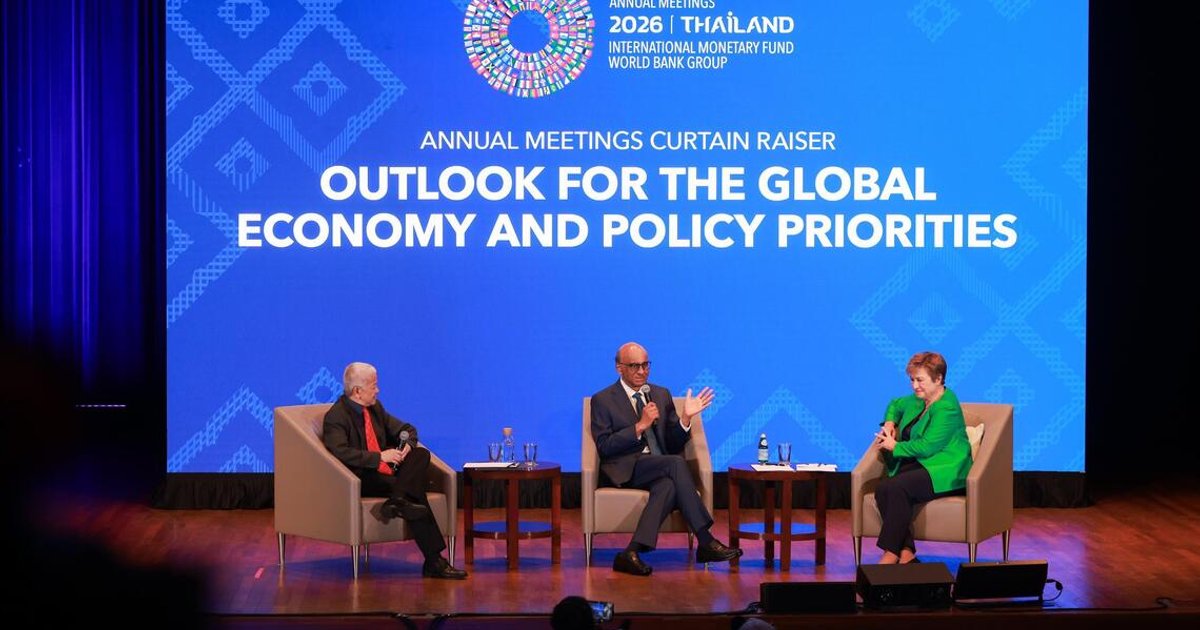
SINGAPORE – Artificial intelligence has the potential to lift global growth by up to half a percentage point annually, but governments should look beyond the short-term gains of enabling its roll-out to long-term productivity gains, said International Monetary Fund (IMF) managing director Kristalina Georgieva.
Raising economic growth by 3% to 3.5% over a decade would be the equivalent of adding an economy the size of ASEAN to the world economy, she noted on Oct 7. But this will only happen if AI is “done right”, which includes ensuring that countries around the globe can access and benefit from the technology, she said.
This comes as AI hardware and related-tech products now account for more than one-tenth of the global trade of goods, with the figure rising.
Georgieva was speaking at a curtain raiser ahead of the IMF and World Bank’s annual meetings next week, organised in partnership with the National University of Singapore’s Lee Kuan Yew School of Public Policy (LKYSPP) and East Asian Institute.
She noted that the rapid advancement of AI, which is driving economies like the US, China and India that are building the infrastructure to be key providers of the technology, “largely bypasses most others, increasing the risk of widening economic inequality across the globe”.
AI preparedness would be critical, including having the digital infrastructure, labour market and regulatory guardrails to support the technology, Georgieva said, while noting that Singapore has topped the IMF’s AI preparedness index.
The Oct 12-18 annual meetings, which will be held in Bangkok, Thailand, will see discussions focusing on AI, along with persistently high energy prices and record levels of public debt, she said.
On energy, she said the price shock experienced by the world has been “large but contained”, thanks to factors including fuel source diversification, contingency planning and the agility of supply chains. Still, oil prices remain at around US$100 per barrel despite a shaky recovery of flows out of the Gulf, she noted. Natural gas supply from the Gulf also remains severely impaired as shipping through the critical Strait of Hormuz remains threatened.
Georgieva said the energy supply crunch has resulted in an uneven impact across the world, with Asia and Europe particularly hard-hit, while adding that the pressure on prices could increase. She said: “To quote from Game Of Thrones, winter is coming. Price pressures may build further as demand rises with the approach of the Northern hemisphere cold season and as countries replenish reserves.”
On the issue of public debt, she said such debt globally was near its highest levels since World War II, and was on track to soon exceed 100% of GDP. She said advanced economies were “the worst offenders with some of the highest gross debt loads”.
Georgieva said the situation demands an urgent and comprehensive set of policy responses, including in monetary policy, as developments such as the AI building boom are inflationary. She added: “Now may be a good time for a prudently hawkish bias in many countries’ monetary policy – and it is highly appropriate that the US Federal Reserve, the European Central Bank, and the Bank of Japan have all raised rates and spoken firmly, with future policy rate paths repricing accordingly.”
Monetary policy also came up at the event’s fireside discussion between Georgieva and Singapore President Tharman Shanmugaratnam, moderated by Danny Quah, Li Ka Shing Professor in Economics at LKYSPP.
[embedded content]
Noting the blurring of the lines between fiscal and monetary policy has been seen in history, Quah asked about safeguards to ensure the credibility of monetary policy.
Georgieva said central banks can only act to protect price stability when they are independent and able to resist pressure which may come on the fiscal end.
President Tharman said he believed the world is set to face two additional forms of subtle fiscal dominance, as governments that start from a position of large fiscal deficits and much higher debts will be much constrained in their ability to deal with future crises.
“So the burden will fall on central banks. And with each crisis, more of the burden falls on central banks to ease monetary policy, or maybe engage in another round of quantitative easing,” he said. “And that will lead, on average over time, to lower interest rates than should be the case, more leverage being created in the system, higher inflation than would have been the case, and gradually less credibility for the central bank.
“Not because central governments are forcing the hand of the central bank, but by virtue of the fiscal authorities having run out of space and the burden now falling increasingly on central banks.”
The second subtle form of fiscal dominance that could arise stems from the increasing occurrence of disorderly market conditions. This happens because countries are operating at very high levels of debt, and investors purchasing the debt are no longer just traditional, stable, sovereign investors.
Instead, a large proportion of investors are hedge funds and other leveraged players with much more complex trading strategies, resulting in disorder from time to time, President Tharman said. He added: “Who steps in to resolve the disorders? The central banks. Because they do have that responsibility of preserving financial stability.
“So, you’ll get a situation where, time and again, the market will perceive the central bank as being willing to step in to resolve disorder. And that leads again to complacency and higher leverage.”
Cooperation in a fragmented world
Responding to a question from an LKYSPP student on what effective international cooperation in today’s fragmented world looks like, Georgieva said the IMF has a huge responsibility to demonstrate why cooperating on issues is paramount and in everybody’s interest.
She said: “In my hearts of hearts, I believe that we, as community, we will work together. It would be sometimes not as optimal as we wish it to be, but we are all in this one boat that happens to be in very rough waters.”
President Tharman cited the Chinese idiom that means “in wind and rain, we are in the same boat”, to describe “resonance in how we view not just communities but in the relations between nations”. He also noted that the international order is often raised when discussing issues ranging from peace, to maritime law and trade arrangements.
Macroeconomic policies are fundamental to a stable global order, and what the US and China each do in their domestic macroeconomic policies has significant international repercussions. “If the US doesn’t address forthrightly and in time, its growing fiscal deficit, there will be implications not just for the US… but there’ll be implications for the rest of the world, too, because global bond yields are going up.
“If the US doesn’t address forthrightly and in time, its growing fiscal deficit, there will be implications not just for the US… but there’ll be implications for the rest of the world, too, because global bond yields are going up.
“And there’ll be implications for the proportion of global finance that flows into financing the US deficit.”
Addressing China, President Tharman said the country will have to recognise that its own interests to find a better balance between production and domestic demand are also extremely important internationally. He said: “For China to continue to succeed as a major supplier of goods to the world, it will have to be a major source of demand as well.
“That’s in China’s interests, and it’s in the world’s interests. It will lead to a more stable form of global interdependence.”

