


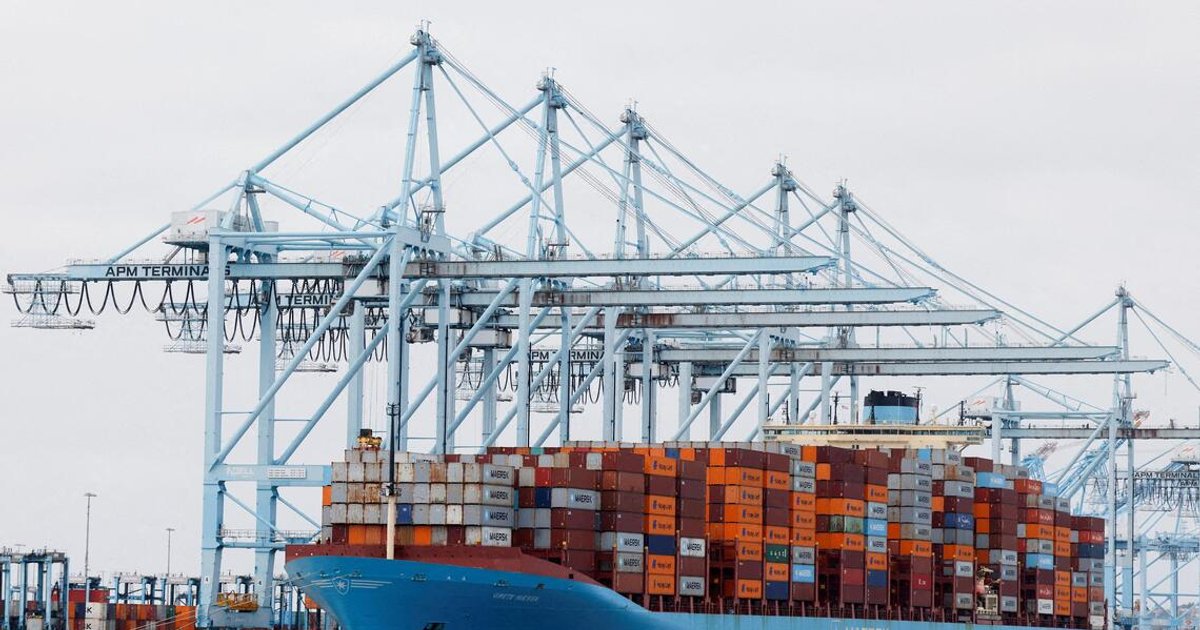
WASHINGTON – The US trade deficit widened more than expected in August as imports jumped to a record high against the backdrop of robust domestic demand, keeping trade on track to again subtract from economic growth in the third quarter.
The deterioration reported by the Commerce Department on Oct 6 was despite President Donald Trump’s aggressive tariffs on imports, which he has argued are meant to shrink the trade gap.
The US posted record goods trade deficits with at least three countries, including Mexico.
Economists have long argued that the US does not have the capacity to produce enough goods to meet its consumption needs.
“The administration’s trade policies have largely been a failure. Trade tariffs have done nothing to reduce America’s reliance on the import of foreign-produced goods,” said Christopher Rupkey, chief economist at FWDBONDS.
“The cost of American labour is simply too high to produce goods here cheap enough for consumers to even think about purchasing. Even if US manufacturers were willing, the factories could not be built here fast enough to produce the goods that consumers depend on,” he said.
The trade shortfall increased 13.7% to US$105.6 billion (S$135 billion), the largest since March 2025, the Commerce Department’s Bureau of Economic Analysis and Census Bureau said. Economists polled by Reuters expected the deficit to be US$102 billion.
The trade deficit was at US$79.8 billion when Trump was elected for a second term in November 2024. August’s deterioration was flagged by data that showed an import-driven surge in the goods trade deficit.
Domestic demand increased at its fastest pace in more than 3½ years in the second quarter, reflecting robust consumer spending and business spending on equipment, mostly related to AI.
The trend appears to have spilled over into the third quarter, with data in September showing strong consumer spending in August, as well as orders and shipments of non-defence capital goods, excluding aircraft.
But businesses are relying on imports to meet demand.
Imports increased 4.3% to an all-time high of US$420.8 billion in August. Goods imports jumped 5.3% to US$342.2 billion. They were boosted by a US$9.1 billion increase in industrial supplies and materials, which include petroleum.
Crude oil imports rose US$3.3 billion, while non-monetary gold increased US$3.1 billion. Non-monetary gold is excluded in the calculation of gross domestic product (GDP).
Capital goods imports soared US$6.2 billion to a record high US$146.4 billion, driven by semiconductors and other industrial machinery. But imports of computer accessories decreased US$1.6 billion.
Trade set to weigh on growth
Exports rose 1.4% to US$315.2 billion. Goods exports increased 2.2% to US$205.7 billion, reflecting a US$6.3 billion rise in industrial supplies and materials, mostly non-monetary gold, crude oil and fuel oil.
Capital goods exports rose by US$1.3 billion, lifted by semiconductors and computers. But exports of civilian aircraft fell by US$1 billion.
Consumer goods exports dropped US$2.2 billion, pulled down by a US$2.4 billion decline in pharmaceutical preparations.
The goods trade deficit increased 10.3% to US$136.6 billion in August. When adjusted for inflation, it widened US$8.7 billion, or 8.2%, to US$114.7 billion.
Trade has subtracted from GDP for three straight quarters, and economists estimate it could cut as much as 2.5 percentage points from GDP in the third quarter.
Growth estimates for the July-September quarter are mostly above a 3% annualised rate, with consumer spending expected to offset the drag from imports. The US economy grew at a 2.2% pace in the second quarter.
Services imports rose less than US$100 million to US$78.5 billion in August, amid a small gain in transport. Charges for the use of intellectual property fell as did travel.
Exports of services also advanced by less than US$100 million to US$109.5 billion. There were modest increases in charges for the use of intellectual property and other business services. Travel and financial services both declined.
The US had record goods trade shortfalls with Mexico, Vietnam and Malaysia. It maintained deficits with Taiwan, China, the European Union, South Korea, Canada and India among other trade partners.
The country, however, posted a record goods trade surplus with Belgium, while maintaining surpluses with the Netherlands, South and Central America, Britain, Hong Kong, Brazil, Australia and Saudi Arabia. REUTERS

