


SINGAPORE – Listed companies should proactively disclose their three- to five-year strategies so that investors can better understand their businesses and growth prospects, with board chairs leading the effort, Singapore Exchange chairman Koh Boon Hwee said on Oct 1.
He was speaking at an event organised by the Singapore Institute of Directors.
Koh said Singapore has strongly signalled its desire to reform its stock market, and more capital is already starting to flow in.
However, small and medium-sized enterprises cannot solely depend on the SGX to boost their valuations, as the bourse does not create liquidity nor demand and supply.
He said: “If you say that the market misunderstands you, it is your job to make sure that it understands you. If you say that there is no liquidity, it is because you have not been talking to the people who might have an interest in buying or demanding the stock.”
Therefore, it is incumbent upon companies and their leaders to communicate their growth strategies to the public.
“The exchange can’t do that for you, neither can it guarantee that your counter will be liquid.”
Koh said privatisation could be an option for companies whose shares are thinly traded and which are reluctant to disclose their long-term plans publicly.
His comments echoed a point made in his annual letter to shareholders on Sept 29, in which he said that “privatisation is not a tragedy but a rational and often healthy outcome”.
“For a listed company with limited growth prospects, low trading liquidity and persistently low valuations, going private is a sensible path,” he wrote.
“It serves little purpose for a company to remain listed simply so that an exchange can preserve its company count.”
CDL tumbles after revealing 3-year plan
Shares of City Developments Limited (CDL) fell by more than 14% through the week, after the property giant announced a three-year road map on Sept 28.
The counter fell 5.7% by midday after its plans were unveiled before the market opened, and later closed 8.1% down at $7.59. It continued to slide and closed the week at $7.04, the lowest since Nov 2025.
Explaining why CDL’s share price fell, analysts said weak market conditions and the interest rate outlook could make it difficult for CDL to divest $6 billion worth of assets as planned. Details on where CDL intends to invest an additional $5 billion are also lacking.
In addition, doubts remain over whether the feud between chief executive Sherman Kwek and his father, executive chairman Kwek Leng Beng, has truly subsided. In early 2025, the father accused his son of orchestrating a boardroom takeover.
The elder Kwek was also absent from the Sept 28 unveiling of the road map, which left questions on succession from the media unanswered.
Others noted that some institutional investors have been dumping CDL shares in a typical “buy the rumour, sell the news” fashion, while some have also been short selling the shares.
CDL had said on Sept 28 that it plans to sell $6 billion worth of non-core assets, including $1.8 billion worth of hotels, over the next three years.
The company will also deploy $5 billion of growth capital, with Singapore remaining the principal market for new investments. A third of the funds has been earmarked for investments in China, where the property market has been weak, and Japan.
In addition, CDL plans to achieve a dividend payout of more than 35% annually, increase its assets under management from $5 billion to $10 billion, and lock in more than $1 billion in profit after tax and minority interests to be realised from divestment gains, over the three years.
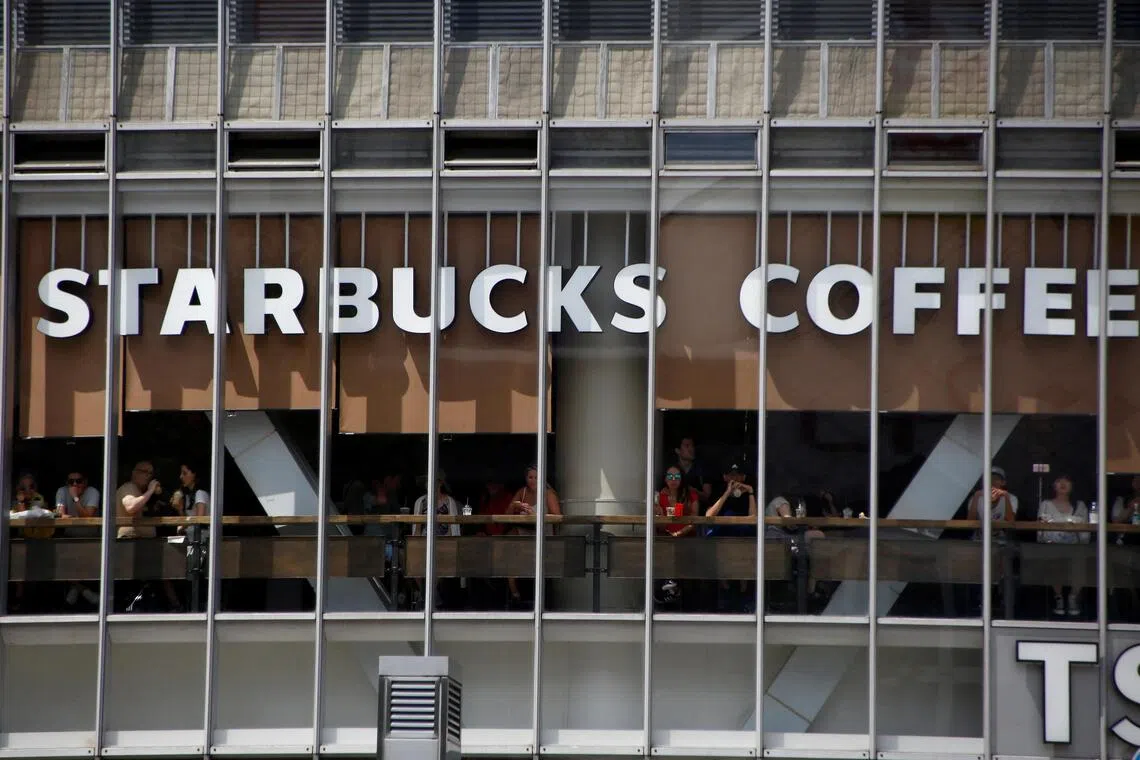
DFI takes full control of Starbucks in Asia
DFI Retail Group’s shares jumped 6.6% when the market opened on Oct 1 and closed at US$3.41, the week’s peak, before falling the following day to close the week 6.1% lower at US$3.10.
The company said on Sept 1 that it will take full control of Starbucks’ licensed operations in the region, including Singapore, from Maxim’s Caterers, following a reorganisation.
Currently, DFI and Hongkong Caterers each own a 50% stake in Maxim’s Caterers. The new arrangement will see Hongkong Caterers retain Maxim’s other food and beverage businesses, which include five brands in Singapore: Genki Sushi, sen-ryo, Yakiniku Like, Butahage and Uoharu.
The reorganisation is slated to be completed by end-March 2027 and expected to immediately boost DFI’s revenue and profitability. DFI will transfer its 50% stake in Maxim’s to Hongkong Caterers for US$340 million (S$434.7 million) in cash, which it intends to deploy for growth or return to its shareholders as special dividends.
The group plans to build on the coffee chain’s leading position in Asia’s breakfast market by expanding its food and beverage menus and attracting more customers at lunchtime and later in the day, said Andrew Wong, chief executive of DFI IKEA, who will oversee the Starbucks operations.
DFI also plans to broaden Starbucks’ breakfast and bakery offerings, and adapt menus to local tastes.
More outlets are expected to open across Singapore as well as Thailand, Hong Kong, Macau, Vietnam, Cambodia and Laos between 2027 and 2029, taking the total number of Starbucks outlets in Asia to 1,350 from 1,110 currently. The Starbucks business in the seven Asian markets generated US$746 million in revenue in 2025.
The reorganisation comes at a time when competition for the coffee and tea consumer in Asia is intensifying. Chinese coffee giant Luckin Coffee already runs 103 outlets in Singapore – just three years after it first opened in the Republic.
Two more IPOs in the pipeline
Two companies have lodged their preliminary prospectuses to list on SGX.
Metasurface Technologies, which specialises in precision machining and precision welding for international customers in the industrial sector, filed its prospectus for a dual primary listing on the Catalist board on Sept 28.
The Singapore-based company has been listed since 2024 on the GEM board of the Hong Kong Stock Exchange, which is designed for SMEs.
Shares of Metasurface in Hong Kong are up about 145% year to date, from HK$1.50 to HK$3.68. It has a market capitalisation of about HK$523 million (S$85.3 million).
It will issue a new share placement, with UOB Kay Hian acting as sponsor, issue manager and placement agent.
Headquartered in Singapore, Metasurface’s operations are supported by production facilities located in both the Republic and Malaysia, where it has a “large fleet of machinery and equipment”.
Meanwhile, home-grown fire-protection specialist Deluge Fire Protection lodged its preliminary offer document for a Mainboard listing on Sept 29.
The offering will include a public tranche in Singapore, although its size has yet to be disclosed.
Separately, 23.4 million cornerstone shares will be issued to institutional investors including fund managers Amova Asset Management Asia and Avanda Investment Management, as well as several individual investors.
SAC Capital is the issue manager for the offering, and serves as the joint book-runner and underwriter with Maybank Securities.
Set up in 1983, Deluge has grown into one of the leading fire prevention and protection specialists in Singapore. One of eight contractors holding the highest L6 grade certification from the Building and Construction Authority, Deluge can bid for jobs of unlimited contract value.
Since its founding, it has secured projects totalling more than $1 billion across Singapore’s critical infrastructure, including a $109 million contract in relation to the ongoing construction of the North-South Corridor, and a $73.5 million contract from the Land Transport Authority for the Cross Island MRT line.
As at March 31, Deluge had an order book of about $410.8 million, of which $357 million were from government projects. According to its prospectus, the projects are expected to be largely fulfilled over the next four financial years.
Other market movers
US Treasury yields hit their highest levels since 2002 this week after a global bond sell-off that drove stock prices down.
The 30-year rate surpassed 5.61% on Sept 29 and hit 5.63% on Oct 2, a 24-year high, while the 10-year rate also hit a peak of 5.33% on Oct 1 before dipping to 5.28% the following day.
The surge came amid rising inflation and hefty corporate debt supply, driven by heavy artificial intelligence infrastructure spending, which weighed on the market.
Meanwhile, the two-year US Treasury yield, which typically moves in step with interest rate expectations for the US Federal Reserve, fell about 10 basis points on Oct 2 following a weaker-than-expected September labour market report.
The US economy added only 29,000 jobs that month, far below estimates for a gain of more than 80,000.
As a result, analysts now say that the Fed is unlikely to raise interest rates in October.
What to look out for next week
From Oct 5, younger and first-time investors can own shares in some of Singapore’s 30 largest companies without breaking the bank
SGX will reduce the standard board lot size from 100 units to 10 units for 11 companies, including the three Singapore banks, Jardine Matheson and Keppel.
A basket of 10 shares per bank will now cost around $1,300, compared with around $12,900 currently.
SGX said making established Asian companies more accessible at smaller ticket sizes gives investors “greater flexibility to size their positions and diversify across companies and sectors”.
To learn more about The Straits Times Index, go to the SPH campaign website.

